
Printable worksheet
Science Detective: Observe, Predict and Test
QuizScienceGrade 3English

Practise more with these
Picked by meaning from games, worksheets, simulations, teacher tools and videos.
 GameA Scientist's Careful Look
 GameA Fair Test Under Real Constraints
 GameQuestions Science Can Test
 GameData Detectives at School
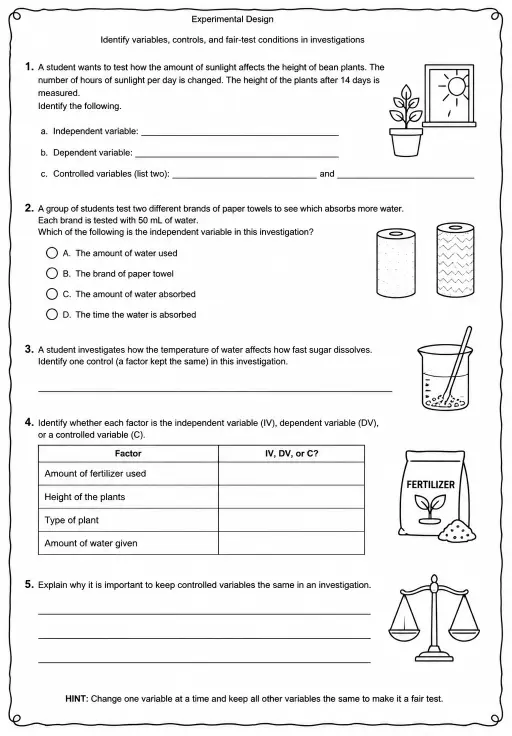 WorksheetIdentify variables, controls, and fair-test conditions in investigations
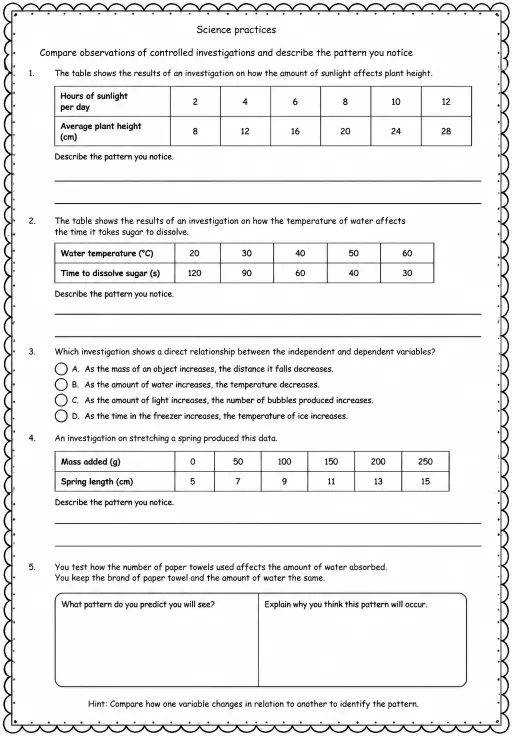 WorksheetCompare observations of controlled investigations and describe the pattern you notice
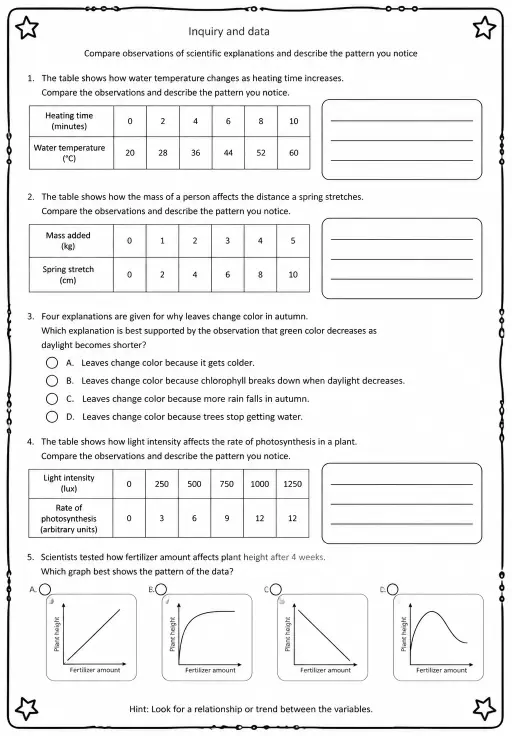 WorksheetCompare observations of scientific explanations and describe the pattern you notice
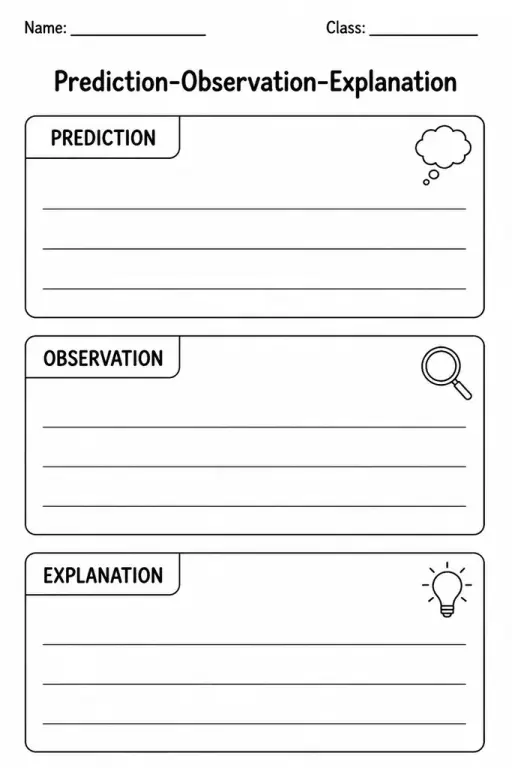 WorksheetPrediction-Observation-Explanation
On this sheet
The words and questions from the game
- 1Which statement is something you can directly observe in the picture?The leaf will dry by tomorrow. · The leaf is on the desk. · The leaf came from the tallest tree. · The leaf fell yesterday.
- 2Tap the centre of the magnifying glass lens, the part you look through.
- 3Which picture shows a leaf floating on water?
- 4“The plant is unhappy” is a direct observation that can be measured as written.True · False
- 5Look at the picture. Choose the matching description.Ice on metal and wood · Magnets attracting paper clips · Plants in light and dark · Cars on smooth and rough ramps
- 6Listen. Which statement reports an observation rather than a guess?The leaf floated because it was happy. · The leaf will float for a week. · The leaf stayed on the water surface. · Every leaf in the world will float.
- 7You want to compare how tall two seedlings grow. What should you measure?Distance from the pot to the door · Height from the soil surface to the top of the stem · Number of windows in the room · Width of the plant pot
- 8A test compares bean seedlings in light and darkness. The thing deliberately changed is the amount of ___.light · water · soil · sound
- 9Which picture illustrates a setup for asking: Does light affect seedling growth?
- 10Which is a prediction about the ice test, rather than a result already measured?The notebook already lists three melting times. · One cube melted after 12 minutes. · I think the ice on metal will melt sooner. · The timer recorded 8 minutes for one cube.
- 11Arrange these steps for a fair test of ramp surface.
- 12Listen. Which conclusion matches these recorded results?The car travelled farther on the rough surface in every run. · In these runs, the car travelled farther on the smooth surface. · The smooth surface made the car travel exactly twice as far. · The rough surface always makes every car stop at once.
- 13A learner compares seedling growth in light and darkness. Which factor should be kept the same to make a fair comparison?The growth result the learner hopes to see · Amount of light each seedling receives · Amount of water each seedling receives · Use a different bean variety in each light condition.
- 14Two cars start at different ramp heights AND use different surfaces. Why can we not tell which surface makes the car travel farther?Both height and surface changed. · Travel distance can never be measured. · Repeating the two different setups removes the height difference. · All ramps must be made of metal.
- 15A car travels 61 cm in one smooth-surface run. Why repeat the same test?To make the car travel farther by repeating the measurement alone · To guarantee every distance is identical · To make a different question unnecessary · To check how consistent the distances are
- 16One leaf floated for one minute. Which claim goes beyond the evidence?This leaf stayed on the surface for one minute. · The observation lasted one minute. · Every kind of leaf will float for a whole day. · One leaf was tested.
- 17Bean seedling results after 7 days: light group growth 3, 4, 3 cm; dark group growth 6, 7, 6 cm. Other conditions were the same. Which conclusion is supported?Plants never need light. · In this test, the dark group grew more in height. · Darkness always makes every plant healthier. · The light group grew more in height than the dark group.
- 18A learner tests ice on metal and wood using same-size cubes in the same room. Results: metal 8, 9, 8 minutes; wood 12, 13, 12 minutes. Another metal run takes 2Repeat that run with the agreed cube size and record why the 25-minute run differed. · Hide the 25-minute run and say it never happened. · Conclude wood always melts ice faster. · Keep using twice-size cubes only on metal and call the comparison fair.
- 19To compare seedling height fairly on Monday and Friday, which measuring rule should be used both times?On Monday measure from the pot bottom; on Friday measure from the soil. · Measure whichever leaf looks longest each day. · Measure from the pot rim on Monday and from the floor on Friday. · Measure from the soil surface to the top of the stem.
- 20Two groups test ice on metal and wood. Group A uses equal-size cubes for both materials. Group B uses small cubes on metal and large cubes on wood. Which group Neither group can measure melting time at all. · Both groups, because cube size cannot affect melting time. · Group B, because changing cube size makes a stronger test. · Group A, because cube size is kept the same.
- 21Which plan best answers “Does ramp surface affect how far a toy car travels?”Use one car on smooth material and a different car on rough material; measure one distance for each. · Use the same car but push it harder on the rough surface. · Use the same car and ramp height; release without pushing from the same point on each surface, measure distance the same way, and repeat each surface test. · Use the same car, but use a higher ramp for smooth material and a lower ramp for rough material; repeat both.
About this worksheet
A printable worksheet made from the KiwiBee game “Science Detective: Observe, Predict and Test”. Open it in the free Worksheet Studio to choose the design and the sheet type, then print it or save a PDF.
Use pictures, spoken observations and small data tables to plan fair investigations and evaluate evidence.
- scientific investigation
- fair testing
- science variables
- observation and inference
- interpreting data
- scientific evidence
 Home
 All solutions
 Pricing
 About us
 KiwiBee for Non-profits
 Events & webinars
 For big organisations
 For schools
 For centers
 For team leaders
 For teachers
 Resources
 Printable worksheets
 Interactive simulations
 Teacher tools
 Ideas and research


Comments