
Printable worksheet
Particles Explain a Mystery Change
QuizScienceGrade 6English

Practise more with these
Picked by meaning from games, worksheets, simulations, teacher tools and videos.
 GameParticles and States
 GameStates of Matter
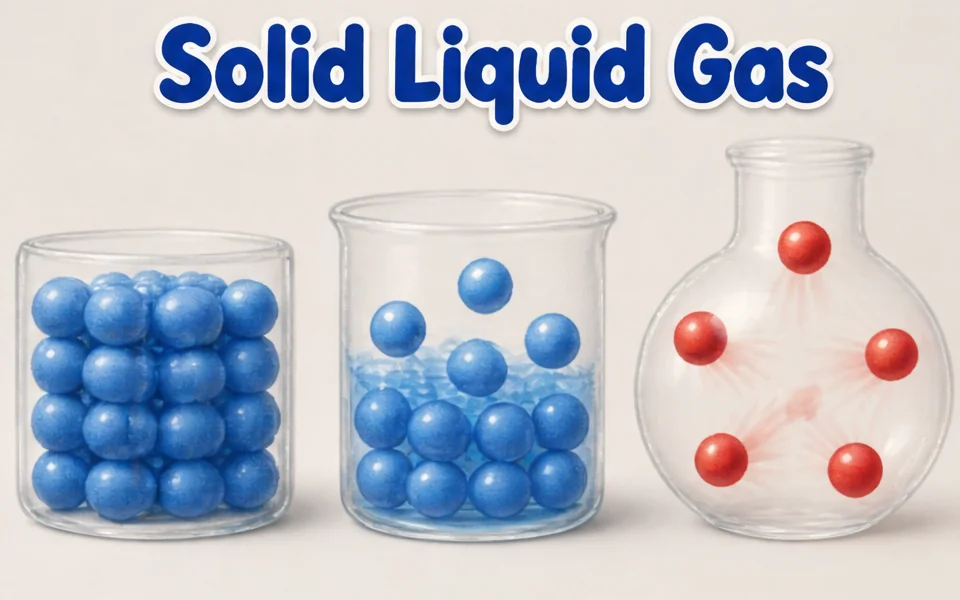 SimulationStates of Matter
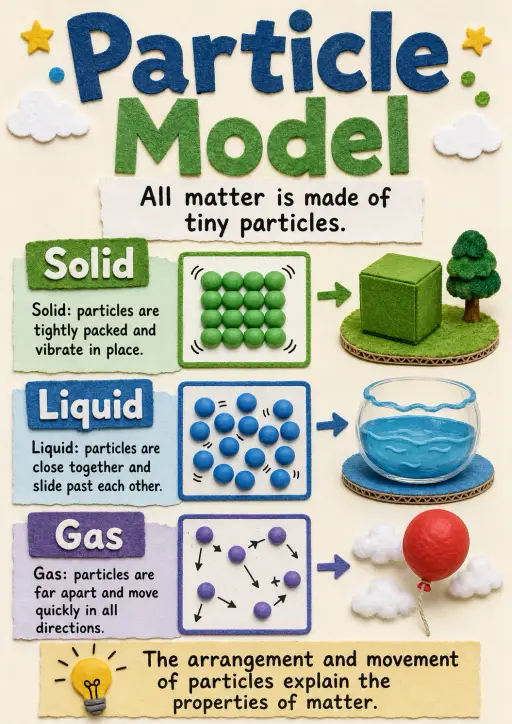 Worksheet★.particle: Model★ Matter Infographic
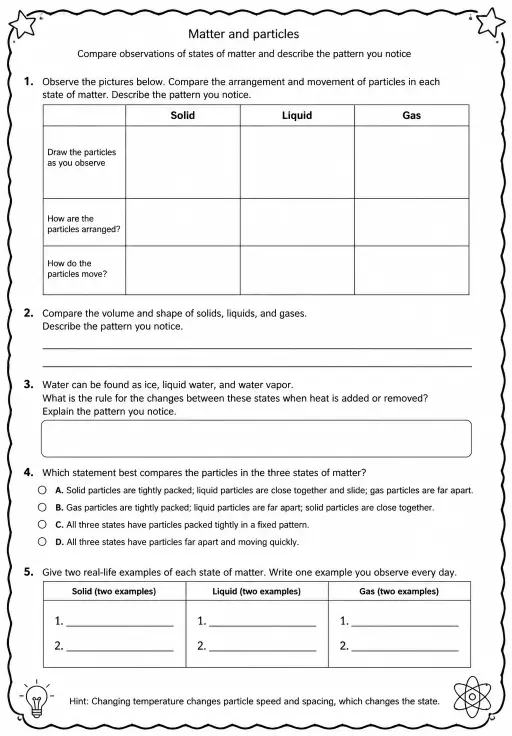 WorksheetCompare observations of states of matter and describe the pattern you notice
 GameThe Changing Water Challenge
 GameScientific Models at Their Limits
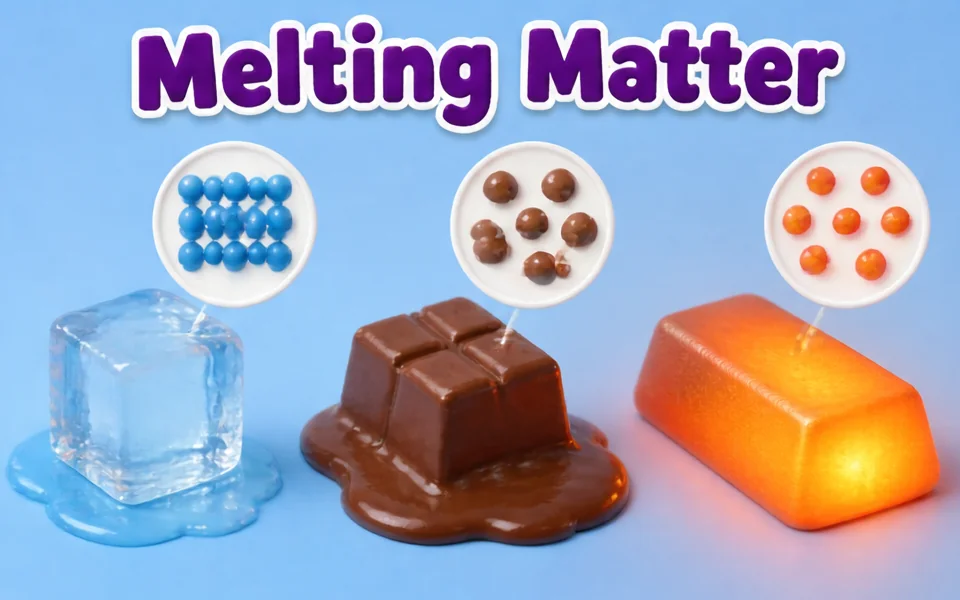 SimulationStates of Matter Lab
On this sheet
The words and questions from the game
- 1Which statement matches the particle model of a solid?Particles are close together and only vibrate around fixed positions. · Particles are far apart and move freely past each other. · Particles stop existing between collisions. · Particles disappear when the solid cools.
- 2True or false: In a gas, particles are much farther apart than in a liquid.True · False
- 3A candle has solid wax lower down and melted wax near the flame. Which change of state is happening near the flame?Freezing: liquid wax changes to solid wax · Melting: solid wax changes to liquid wax · Boiling: liquid wax changes into a solid. · Condensation: gas changes to liquid
- 4Which statement is direct evidence rather than a particle-model idea?The spaces between particles doubled. · The particles spread out because they repel each other. · The particles in the liquid are vibrating faster. · A thermometer reading rose from 20 °C to 35 °C.
- 5A syringe is sealed at the tip. Air inside is pushed from 30 mL to 15 mL. Which particle-model explanation fits this change best?Each air particle melts into a liquid. · Half of the air particles disappear. · The spaces between air particles decrease. · The air particles become smaller.
- 6For this particle model of substance X, the solid has the smallest average particle spacing, the liquid has intermediate spacing, and the gas has the largest sp
- 7Listen to the observation. Which conclusion is supported?Some liquid water changed into water vapour. · The mass of water increased because particles were created. · Water particles ceased to exist as the level fell. · The cup became colder because freezing happened.
- 8A cold bottle is taken from a refrigerator. After 3 minutes, tiny drops appear on the outside. Which particle-model explanation fits best?The bottle created new water particles on its surface. · Water inside the bottle passed through the plastic and formed the drops. · Water vapour in the air lost energy and changed to liquid on the cold surface. · Air particles turned directly into solid water outside the bottle.
- 9Drops are found on the underside of a pot lid while soup is boiling. Which state change made those drops?Evaporation · Melting · Freezing · Condensation
- 10True or false: Frost forming directly from water vapour on a very cold window is an example of gas changing to solid.True · False
- 11A puddle on warm pavement becomes smaller during a sunny afternoon, and the pavement is dry by evening. Which change of state explains this?Water vapour changed to liquid water. · Liquid water changed to water vapour. · Liquid water changed to ice. · Ice changed directly into water vapour.
- 12Listen to the observation. Which state change happened to the wax first?Melting · Evaporation · Freezing · Condensation
- 13Order these events for making ice cubes from liquid water, from first to last.
- 14Which statement is a model-based inference, not a direct observation?The beaker mass is 125 g. · The liquid level dropped by 2 cm. · The particles are moving faster after heating. · Small droplets appeared on the lid.
- 15In the spoon-and-steam situation, which statement is direct evidence?Water particles from the air collected on the spoon. · Water changed state on the spoon. · Particles slowed down near the cool spoon. · The spoon surface became wet.
- 16True or false: If you can see droplets on a window, you have directly observed water molecules.True · False
- 17A sealed dry clear box contains only dry air and a dish of liquid ethanol. The lid is kept cooler than the liquid; there is no splashing. Initially the inside wThe dish level fell because some particles were destroyed inside the box. · Ethanol evaporated, then condensed on the cooler lid. · The droplets prove that particles were directly seen moving upward. · The droplets formed because the lid melted.
- 18Listen to the lab result. Which conclusion is best supported?Water vapour already inside the container condensed on the cold inner wall. · Liquid water passed through the plastic wall from outside. · Water from outside the container leaked in and made the droplets. · The ice created new particles when it cooled the air.
- 19A cold mirror is held above hot water. Order the events from first to last.
- 20A student says about a cold bottle, 'The drops on the outside came from water inside the bottle passing through the wall.' Which new observation would most stroThe bottle feels cold to touch. · The bottle is made of clear plastic. · Drops form on the outside of an empty cold bottle too. · The room contains air.
About this worksheet
A printable worksheet made from the KiwiBee game “Particles Explain a Mystery Change”. Open it in the free Worksheet Studio to choose the design and the sheet type, then print it or save a PDF.
Students use particle ideas to explain changes of state, match observations to melting, freezing, evaporation and condensation, and separate what is directly observed from what is inferred from a model.
- ms 121
- science
- use particle models
- connect observations to state changes
- distinguish a model from direct evidence
 Home
 All solutions
 Pricing
 About us
 KiwiBee for Non-profits
 Events & webinars
 For big organisations
 For schools
 For centers
 For team leaders
 For teachers
 Resources
 Printable worksheets
 Interactive simulations
 Teacher tools
 Ideas and research


Comments