
Printable worksheet
Enzymes and a Controlled Investigation
QuizScienceGrade 9English

Practise more with these
Picked by meaning from games, worksheets, simulations, teacher tools and videos.
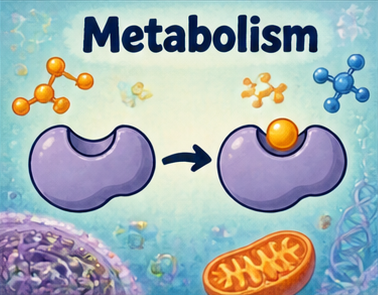 GameMetabolism Across Linked Pathways
 GameHomeostasis from Feedback Evidence
 GameA Cell as a Working System
 GameGene Expression Across a Regulatory System
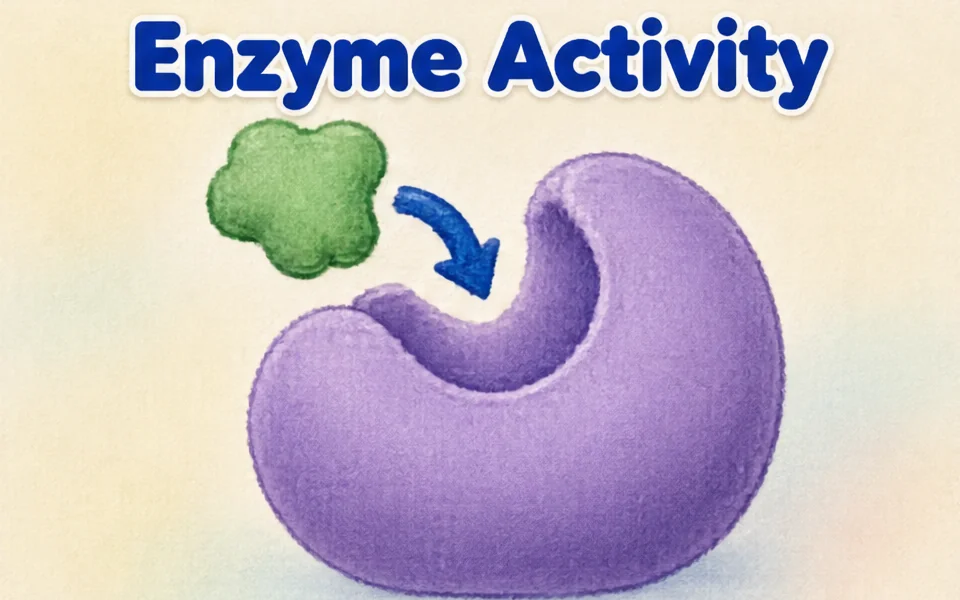 SimulationEnzyme Activity & Kinetics
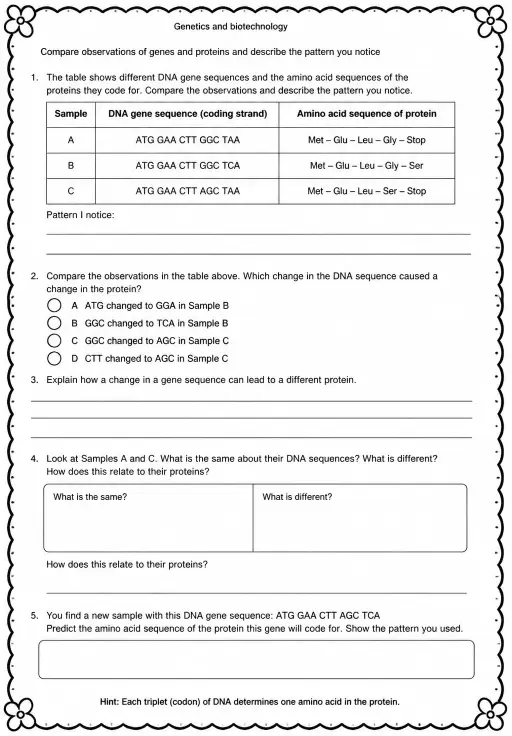 WorksheetCompare observations of genes and proteins and describe the pattern you notice
 SimulationEnzyme Active Site & pH
On this sheet
The words and questions from the game
- 1What links an enzyme’s three-dimensional structure to its function?Enzymes are consumed as the main fuel · Its active site interacts with suitable substrates · Only its total mass matters; active-site shape is irrelevant · Every enzyme has the same shape
- 2A catalyst changes the reaction rate without being consumed overall by that reaction.True · False
- 3A mutation changes a residue needed for substrate binding. What is a plausible consequence?Guaranteed creation of energy from nothing · No possible functional effect · The enzyme must bind every substrate equally well · Changed binding and reaction rate
- 4Heating disrupts an enzyme’s functional shape. What term describes this loss of structure?Fertilisation · DNA replication · Denaturation · Translation
- 5A higher temperature always increases an enzyme’s activity without limit.True · False
- 6Order this stipulated simplified catalytic cycle.
- 7Which statement separates rate from amount?Product per second is a rate; total product is an amount · Product per second is an amount, while total product is a rate. · Time is irrelevant to rates · Every product amount is already a rate
- 8Initial rates at substrate concentrations 1, 2 and 4 units are 3, 5 and 5 rate units. What pattern is shown?Rate rises then levels off in this range · Rate doubles at every step · The final rate is lower than the first rate · Rate falls throughout
- 9Listen. Which interpretation fits the model?Substrate must be absent · No catalytic process can be occurring · Extra enzyme must lower the maximum available capacity · Available enzyme capacity may be limiting
- 10A flat product curve always proves that all enzyme molecules have denatured.True · False
- 11Why compare initial rates when substrate depletion would otherwise differ?To avoid measuring time · To reduce changes in conditions during the measurement interval · To guarantee no experimental error · To measure only after substrate is completely exhausted
- 12A pH comparison also changes enzyme concentration. What is the main limitation?Changing enzyme concentration isolates pH automatically · No controls can ever help · The pH effect is confounded with enzyme amount · There is only one changed factor
- 13Listen. Which control most directly checks non-enzymatic product formation?A matched mixture without active enzyme · Only a different notebook · A mixture lacking substrate but containing more enzyme · A mixture with extra enzyme and extra substrate
- 14Removing an inconvenient data point without an evidence-based reason improves reliability.True · False
- 15An inhibitor lowers rate, but the solvent alone also lowers rate. What comparison is needed?A larger coloured label · Matched solvent control · Only an untreated sample with no solvent information · Compare only different inhibitor doses with different solvent amounts
- 16In a supplied competitive-inhibition model, enough substrate restores the same maximum rate. Which result fits?The inhibited maximum is permanently zero by definition · Substrate can never affect the inhibited rate · Both curves approach different maximum rates forever · Both curves approach 12 rate units at high substrate
- 17Order these distinct measured rates from lowest to highest.
- 18A mutation changes enzyme activity but not measured protein amount. Which explanation remains plausible?The protein amount must have doubled · The mutation necessarily prevented all protein production · Catalytic efficiency changed · The data prove no structural change
- 19A student claims a high final product amount proves the fastest initial rate. What is missing?Only the tube colour · The number of letters in the enzyme name · Time-course evidence and comparable conditions · Only the final product amount measured again
- 20Which conclusion best combines structure, data and controls?Matched tests: altered enzyme's lower initial rate fits changed function. · The altered enzyme's lower initial rate proves its exact atomic structure · One curve proves the exact atomic mechanism · The altered enzyme is useless in every organism
About this worksheet
A printable worksheet made from the KiwiBee game “Enzymes and a Controlled Investigation”. Open it in the free Worksheet Studio to choose the design and the sheet type, then print it or save a PDF.
A 28-question progressive quiz connecting three skills through explicit observations, data and scenarios.
- ms 171
- biology
- connect protein structure to function
- interpret rate graphs
- evaluate controls and confounding factors
 Home
 All solutions
 Pricing
 About us
 KiwiBee for Non-profits
 Events & webinars
 For big organisations
 For schools
 For centers
 For team leaders
 For teachers
 Resources
 Printable worksheets
 Interactive simulations
 Teacher tools
 Ideas and research


Comments