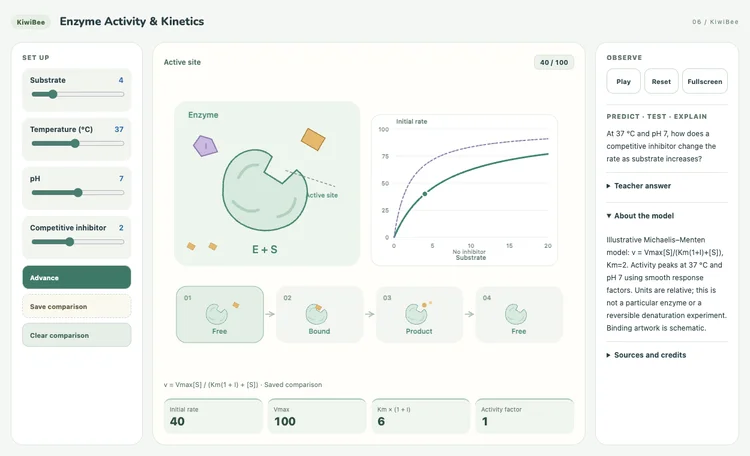
Explore an enzyme’s active site and investigate substrate, temperature, pH and competitive inhibition with live rate curves.
—
KiwiBee uses optional Google Analytics, Google Ads, and Meta Pixel cookies to understand adult visitors, measure completed sign-ups, and improve campaigns. Essential cookies always stay on. OpenAI’s ChatGPT Ads Pixel also measures page views and completed enquiries after advertising consent, and may use hashed contact details for matching. Privacy policy
Enzyme Active Site & pH is an interactive 3D biochemistry lab showing how globular enzymes recognise specific substrates and catalyse reactions. Students drag the green substrate molecule into the sculpted active-site cleft to trigger an induced-fit conformational hug that splits the substrate into products. They can also drag a red competitive inhibitor into the active site or a purple non-competitive inhibitor into the side allosteric pocket. Sliders for temperature, solution pH, and substrate concentration update live readouts for reaction rate, active site conformation, percentage of enzyme bound, and effective Vmax.
The classic lock-and-key model treated the active site as completely rigid. The modern induced-fit model shows that as the substrate binds, the flexible protein jaws mould tightly around it, straining substrate bonds to speed up catalysis.
Up to the optimum temperature, heat increases molecular collisions. Above roughly 45 °C in human enzymes, thermal vibration breaks the weak hydrogen and ionic bonds holding the 3D tertiary structure together, unfolding the active site.
A competitive inhibitor resembles the substrate and competes directly for the active site, so adding extra substrate can overcome it. A non-competitive inhibitor binds a separate allosteric site, warping the active site so maximum velocity Vmax decreases regardless of substrate level.
Drop it into your LMS, blog, or class site — free.
<iframe src="https://kiwibee.io/en/simulations/enzyme-lock-and-key-3d-3d-simulation/embed" title="Enzyme Active Site & pH | KiwiBee" loading="lazy" allowfullscreen style="width:100%;height:min(70vh,620px);min-height:420px;border:0;border-radius:16px"></iframe>Continue exploring
Explore an enzyme’s active site and investigate substrate, temperature, pH and competitive inhibition with live rate curves.

Explore an adult male reference body in 3D. Reveal 14 anatomical systems, search thousands of named structures, isolate organs, and pull 2,209 modeled pieces apart to see how the body is organized.
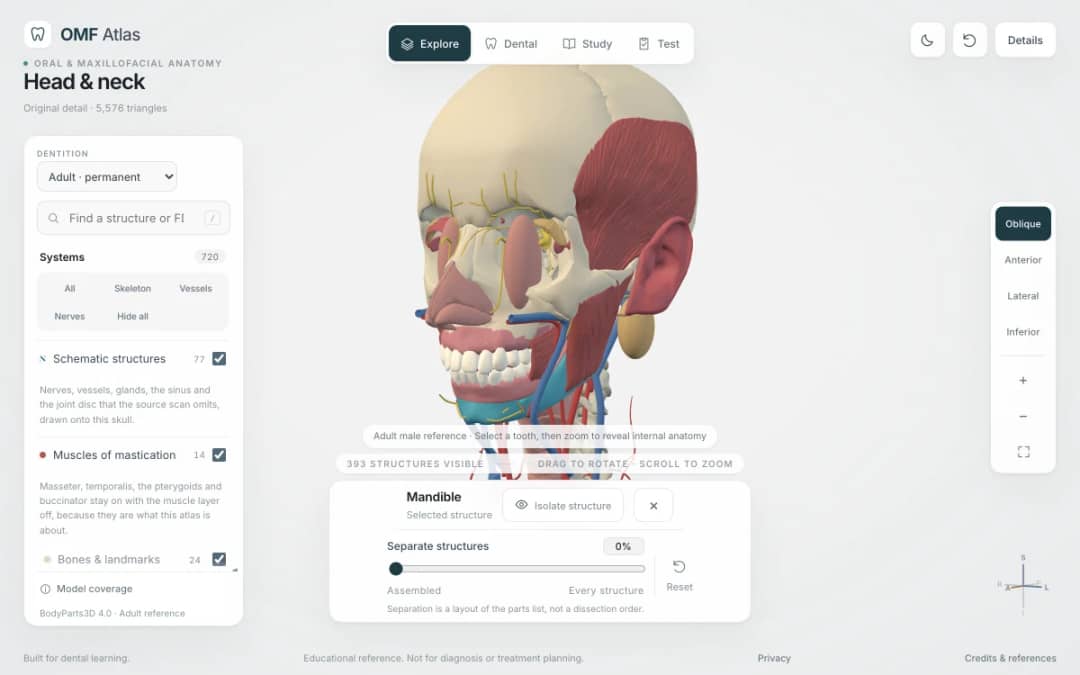
Explore the head and neck in 3D: 643 source meshes across 14 layers, 47 facial and masticatory muscles, and 77 drawn nerves, vessels and glands the source scan omits. Open any tooth onto its own pulp canal, and follow the seven stages of tooth development.

Free interactive photosynthesis simulation. Explore photosynthesis hands-on online — great for whole-class or independent practice.

Free interactive states of matter simulation. Explore states of matter hands-on online — great for whole-class or independent practice.
KiwiBee's free teacher workspace brings lesson planning, worksheets, classroom tools, and gradebook together in one place.
Start free and create your first class Home
 All solutions
 Pricing
 About us
 KiwiBee for Non-profits
 Events & webinars
 For big organisations
 For schools
 For centers
 For team leaders
 For teachers
 AI and resources
 Resources
 Printable worksheets
 Lesson Packs
 Interactive simulations
 Teacher tools
 AI studio
 Ideas and research