
Printable worksheet
A Good Observation Record Does Not Lose the Change
QuizScienceKindergartenEnglish
Practise more with these
Picked by meaning from games, worksheets, simulations, teacher tools and videos.
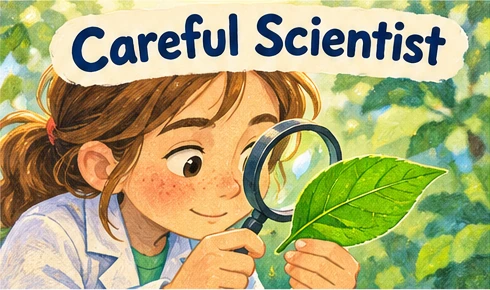 GameA Scientist's Careful Look
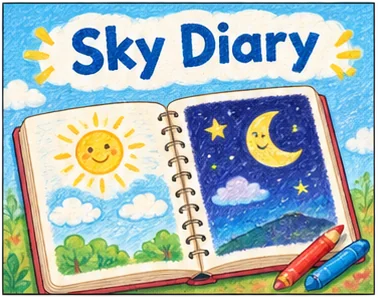 GameA Sky Diary Beyond the Weather
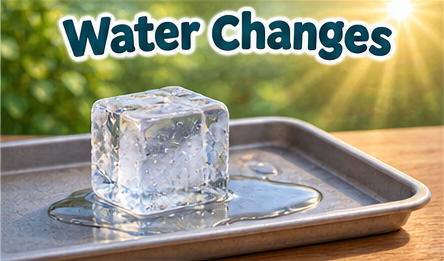 GameWater Changes Through a Day
 GameMemory Observation Quiz
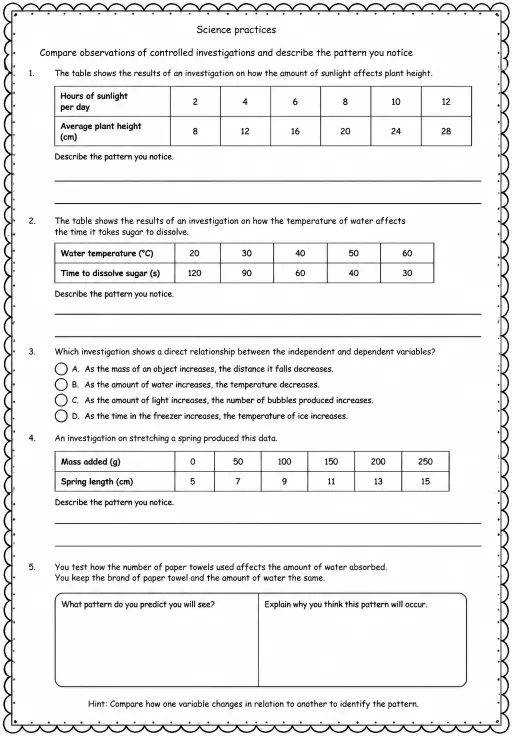 WorksheetCompare observations of controlled investigations and describe the pattern you notice
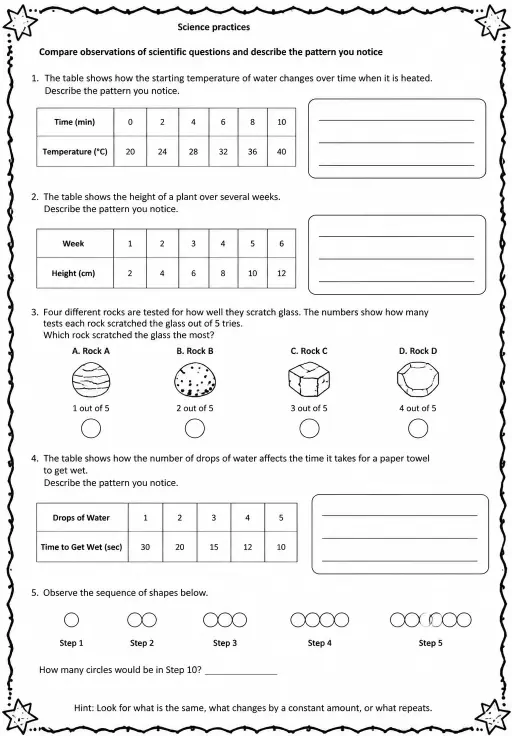 WorksheetCompare observations of scientific questions and describe the pattern you notice
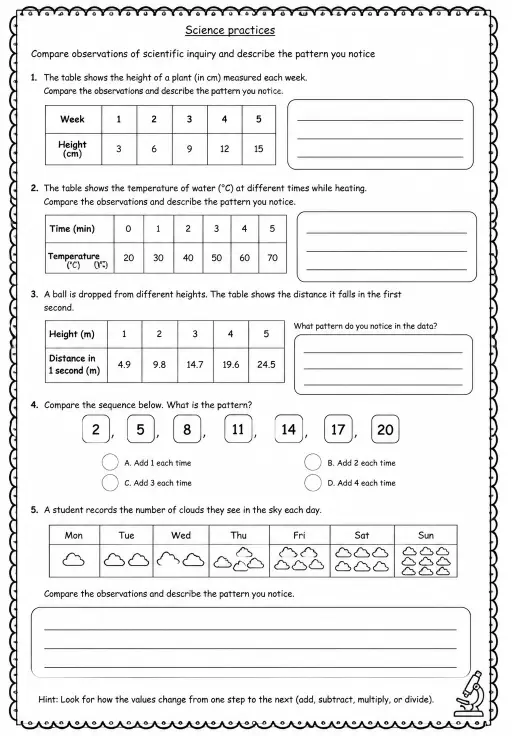 WorksheetCompare observations of scientific inquiry and describe the pattern you notice
 WorksheetExperiment Recording Sheet
On this sheet
The words and questions from the game
- 1Mia wants to watch an ice cube melt. Which plan uses the same wait time between each check?Look now, then after 1 minute, then after 4 minutes · Look at 1 minute, then 2 minutes, then 5 minutes. · Look at 1 minute, then 3 minutes, then 6 minutes · Look every 2 minutes
- 2True or false: If you want to compare changes fairly, it helps to check at the same amount of time each time.True · False
- 3Sam watched a puddle at these times: 9:00, 9:10, 9:20. What is the time gap each time?30 minutes · 10 minutes · 5 minutes · 20 minutes
- 4Put these times in order from earliest to latest.
- 5Lina wants 5-minute gaps while watching a plant. Which times should she use?2:00, 2:05, 2:10 · 2:00, 2:05, 2:12 · 2:00, 2:10, 2:20 · 2:00, 2:03, 2:10
- 6Listen to the observation plan. Which time should come next to keep the same gap?3:30 · 3:10 · 3:20 · 3:15
- 7Before: the ice cube is big and hard. After: the ice cube is smaller and there is water in the tray. Which event happened?It was cut with scissors · It melted · It grew leaves · It froze into a larger block.
- 8True or false: Before a plant is small. After one week it is taller with two new leaves. This record matches the event 'the plant grew.'True · False
- 9Listen to the observations. Which event is supported?The bread was freshly toasted. · The bread dried a little · The bread grew mould · The bread was eaten
- 10A snowman changed on a warm day. Put these records in time order from first to last.
- 11Rae wrote in a change diary: 'The puddle was smaller.' What important information is missing?When Rae looked · The colour of Rae's shoes · Rae's favourite game · The name of Rae's pet
- 12True or false: This is a complete record: '10:00 - ice cube is hard. 10:10 - ice cube is smaller.'True · False
- 13Listen to the diary line. What important information is missing?The observer's favourite song · The colour of the table · The observer's lunch · What was seen
- 14A child wants to record a snowman melting. Which diary plan is best for keeping fair time gaps and clear records?9:00 tall, later smaller, much later small pile · 9:00 tall, 9:05 shorter, 9:20 small pile · 9:00 tall, 9:10 shorter, 9:20 small pile · Morning tall, lunch shorter, after school small pile
- 15A diary says: 1:00 - ice cube is hard. 1:10 - there is a puddle of water and the ice cube is smaller. Which event matches the diary?The ice cube melted · The puddle froze into a bigger ice cube. · The ice cube turned into bread · The ice cube grew
- 16Nia wants to watch an apple slice turn brown over one morning. Which diary is the best new example of a good observation record?8:00 pale, 8:10 no observation written, 8:20 no observation written · 8:00 pale, later different, later more different · 8:00 pale, 8:07 a little brown, 8:20 more brown · 8:00 pale, 8:10 a little brown, 8:20 more brown
About this worksheet
A printable worksheet made from the KiwiBee game “A Good Observation Record Does Not Lose the Change”. Open it in the free Worksheet Studio to choose the design and the sheet type, then print it or save a PDF.
Students practise keeping fair, clear change records by using equal time gaps, matching before-and-after observations to an event, and spotting missing parts in a diary.
- ms 110
- science
- choose a consistent observation interval
- match before and after records to an event
- identify missing information in a change diary
 Home
 All solutions
 Pricing
 About us
 KiwiBee for Non-profits
 Events & webinars
 For big organisations
 For schools
 For centers
 For team leaders
 For teachers
 Resources
 Printable worksheets
 Interactive simulations
 Teacher tools
 Ideas and research


Comments