
Printable worksheet
A Financial Decision with Trade-offs
QuizOtherGrade 9English

Practise more with these
Picked by meaning from games, worksheets, simulations, teacher tools and videos.
 GameEvaluate a Financial Product Scenario
 GameA Budget for a Class Project
 GameEveryday Needs and Thoughtful Choices
 GameA Team Project Under Pressure
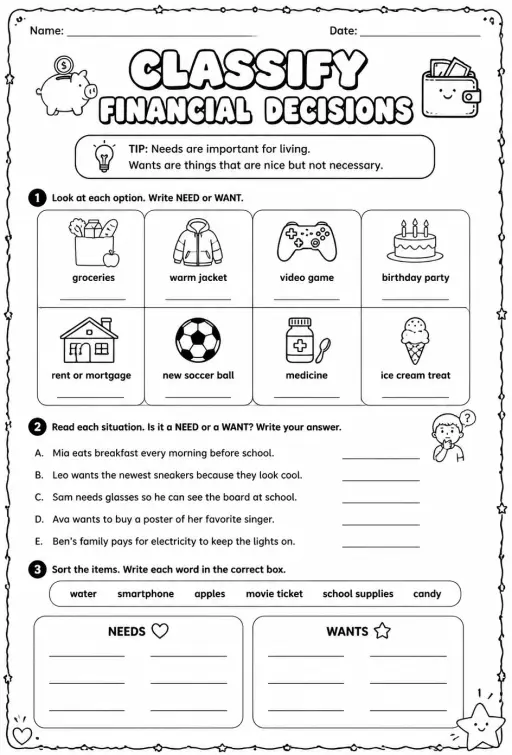 WorksheetClassify financial decisions
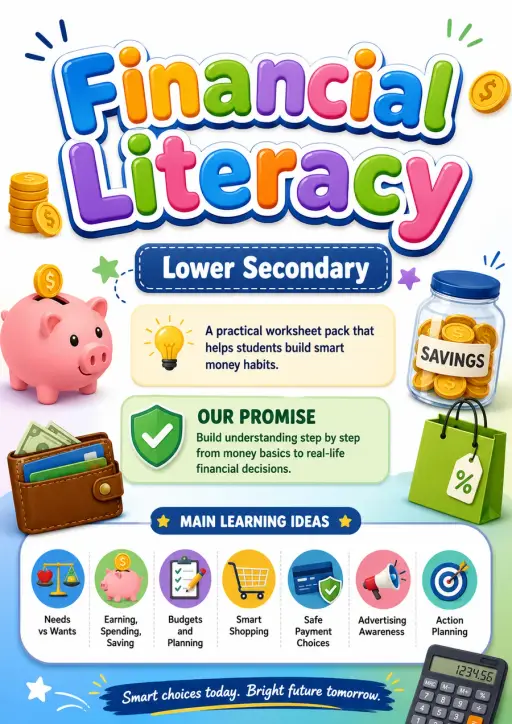 WorksheetFinancial Literacy
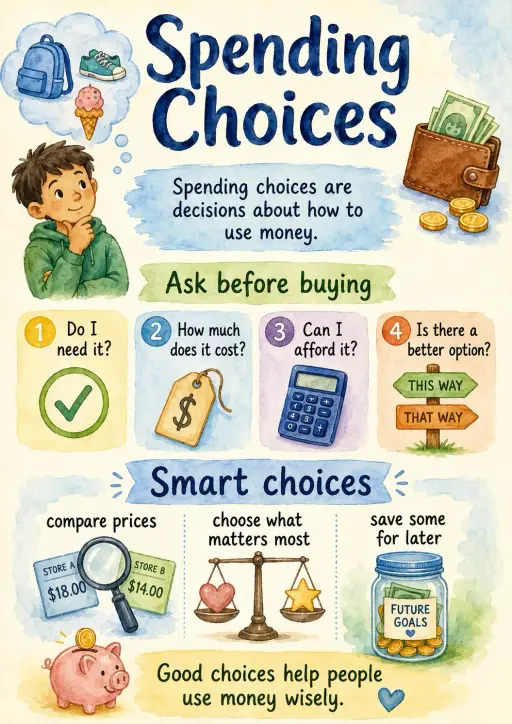 WorksheetSpending Choices Economics Infographic
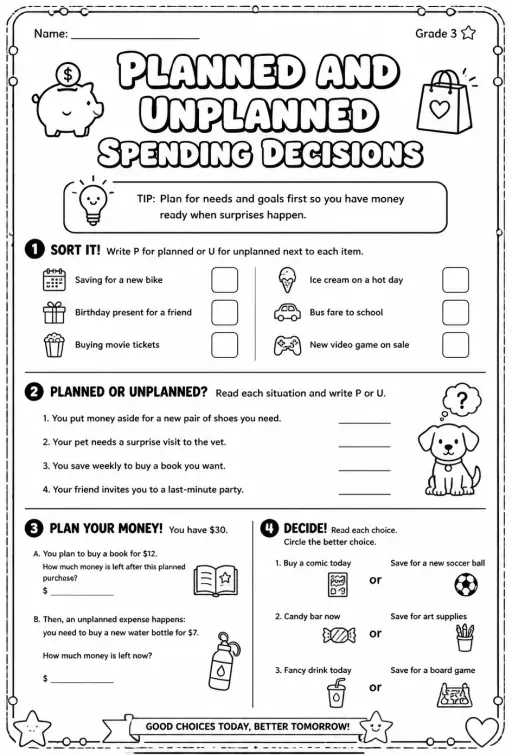 WorksheetPlanned and unplanned spending decisions
On this sheet
The words and questions from the game
- 1In a fictional budget, resources are 120 tokens and required costs are 90. What is available before optional spending?210 tokens · 90 tokens · 20 tokens · 30 tokens
- 2A plan can be affordable in one stated scenario and unaffordable after a cost increase.True · False
- 3A model loan provides 100 tokens and requires one total repayment of 112 with no other costs. What is the borrowing cost?112 tokens · 12 tokens · 212 tokens · 100 tokens
- 4Why compare borrowing options over the same stated period and amount?Different bases can make raw totals misleading · Fees never matter · Only the shortest product name determines cost. · Every period has the same cost automatically
- 5The specified budget process is requirements, full costs, then feasibility. Order it.
- 6A smaller monthly payment alone proves a smaller total borrowing cost.True · False
- 7Option A requires 6 payments of 20 tokens; B requires 10 payments of 14. With no other costs, which has lower total payments?Neither has a calculable total. · B at 140 tokens · A at 120 tokens · They are equal
- 8A lower complete cost necessarily meets every person’s cash-flow constraints.True · False
- 9A model can pay at most 15 tokens each month. A requires 20 monthly; B requires 14. Which meets that monthly limit?Both · A · B · Neither
- 10Option A requires 6 monthly payments of 20 tokens, and B requires 10 monthly payments of 14 tokens. There are no other costs, and the monthly limit is 15 tokensA meets every limit automatically · A has both the lower monthly payment and the higher total. · B must have lower total because each payment is lower · A has lower total payments, while B meets the stated monthly limit
- 11A future fee is unknown. What is accurate about a current full-cost claim?The unknown fee must be zero · It remains uncertain unless that fee is bounded or supplied · The price is guaranteed final · The unknown fee is proven to equal the item price.
- 12A conditional calculation should retain the assumption on which it depends.True · False
- 13Order these total costs from least to greatest.
- 14A model uses simple non-compounding interest of 10% on 100 tokens for one year, with no fee. What is repayment?110 tokens · 10 tokens · 100 tokens · 120 tokens
- 15A budget leaves 12 tokens. A possible compulsory repair costs 15. What issue does that scenario reveal?A 3-token shortfall if the repair occurs · A guaranteed 3-token surplus · That the repair is impossible by definition · Guaranteed surplus in every scenario
- 16A plan with the lowest model cost is a universal recommendation for every real borrower.True · False
- 17Which new assumption could reverse a complete-cost comparison?Using the same already included fee again · Changing only the decorative typeface · A compulsory fee applying to only one option · Changing an unrelated label colour
- 18What should a transparent explanation include?Only the smallest advertised number · A promise that uncertainty has disappeared · Only the product's longest slogan · The compared amount, period, costs, payment limits and unresolved assumptions
- 19Which final judgement is warranted?One number identifies the best choice for everyone · Under these assumptions, each option has the stated cost and timing trade-offs; changed terms require recalculation · A choice remains cheapest even if its compulsory fees change without limit. · Lower monthly means lower total in every case
About this worksheet
A printable worksheet made from the KiwiBee game “A Financial Decision with Trade-offs”. Open it in the free Worksheet Studio to choose the design and the sheet type, then print it or save a PDF.
A 28-question progressive quiz connecting three skills through explicit observations, data and scenarios.
- ms 291
- arts life skills
- compare budget scenarios
- interpret borrowing costs
- identify assumptions that change a decision
 Home
 All solutions
 Pricing
 About us
 KiwiBee for Non-profits
 Events & webinars
 For big organisations
 For schools
 For centers
 For team leaders
 For teachers
 Resources
 Printable worksheets
 Interactive simulations
 Teacher tools
 Ideas and research


Comments