Quadratic Domain and Range: Matching and Real Situations
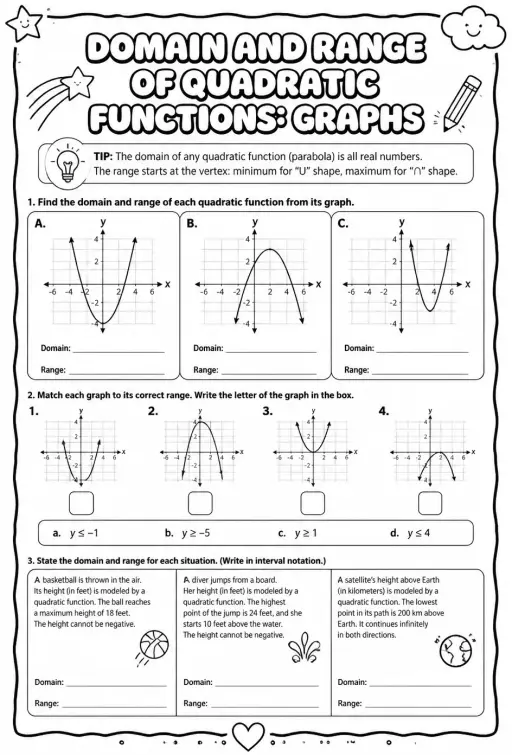
Students find the domain and range from three parabolas, match four small graphs to ranges such as y ≤ 4, and state the domain and range for a basketball, a diver and a satellite.
KiwiBee uses optional Google Analytics, Google Ads, and Meta Pixel cookies to understand adult visitors, measure completed sign-ups, and improve campaigns. Essential cookies always stay on. OpenAI’s ChatGPT Ads Pixel also measures page views and completed enquiries after advertising consent, and may use hashed contact details for matching. Privacy policy
This worksheet challenges students to write quadratic functions using three given points, reinforcing their understanding of quadratic relationships and algebraic manipulation. Teachers can use this resource to deepen students' skills in constructing equations and solving systems, essential for mastering quadratic functions. Ideal for Algebra 2 classes, it supports rigorous practice in function writing and problem-solving.
Skill lists aligned to IXL Learning skill plans, carried over from KiwiBee's System presets; the Maths section names are KiwiBee's own. IXL is a trademark of IXL Learning; no endorsement is implied.
Students find the domain and range from three parabolas, match four small graphs to ranges such as y ≤ 4, and state the domain and range for a basketball, a diver and a satellite.
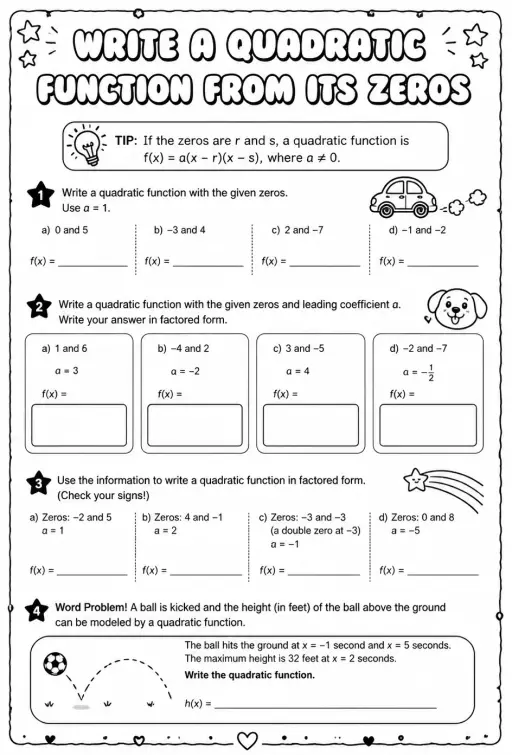
Free printable Algebra 2 math worksheet for "Write a quadratic function from its zeros" — practice quadratic functions. No-prep, print or assign online.
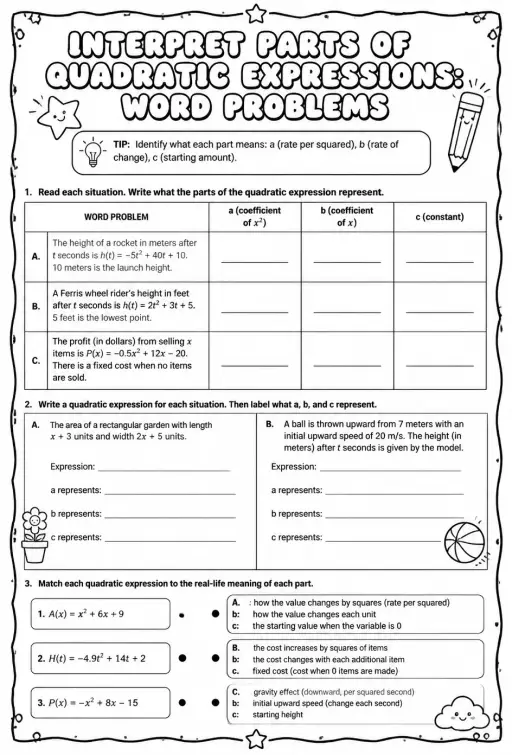
Students identify what a, b and c represent in three quadratic word problems about a rocket, a Ferris wheel and profit. They write expressions for a garden area and a thrown ball, then match three expressions to the meaning of each part.
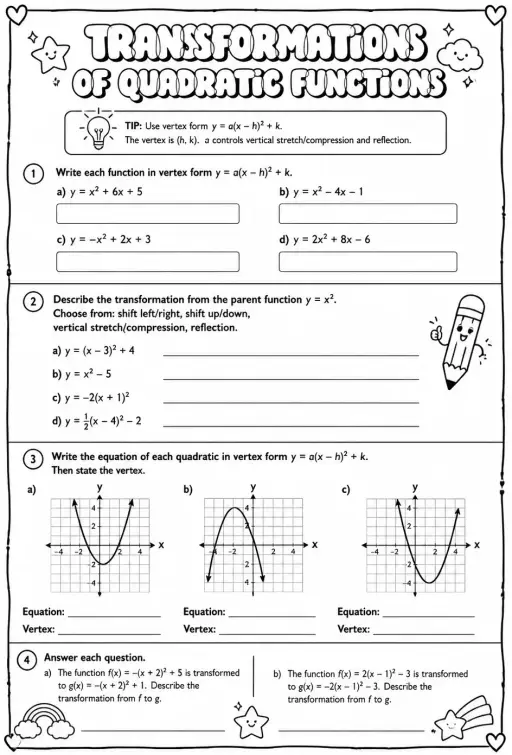
Students write four quadratics in vertex form, describe four transformations of y = x², write the equation and vertex of three parabolas from graphs, and describe how f changes to g in two cases.
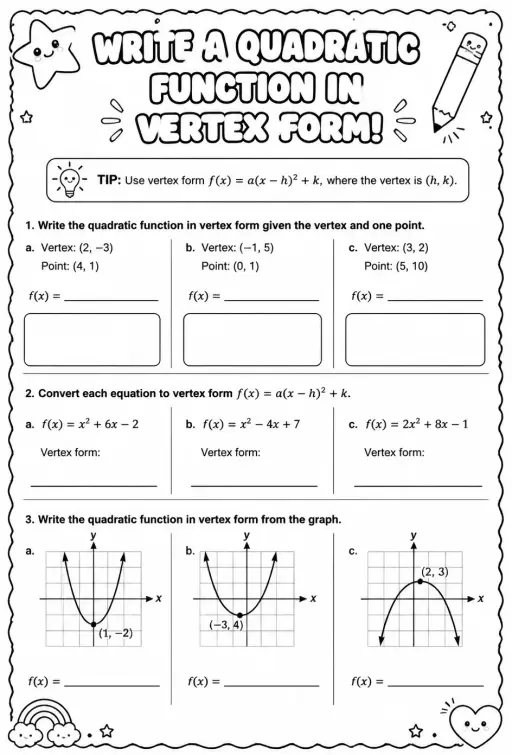
Students write quadratic functions in vertex form, f(x) = a(x - h)² + k, in three ways: from a vertex and one point, by converting equations such as x² + 6x - 2, and from a graph with its vertex labeled.
See what other teachers think and share a helpful note.
Generate a fresh worksheet for any grade, topic and language. Free.