KiwiBee uses optional Google Analytics, Google Ads, and Meta Pixel cookies to understand adult visitors, measure completed sign-ups, and improve campaigns. Essential cookies always stay on. OpenAI’s ChatGPT Ads Pixel also measures page views and completed enquiries after advertising consent, and may use hashed contact details for matching. Privacy policy
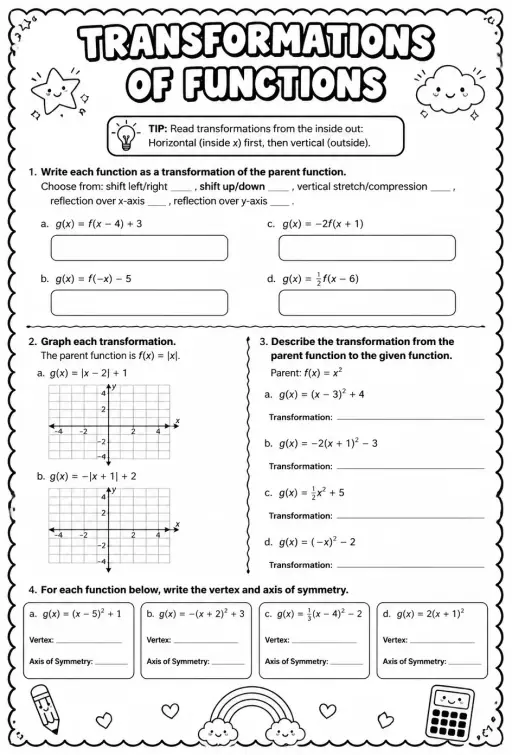
This Algebra 1 sheet has a tip to look at the outside of the function, and four sections. Section 1 shows lines for g(x) = x + 3, x - 2, -x and 2x, and section 2 matches six function rules to descriptions A to F. Section 3 asks for the transformation of four parent functions (x², |x|, √x, x³), and section 4 graphs three functions from tables, plotting at least 3 points.
Learning objectives
Describe shifts, reflections and stretches from a function rule
Match rules such as g(x) = f(x + 2) or -f(x) to their effect on the graph
Graph a transformed function by building a table of points
How to use this worksheet
1Select “Sign in / Sign up to download”, then sign in with Google or email to get the PDF from KiwiBee Printables.
2Print at home or in class for High School; it's no-prep, with no extra materials needed.
3Hand it out as classwork, homework, or a quick warm-up.
Skill lists aligned to IXL Learning skill plans, carried over from KiwiBee's System presets; the Maths section names are KiwiBee's own. IXL is a trademark of IXL Learning; no endorsement is implied.
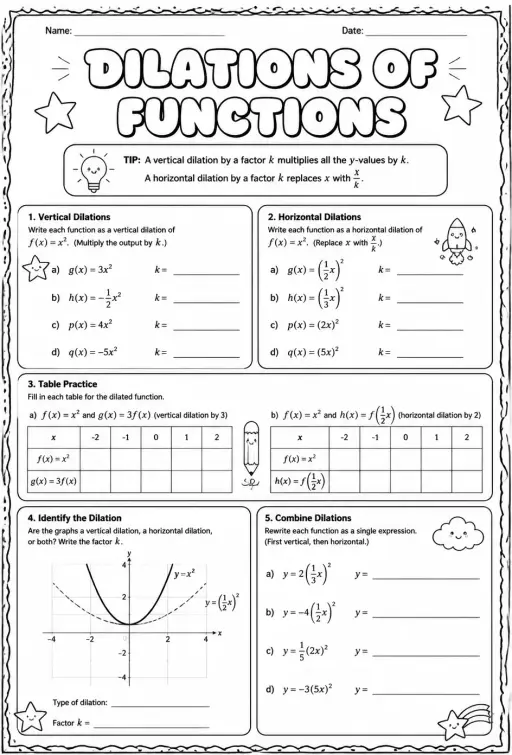
Students find the factor k for four vertical and four horizontal dilations of f(x) = x², fill two tables for dilated functions, identify the dilation on a graph, and rewrite four combined dilations.
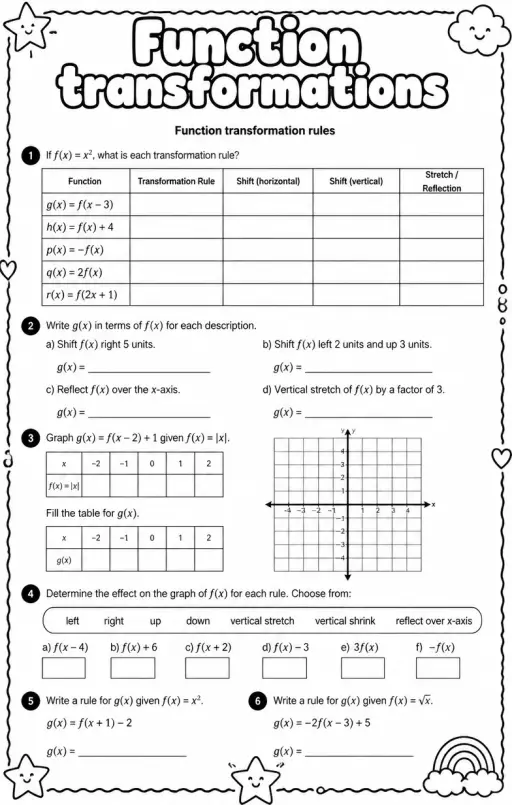
Students fill in a table of shifts, stretches and reflections for five rules built on f(x) = x², write g(x) from descriptions, graph g(x) = f(x − 2) + 1 from f(x) = |x|, and choose effects from a word bank.
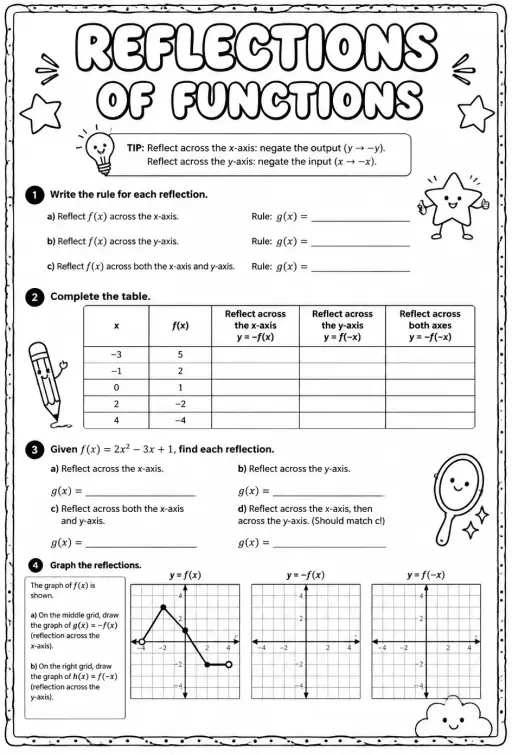
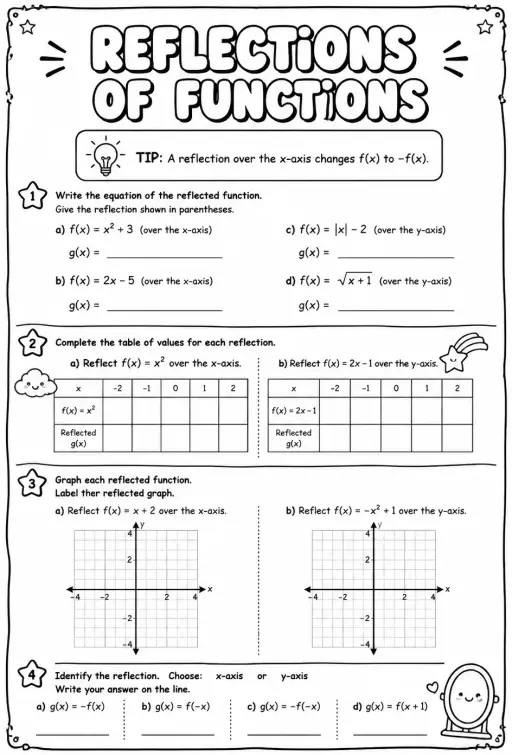
Students write four reflected equations including |x| − 2 and √(x + 1), complete two tables of values for x from −2 to 2, graph two reflected functions on blank grids, and name the axis for four rules such as g(x) = f(x + 1).
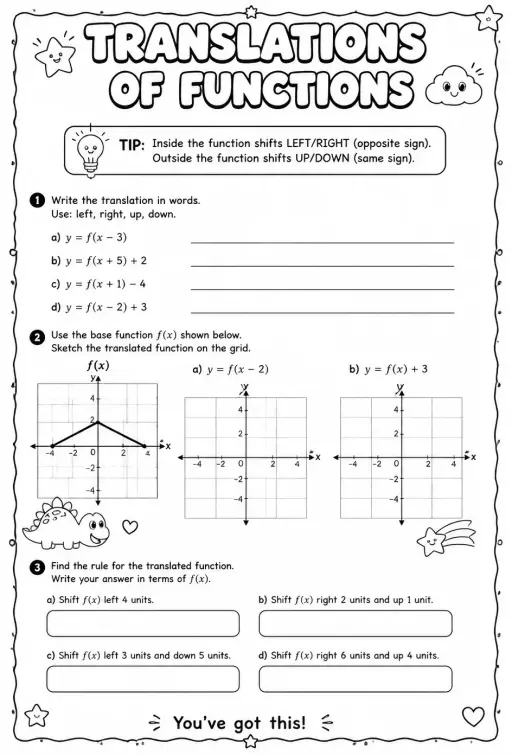
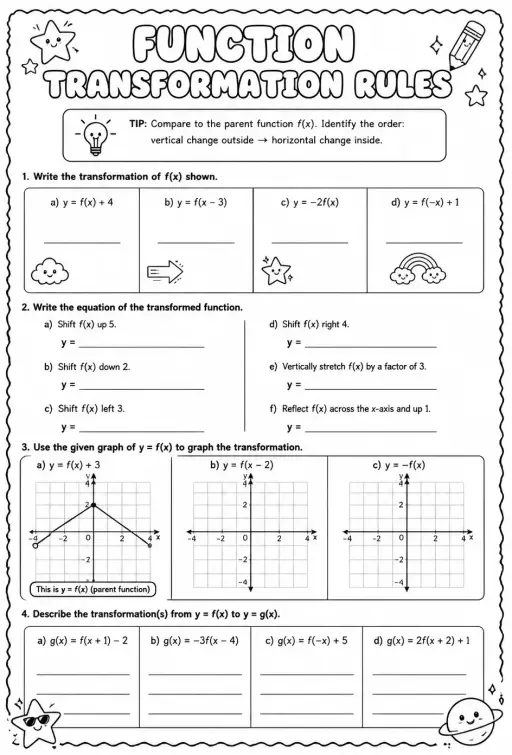
Students name four transformations of f(x), write six transformed equations from descriptions, graph f(x) + 3, f(x − 2) and −f(x) from a given graph, and describe four combined transformations.
——
Likes & comments
See what other teachers think and share a helpful note.
Loading likes and comments…
✦ Worksheet Studio
Need a different version? Make your own.
Generate a fresh worksheet for any grade, topic and language. Free.



 Home
 All solutions
 Pricing
 About us
 KiwiBee for Non-profits
 Events & webinars
 For big organisations
 For schools
 For centers
 For team leaders
 For teachers
 Resources
 Printable worksheets
 Interactive simulations
 Teacher tools
 Ideas and research


