Evidence-First Formative Assessment: Review AI Suggestions Before the Gradebook
 By KiwiBee Team
Last updated August 30, 2026
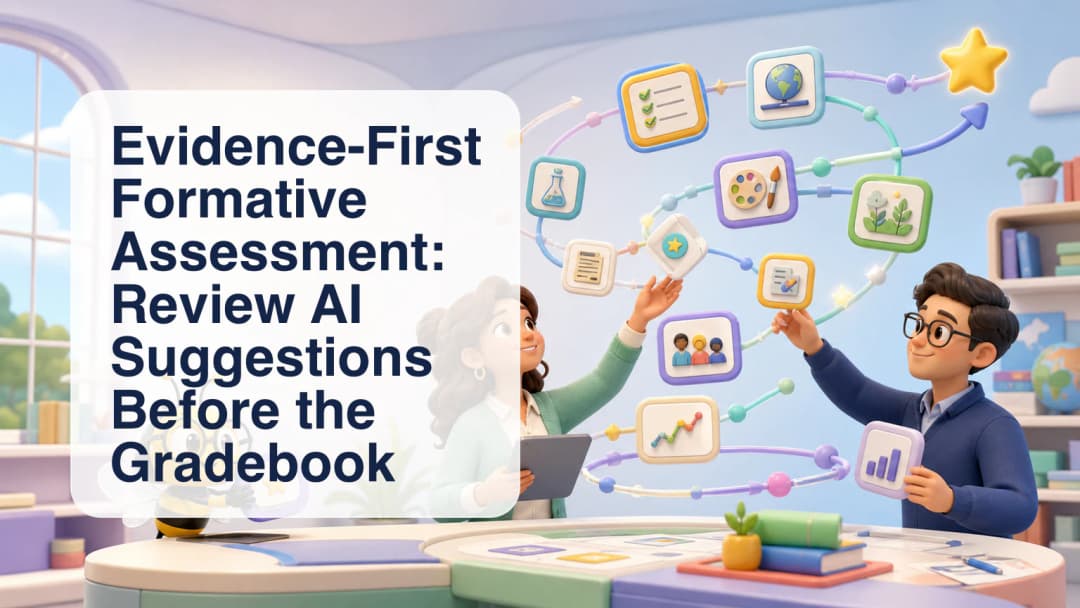
An AI formative assessment review workflow should make the evidence visible and keep the teacher in control of the result. In ClassSpark, AI analysis can propose observations and scores, but a proposal is not a grade. The teacher reviews, edits, and confirms before reviewed evidence enters the formative pipeline.
Begin with the right roster and standards
The review flow uses the scoped class roster and the relevant curriculum standards. Evidence can be analyzed against the curriculum’s own scoring system rather than a universal ClassSpark scale. When the available work does not support a conclusion, the workflow can indicate insufficient evidence instead of forcing a score.
The review screen presents the teacher with proposed student matches, reasoning or observations, and suggested scores. Roster-only matching helps keep the analysis within the selected class, but the teacher still checks the identity, evidence, standard, and proposed result. Image analysis, text extraction, and AI interpretation can all be wrong.
Separate collection from grading
Not every upload should travel directly to the gradebook. Activity-bound worksheet evidence uses a private evidence area and enters a “Needs student” queue when it has not yet been assigned. It remains ungraded and does not trigger the gradebook. A teacher first attaches it to the correct student and then decides how it should be reviewed.
That separation matters. Collecting work, identifying its owner, interpreting evidence, and recording a formative result are different decisions. The evidence assessment workflow preserves those stages, while the gradebook overview explains where confirmed academic records are used.
Confirm the result you are prepared to own
A practical review looks like this:
- Choose the intended class, roster, and curriculum standard.
- Upload or open the relevant piece of student evidence.
- Resolve the student identity if the item is waiting in the unassigned queue.
- Review the AI’s reasoning, observations, and proposed score.
- Correct the student, standard, notes, or score when needed.
- Confirm only the result supported by the evidence.
After confirmation, reviewed evidence can be linked to the standards and used in the formative gradebook workflow. The teacher’s review is the decisive step; there is no promise that AI suggestions are accurate or that every upload contains enough evidence to assess.
For moderation, teams can agree on what counts as sufficient evidence and compare reviewed examples against the curriculum rubric. That professional conversation is still necessary when teachers share a scoring system. The workflow can retain the evidence and review steps, but it cannot resolve every judgment difference on its own.
This evidence-first design gives academic leaders a clearer policy question to ask: not “Does AI grade?” but “Where does professional review happen before a result becomes a record?” Create an account to explore the configured assessment workflow.
Explore the platform
Continue with KiwiBee
Choose the KiwiBee workspace or resource library that fits what you need next.
 For big organisations
 For schools
 For centers
 For team leaders
 For teachers
 AI and resources
 Printable worksheets
 Interactive simulations
 Teacher tools
 AI studio
 Ideas and research