
About this simulation
Two bodies moving under gravity have an exact solution: each traces a conic section, and you can write down where they will be at any future moment. Three bodies obey the very same law and have no such general solution. Special cases exist — the figure-eight choreography and Lagrange's triangle are both real, exact orbits — but they are fragile: change one mass slightly and the motion never repeats. Students can change body 1 mass and body 2 mass and compare what happens. Use it for math inquiry with High School on a projector or student device.
Standards: Common Core CCSS.MATH.CONTENT.HSF.IF.B.4, CCSS.MATH.CONTENT.HSF.IF.C.7
What students can explore
- Run the figure-eight, then raise one mass by a few percent and watch the pattern break
- Compare the energy readout with the paths: the orbits become unpredictable while the total energy does not
- Set up the Lagrange triangle and check that all three separations stay equal as it turns
- Use the Sun-planet-moon setup to see why a hierarchy of orbits stays stable when a crowded system does not
Learning objectives
- 1Predict how changing body 1 mass will affect the pull between 1 and 2, then test the prediction.
- 2Use evidence from the live calculation and visual to explain the result.
Questions teachers ask
Is the Three-Body Problem simulation free?
Yes. Open the Three-Body Problem simulation in a modern browser with no download or sign-up required.
Is it suitable for High School?
The simulation includes learning-level presets spanning High School. Choose the level that matches your class, then use it on a projector or student devices.
Embed this simulation
Drop it into your LMS, blog, or class site — free.
<iframe src="https://kiwibee.io/en/simulations/three-body-problem-simulation/embed" title="Three-Body Problem Simulation | KiwiBee" loading="lazy" allowfullscreen style="width:100%;height:min(70vh,620px);min-height:420px;border:0;border-radius:16px"></iframe>Continue exploring
More interactive science models

Spin a spinner, flip a coin or roll a die and watch two sets of bars: the chances the shapes predict, and the results you actually got. Ten spins prove nothing; a few hundred and the two are hard to tell apart.

Type any function and see its shape straight away. Plot up to three at once in three colours to compare them, drag the trace point to read a value off a curve, and see where each one crosses zero.

Move m and watch the line tilt; move b and watch it slide. Or drag the two points on the line and read the equation it writes back. A rise-over-run staircase climbs the line so slope becomes something you can count.

Two paths start a hair apart and follow the same three equations. Watch them agree, then part onto opposite wings of the butterfly. Drag the start, spin the shape and pull rho down until chaos stops.

Approximate the area under a curve with strips and choose how each takes its height: left edge, right edge, middle, or a sloping top. Push the strip count up and watch the error fall, with the running total plotted as its own curve.
From model to evidence
Pair this simulation with a printable
Use a worksheet to capture predictions, observations, and explanations after students explore.
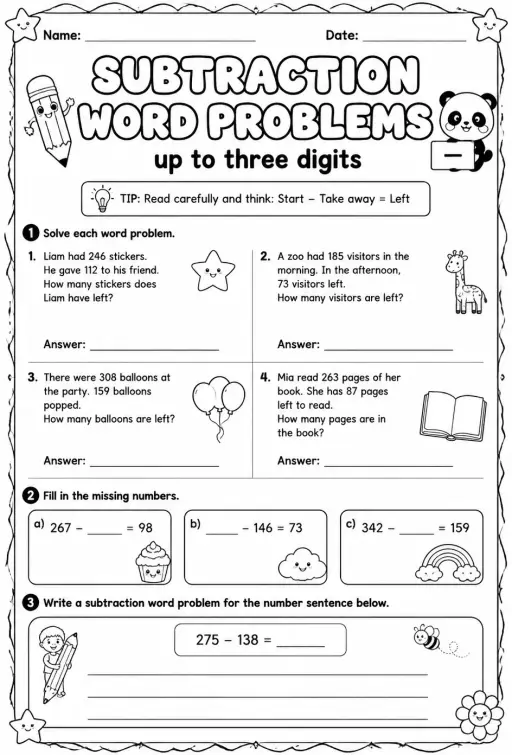
Subtraction word problems - up to three digits
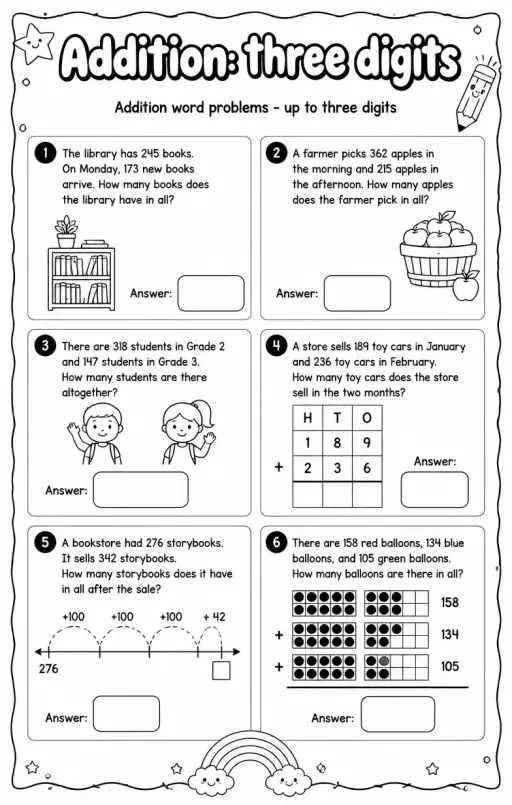
Addition word problems - up to three digits
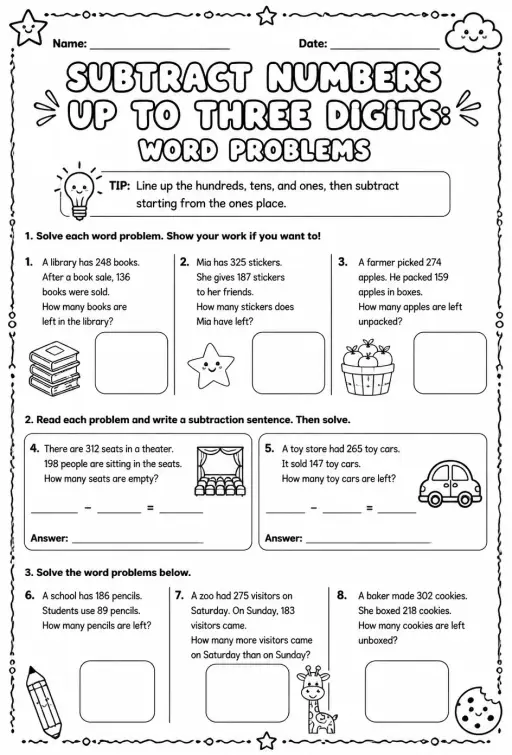
Subtract numbers up to three digits: word problems
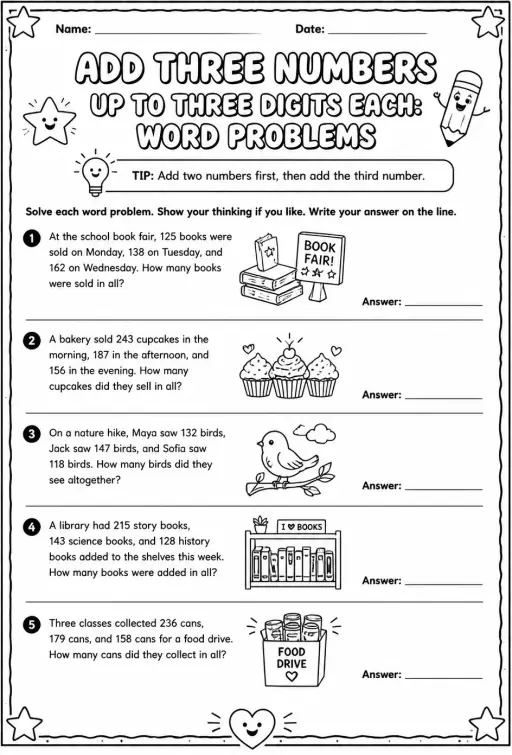
Add three numbers up to three digits each: word problems

Add two numbers up to three digits: word problems

Addition word problems - three numbers up to two digits each
Bring interactive science into your classroom
KiwiBee's free teacher workspace brings lesson planning, worksheets, classroom tools, and gradebook together in one place.
Start free and create your first class Home
Home All solutions
 Pricing
 About us
 KiwiBee for Non-profits
 Events & webinars
 For big organisations
 For schools
 For centers
 For team leaders
 For teachers
 AI and resources
 Resources
 Printable worksheets
 Lesson Packs
 Interactive simulations
 Teacher tools
 AI studio
 Ideas and research