
Circuit Builder
- Physics
Comments
Related to this simulation
Picked by meaning from games, worksheets, simulations, teacher tools and videos.
 SimulationCircuit Current Flow
 SimulationSeries and Parallel Circuits Interactive Simulation
 GameSimple Electrical Circuits Quiz for Grade 4
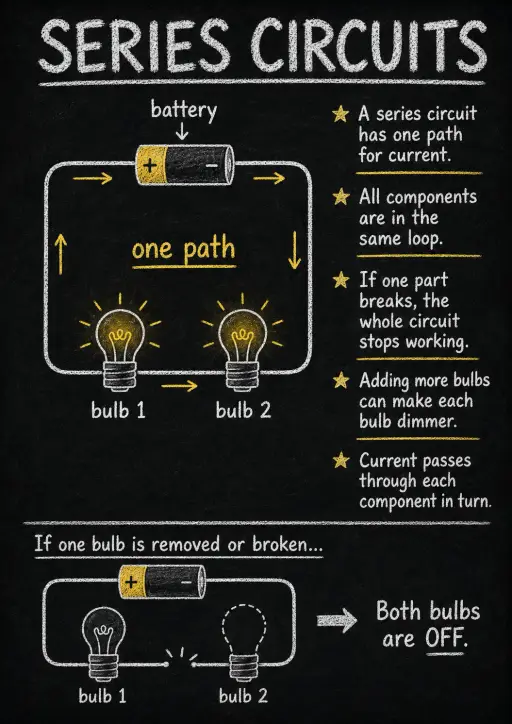 WorksheetSeries circuits Electricity and Magnetism Infographic
 GameA Circuit That Solves a Problem
 SimulationElectric Circuits Interactive Simulation
 GameElectricity in Everyday Life
 GameCircuits, Measurements and Faults
About this simulation
Students drag parts into slot 1, which is in series with the battery, and slots 2 and 3, which are two parallel branches. They click the switch to open or close the circuit and use a slider to set the battery between 1.5 and 12 volts. Readouts show battery voltage, total current, total power and total resistance, and bulbs glow according to their power. An empty slot is a gap, and above about 7.2 V a 4.5 V bulb burns out. Teachers can compare series and parallel brightness and apply V = I x R.
What students can explore
- Place one bulb in slot 1 and close the switch, then read Total current I and Total resistance.
- Add a second bulb in series and notice how both bulbs dim as the resistance grows.
- Fill the two parallel slots with bulbs and compare their brightness with the series version.
- Leave one slot empty to see a gap stop the current, or fill it with a wire piece.
- Raise the Battery slider past about 7 V to burn a bulb, then press Replace burnt bulbs.
Learning objectives
- 1Compare current and brightness in series and parallel arrangements.
- 2Apply V = I x R and P = V x I to readings from the circuit.
- 3Explain why adding bulbs in series raises total resistance.
- 4Describe how excess voltage damages a bulb filament.
Questions teachers ask
Is it free to use?
Yes. It is completely free, needs no sign-up, and runs in any modern browser, including classroom whiteboards, tablets and phones. Just open the page and start.
Why are bulbs dimmer in series?
In series the battery voltage is shared between the bulbs and the total resistance is higher, so less current flows through all of them. In parallel each branch gets the full voltage.
How do I build the circuit?
Drag a bulb or wire piece into one of the three slots, click the switch to close the circuit, and move the Battery slider to change the voltage. Watch the readouts for current and power.
What does an empty slot do?
An empty series slot is a gap, so no current flows at all. An empty parallel slot just removes that branch, while the other branch keeps working. A wire piece fills a slot with almost no resistance.
Embed this simulation
Drop it into your LMS, blog, or class site — free.
<iframe src="https://kiwibee.io/en/simulations/circuit-builder-bulbs-3d-simulation/embed" title="Circuit Builder | KiwiBee" loading="lazy" allowfullscreen style="width:100%;height:min(70vh,620px);min-height:420px;border:0;border-radius:16px"></iframe>Curriculum standards
Cambridge
- 9Pe.01Describe how current divides in parallel circuits.Cambridge Lower Secondary Science (0893) — Stage 9 › Physics › Electricity and magnetism
- 9Pe.02Know how to measure current and voltage in series and parallel circuits, and describe the effect of adding cells and lamps.Cambridge Lower Secondary Science (0893) — Stage 9 › Physics › Electricity and magnetism
Learning objectives © UCLES (Cambridge University Press & Assessment), quoted with attribution.
Bring interactive science into your classroom
KiwiBee's free teacher workspace brings lesson planning, worksheets, classroom tools, and gradebook together in one place.
Start free and create your first classWatch KiwiBee on YouTube
Short KiwiBee videos for teachers and schools. Subscribe, or follow KiwiBee wherever you are.
 Home
 All solutions
 Pricing
 About us
 KiwiBee for Non-profits
 Events & webinars
 For big organisations
 For schools
 For centers
 For team leaders
 For teachers
 Resources
 Printable worksheets
 Interactive simulations
 Teacher tools
 Ideas and research


