
Printable worksheet
Rules for a Shared Classroom
QuizSocial StudiesKindergartenEnglish
Practise more with these
Picked by meaning from games, worksheets, simulations, teacher tools and videos.
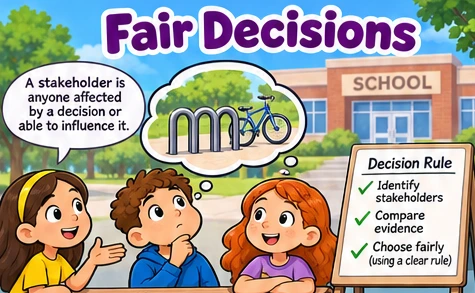 GameMake a Fair Community Decision
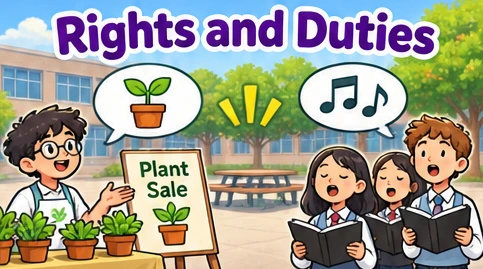 GameRights, Responsibilities and a Real Dilemma
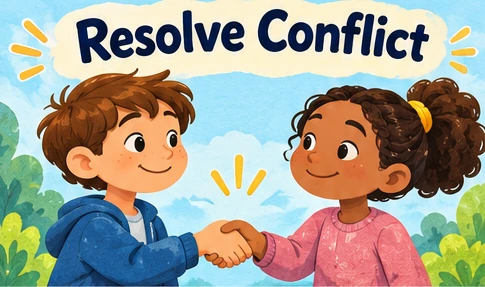 GameConflict Resolution in Everyday Scenarios
 GameLooking After Shared Spaces
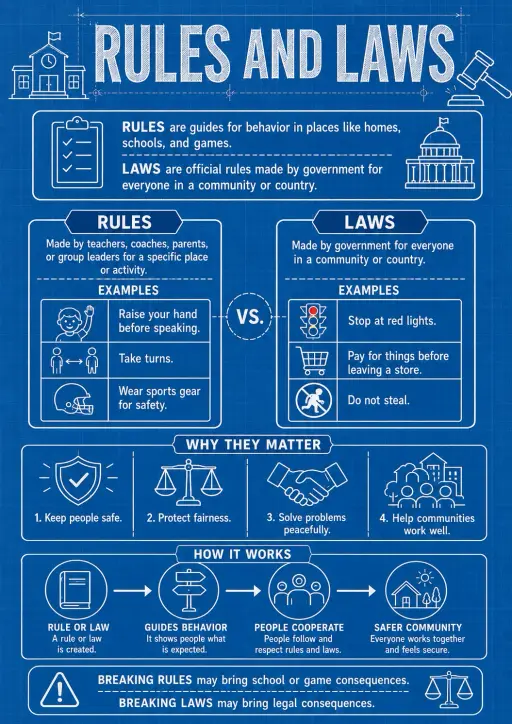 WorksheetRules and Laws Civics Infographic
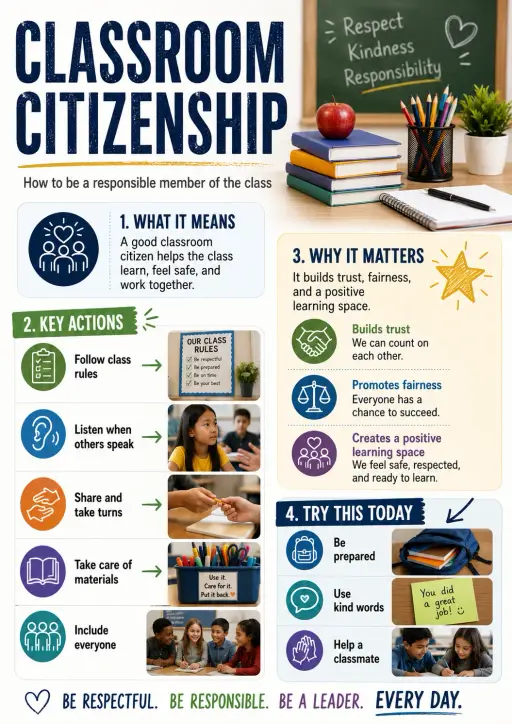 WorksheetClassroom Citizenship Infographic
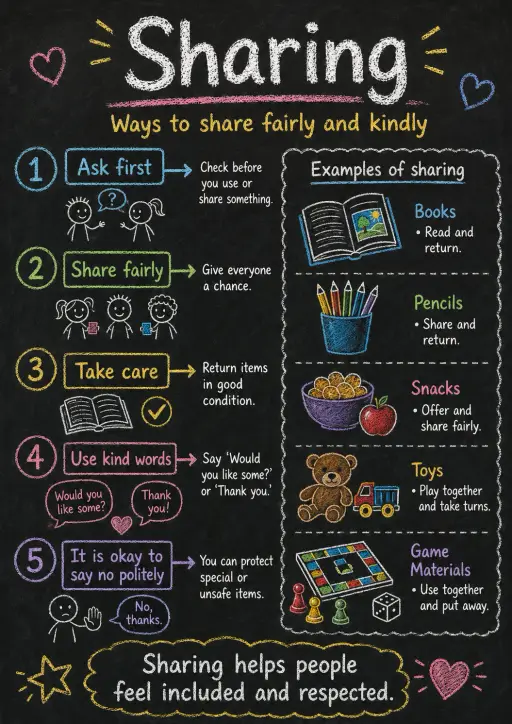 WorksheetSharing Friendship Infographic
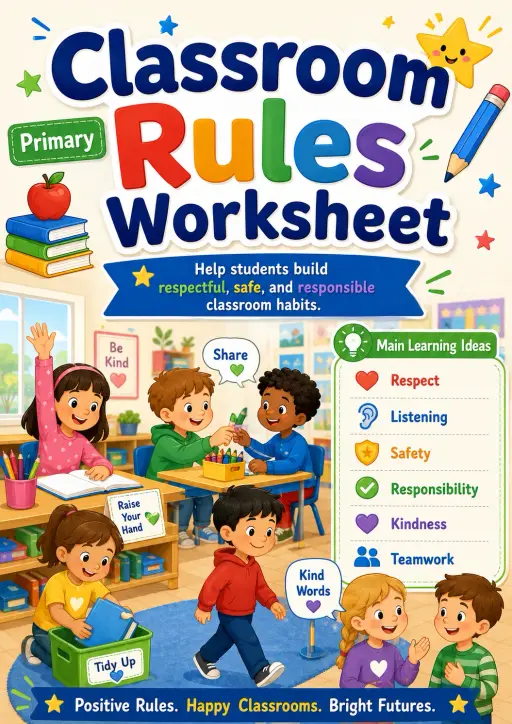 WorksheetClassroom Rules Worksheet Bundle
On this sheet
The words and questions from the game
- 1Why do many classrooms have the rule "Walk indoors"?To make everyone's shoes the same color · To keep people safe · To finish snack faster · To make the room louder
- 2Listen to the situation. The class needs a rule about walking carefully.True · False
- 3Which picture shows fair sharing?
- 4Paint dripped onto the floor. The rule says, "Put caps back on paint cups." Why is that rule helpful?It makes painting impossible · It lets one child use all the paint · It keeps the room cleaner · It changes every paint color to blue
- 5Follow this tablet-sharing checklist: check whose turn is first, use the tablet for that turn, and then pass it to the next child. Put the steps in order.
- 6Listen to the situation. Which rule is needed most?Listen when directions are given · Keep all pencils in alphabetical order · Wear boots during math · Use whisper voices at recess
- 7Mia and Ken both want the red marker. Which choice is fairest?The child who shouts loudest keeps it · The faster child keeps it all day · No one may use it now · They take turns using it
- 8Which picture shows one person taking too much instead of sharing fairly?
- 9Listen to the situation. This is a fair way to decide who goes first.True · False
- 10Sam and Jo both want the special chair in the reading corner. Which plan best solves the disagreement fairly?Both children shout until one gives up · Use a timer and switch halfway through reading time · Leave the chair empty all day · Let the same child keep it every day
- 11Listen to the situation. Which reason best supports the plan?Charts are only decorations · The chart makes the tallest child win · The chart gives everyone a turn · The louder child should win
- 12Follow this disagreement checklist: say the problem calmly, listen to both people, choose a fair plan, and then try the plan. Put the steps in order.
- 13If a solution helps only one child and ignores the other, it is fair.True · False
- 14The science table rule says everyone must stay at the table while using its tools. Only one magnifier is there. Kim says, “I found it first, so I keep it all daLee's plan, because it is fair and follows the table rule · Take the magnifier outside and let one child keep it · Kim's plan, because first always means all day · Hide the magnifier so nobody uses it
- 15A child says, "Fair means everybody gets the same job every day." What is wrong with that idea?Fair means one person keeps every job forever · Fair means jobs should never change · Fair means the tallest child decides · Fair can mean taking turns so different people get a chance
- 16Three groups need the same set of markers. Which rule lets every group use them fairly?Give each group a turn and return the markers after each turn. · Let one group keep the markers all day. · Give the markers only to the fastest group. · Ask each group to take the markers without checking.
About this worksheet
A printable worksheet made from the KiwiBee game “Rules for a Shared Classroom”. Open it in the free Worksheet Studio to choose the design and the sheet type, then print it or save a PDF.
Students identify why classroom rules exist, judge which choices are fair, and choose simple ways to solve disagreements.
- ms 214
- history civics
- connect rules to needs
- compare fair choices
- resolve a simple disagreement with reasons
 Home
 All solutions
 Pricing
 About us
 KiwiBee for Non-profits
 Events & webinars
 For big organisations
 For schools
 For centers
 For team leaders
 For teachers
 Resources
 Printable worksheets
 Interactive simulations
 Teacher tools
 Ideas and research


Comments