
Printable worksheet
Reaction Pathways and Evidence
QuizScienceGrade 11English

Practise more with these
Picked by meaning from games, worksheets, simulations, teacher tools and videos.
 GameA Reaction Designed for a Purpose
 GameMetabolism Across Linked Pathways
 GameReaction Evidence and Conservation
 GameEnergy Through a Designed System
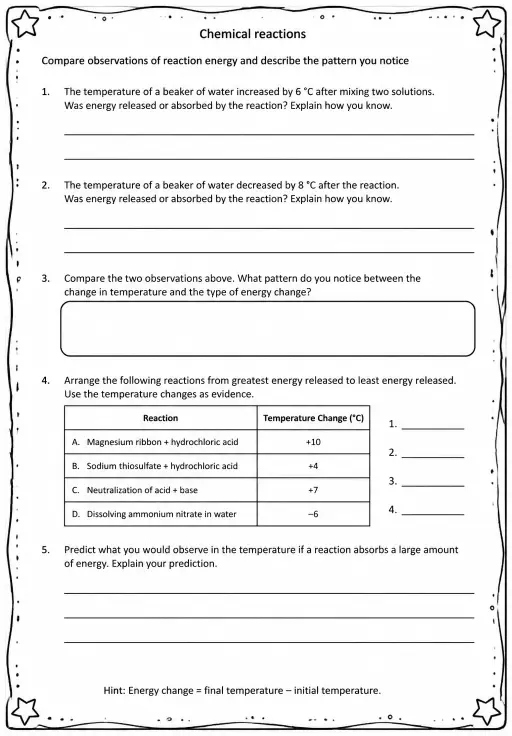 WorksheetCompare observations of reaction energy and describe the pattern you notice
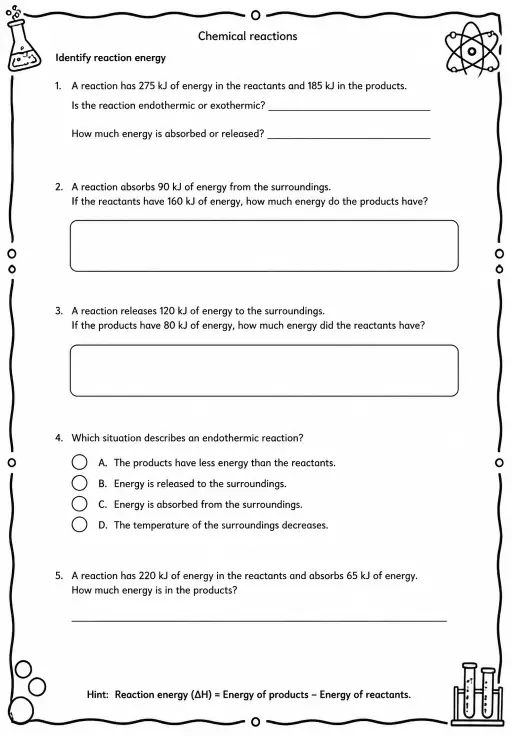 WorksheetIdentify reaction energy
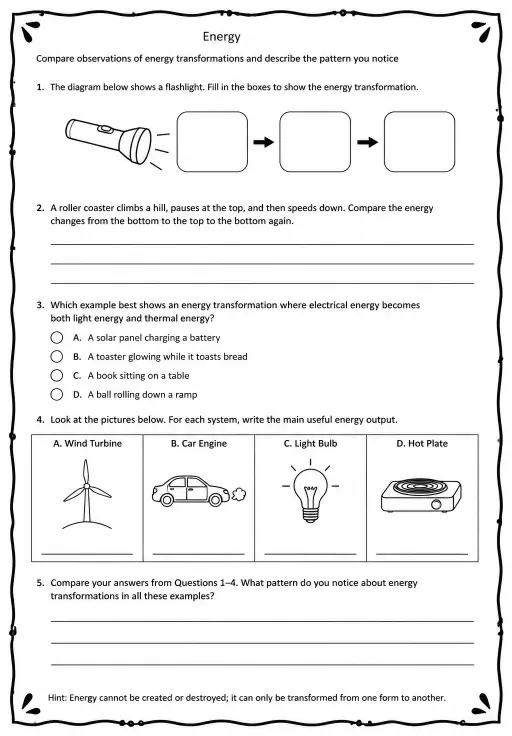 WorksheetCompare observations of energy transformations and describe the pattern you notice
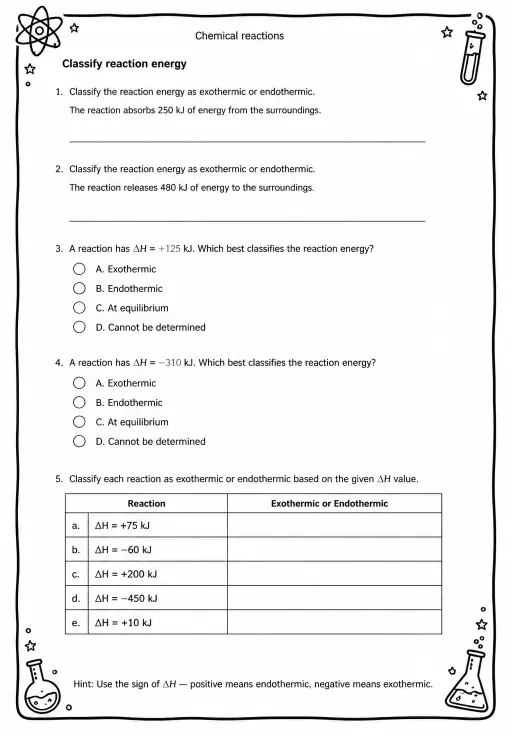 WorksheetClassify reaction energy
On this sheet
The words and questions from the game
- 1On a reaction energy profile, which vertical difference is the forward activation energy?From the products level down to the reactants level · From the reactants level up to the transition state peak · From the products level up to the transition state peak · From the reactants level down to the products level
- 2True or false: A catalyst changes the overall energy change, ΔH, of a reaction.True · False
- 3A reaction profile has two peaks separated by one valley. What does this show?One intermediate and one transition state · Two reactants and one catalyst · One transition state and two products · Two transition states and one intermediate
- 4A one-step reaction is exothermic. Order these from lowest energy to highest energy.
- 5Use the stipulated simplified comparison: equal relevant prefactors and other conditions, with the largest forward local activation barrier controlling the slowThe second step, because it has the larger activation energy · The first step, because the intermediate is above the reactants · The second step, because products are lower than reactants · Neither step; both have the same activation energy
- 6A reaction profile shows reactants at 25 kJ/mol, products at 70 kJ/mol, and a peak at 110 kJ/mol. Which statement is correct?The forward activation energy is 45 kJ/mol · The reaction is exothermic and ΔH = -45 kJ/mol · The reaction is endothermic and ΔH = +45 kJ/mol · The reverse activation energy is 85 kJ/mol.
- 7True or false: On a multistep reaction profile, an intermediate is shown by a local minimum between two peaks.True · False
- 8A reaction has a two-step energy profile. Order these positions along the reaction coordinate from start to finish.
- 9Two profiles have the same reactants and products, but the catalysed profile has a lower highest peak. Why does the catalyst increase the reaction rate?It changes an endothermic reaction into an exothermic reaction · It increases the amount of reactant present at the start · It makes the products lower in energy than before · It allows a larger fraction of particles to have enough energy to react
- 10A chemist measures initial rates for reaction A + B → products at constant temperature. Experiment 1: [A] = 0.10 mol/L, [B] = 0.10 mol/L, rate = 2.0 × 10^-3 molThe rate is first order in A and zero order in B · The rate is first order in both A and B · The rate is zero order in A and first order in B · The rate is second order in A and zero order in B
- 11Listen to the observation. Which trial had the larger average rate during the first 20 s?Trial B · There is not enough information to compare · Trial A · Both trials had the same average rate
- 12A reactant concentration changes like this at constant temperature: 0.80 mol/L at 0 s, 0.40 mol/L at 15 s, 0.20 mol/L at 30 s, and 0.10 mol/L at 45 s. Which conConstant rate: concentration drops by equal amounts each time. · The data are consistent with a constant half-life, as in first-order behaviour · The reaction is zero order because the concentration keeps decreasing · The reaction stops after 45 s
- 13Order these experiments from fastest initial rate to slowest initial rate.
- 14True or false: When two trials produce the same amount of product, the trial that reaches that amount in less time has the slower reaction rate.True · False
- 15A proposed mechanism for the overall reaction A + 2B → C is: Step 1: A + B → I (slow) Step 2: I + B → C (fast) If the slow step controls the rate, which rate larate = k[C] · rate = k[I][B] · rate = k[A][B] · rate = k[A][B]^2
- 16For the overall reaction 2X + Y → Z, experiments give the rate law rate = k[X]^2[Y]. A proposed mechanism is: Step 1: X + Y → I (slow) Step 2: X + I → Z (fast) Accept it, because all mechanisms fit any measured rate law · Reject it, because intermediate I appears in the mechanism · Accept it, because the slow step predicts rate = k[X]^2[Y] · Reject: slow step gives k[X][Y], not measured k[X]^2[Y].
- 17Listen to the evidence about a proposed mechanism. Which conclusion is supported?The evidence proves that no mechanism can be written · Q is an intermediate and M may be a catalyst · Q and M must both be products · Q is a product and M is a reactant
- 18A catalytic mechanism is proposed: Step 1: A + Cat → ACat Step 2: ACat + B → BCat Step 3: BCat → C + Cat Order these events from first to last.
- 19A proposed mechanism for D + F → G is: Step 1: D → E (slow) Step 2: E + F → G (fast) Which observation would most strongly contradict this mechanism?Doubling [F] at constant [D] doubles the initial rate · Species E is detected during the reaction · A small amount of E appears before G forms · The reaction has more than one step
- 20A reaction has reactants at 20 kJ/mol and products at -10 kJ/mol. Pathway U has one peak at 110 kJ/mol. Pathway V has a first peak at 70 kJ/mol, an intermediateThe rates prove that W has a larger ΔH than V · W is reasonably faster: its barrier is below V's highest barrier. · Pathway U must be the fastest because it is a one-step pathway · Pathway V should be faster than W because it has more steps
- 21Listen to the scenario. Which conclusion is best supported?Probably invalid: catalyst may not have entered Flask A. · The energy profile proves that Flask B should have been slower than Flask A · The catalyst definitely lowered ΔH · Equal rates strongly show catalysts never work for this reaction.
- 22Assume equal prefactors, starting energies, temperatures and other conditions. The largest local forward barrier limits rate. Order fastest→slowest initial rate
- 23For the overall reaction R + S → T, experiments show that doubling [R] doubles the initial rate, while doubling [S] does not change the initial rate. A proposedReject: every valid slow step must use both R and S. · The mechanism is impossible because a fast step cannot follow a slow step · Reject: intermediates can never occur in a mechanism. · Plausible: slow elementary R-only step fits rate data; its larger barrier fits.
- 24A student says, "This reaction must be fast because the products are much lower in energy than the reactants." Which evaluation is correct?Correct, because a large negative ΔH always means a low activation energy · Correct, because exothermic reactions do not need a mechanism · Incorrect: judge speed by barriers and pathways, not ΔH alone. · Incorrect: lower-energy products make reaction impossible.
About this worksheet
A printable worksheet made from the KiwiBee game “Reaction Pathways and Evidence”. Open it in the free Worksheet Studio to choose the design and the sheet type, then print it or save a PDF.
Students read energy profiles, compare reaction-rate evidence, and test whether proposed mechanisms fit the data.
- ms 145
- science
- interpret energy profiles
- compare kinetic data
- evaluate a proposed mechanism
 Home
 All solutions
 Pricing
 About us
 KiwiBee for Non-profits
 Events & webinars
 For big organisations
 For schools
 For centers
 For team leaders
 For teachers
 Resources
 Printable worksheets
 Interactive simulations
 Teacher tools
 Ideas and research


Comments