
Printable worksheet
Probability at the School Fair
QuizMathematicsGrade 6English
Practise more with these
Picked by meaning from games, worksheets, simulations, teacher tools and videos.
 GameProbability for Beginners
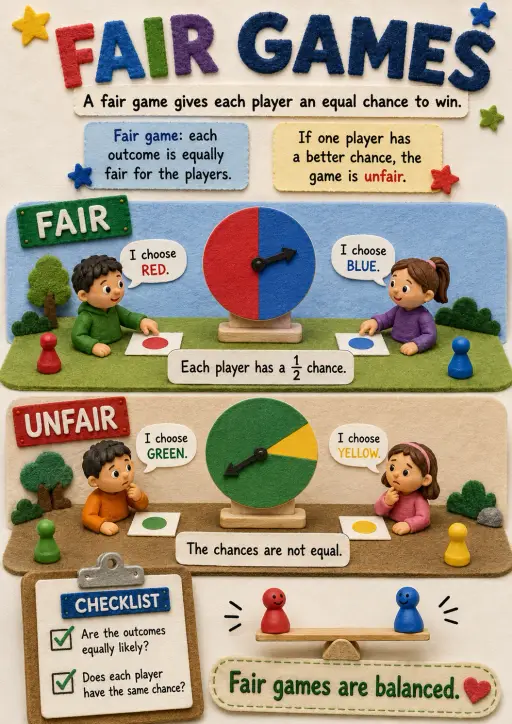 WorksheetFair games Probability Infographic
 GameA Fair Test Under Real Constraints
 GameRisk, Frequency and Conditional Evidence
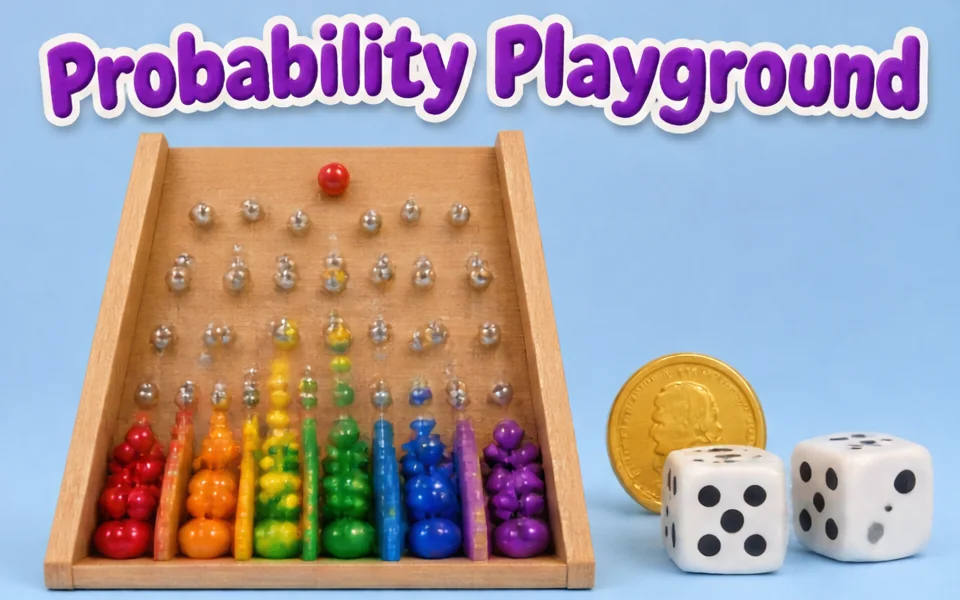 SimulationProbability Playground
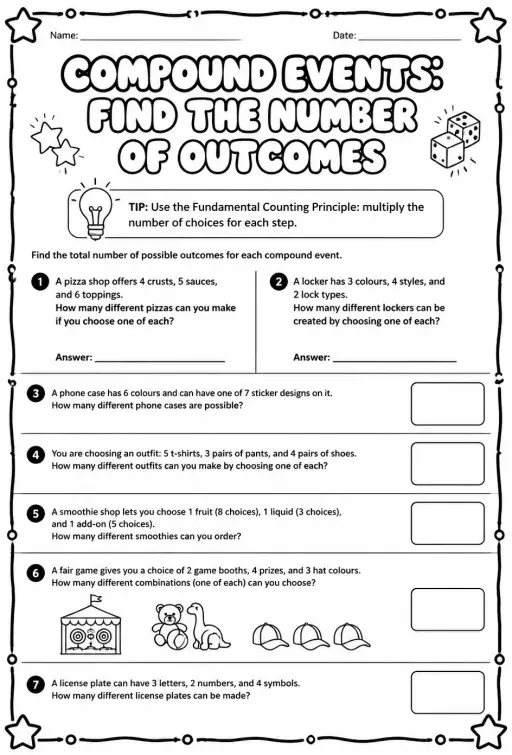 WorksheetCompound events: find the number of outcomes
 WorksheetCompound events: find the number of outcomes
 GameChance Without Guarantees
On this sheet
The words and questions from the game
- 1Look at the spinner. How many possible results are there from one spin?4 · 8 · 3 · 2
- 2A student says this bag has 6 different color outcomes when one marble is drawn. Is the statement true?True · False
- 3Assume each equal spinner section is equally likely. Which picture shows red and blue are equally likely on one spin?
- 4A game uses the numbered spinner and one coin toss. How many total outcomes are possible?6 · 12 · 10 · 8
- 5Assume each equal spinner section is equally likely. Which picture shows blue on exactly 1 of 4 equal sections?
- 6Use this method: count wins first, then total plays, write the ratio, and simplify. Put the supplied steps in that order.
- 7This chart shows 24 spins of a fair 3-color spinner. What is the experimental probability of landing on red?9/24 · 15/24 · 7/24 · 1/3
- 8A fair spinner has 3 equal colours. Red appears 9 times in 24 spins. That limited result alone does not prove the spinner is unfair.True · False
- 9For the coin data, how does the experimental probability 28/50 compare with the theoretical probability 1/2?28/50 is twice 1/2. · 28/50 is greater than 1/2. · 28/50 is equal to 1/2. · 28/50 is less than 1/2.
- 10Listen to the results of a marble-draw experiment with replacement. What is the experimental probability of drawing blue?7/5 · 7/12 · 1/2 · 5/12
- 11Assume each equal spinner section is equally likely. A game pays the same prize for red as for blue. Using this spinner, is that color game fair?Yes, because red has probability 3/4 and blue has 1/4. · No, because red appears first on the spinner. · Yes, because red and blue each have probability 1/2. · No, because there are 4 sections.
- 12Assume each equal spinner section is equally likely. On this spinner, red is more likely than blue.True · False
- 13Assume each equal spinner section is equally likely. Malik says the blue prize should have probability 3/4. Which picture matches his claim?
- 14Listen to the host's explanation. Is the host correct that the game is fair?True · False
- 15A random draw selects each marble equally likely from a bag with 2 red and 1 blue. An independent fair coin is then tossed. What is the theoretical probability 1/6 · 2/3 · 1/2 · 1/3
- 16A student says the theoretical probability of red and heads is 1/2 because the coin has 2 outcomes. What is the student's mistake?The student should have added 2/3 and 1/2. · The student should have used experimental probability only. · The student ignored the chance of drawing red from the bag. · The student should have multiplied 2/3 by 2.
- 17Use this checking method: find the theoretical probability, find the experimental probability, compare them, then evaluate the claim. Order the supplied steps.
- 18A wheel has 8 equal sections numbered 1 to 8. You win on a prime number. In 40 spins, a prime came up 18 times. Which statement is best supported?Theoretical: 4/8 = 1/2. The slightly lower 18/40 alone does not prove unfairness. · The game is definitely unfair because 18/40 is not exactly 1/2. · The theoretical probability is 5/8 because 1 is prime. · The theoretical probability is 3/8 because 2 is not prime.
About this worksheet
A printable worksheet made from the KiwiBee game “Probability at the School Fair”. Open it in the free Worksheet Studio to choose the design and the sheet type, then print it or save a PDF.
Students explore school-fair games by listing possible outcomes, comparing expected and observed results, and deciding whether a game is fair.
- ms 026
- mathematics
- enumerate outcomes
- compare experimental and theoretical probability
- evaluate a fairness claim
 Home
 All solutions
 Pricing
 About us
 KiwiBee for Non-profits
 Events & webinars
 For big organisations
 For schools
 For centers
 For team leaders
 For teachers
 Resources
 Printable worksheets
 Interactive simulations
 Teacher tools
 Ideas and research


Comments