
Printable worksheet
Pressure in Fluids and Devices
QuizScienceGrade 9English

Practise more with these
Picked by meaning from games, worksheets, simulations, teacher tools and videos.
On this sheet
The words and questions from the game
- 1Pressure is calculated from force and area. Which equation is correct?pressure = force ÷ area · pressure = force × area · pressure = area ÷ force · pressure = force + area
- 2True or false: If the same force acts on a smaller area, the pressure becomes larger.True · False
- 3A student pushes down with a force of 60 N on a surface area of 0.20 m². What pressure is produced?3 Pa · 12 Pa · 1200 Pa · 300 Pa
- 4Order these contact situations from highest pressure to lowest pressure. In all four cases the force is the same.
- 5A box with mass 12 kg rests on a table. Take gravitational field strength as 10 N/kg, so its weight is 120 N. If the contact area is 0.40 m², what pressure does160 Pa · 3 Pa · 300 Pa · 48 Pa
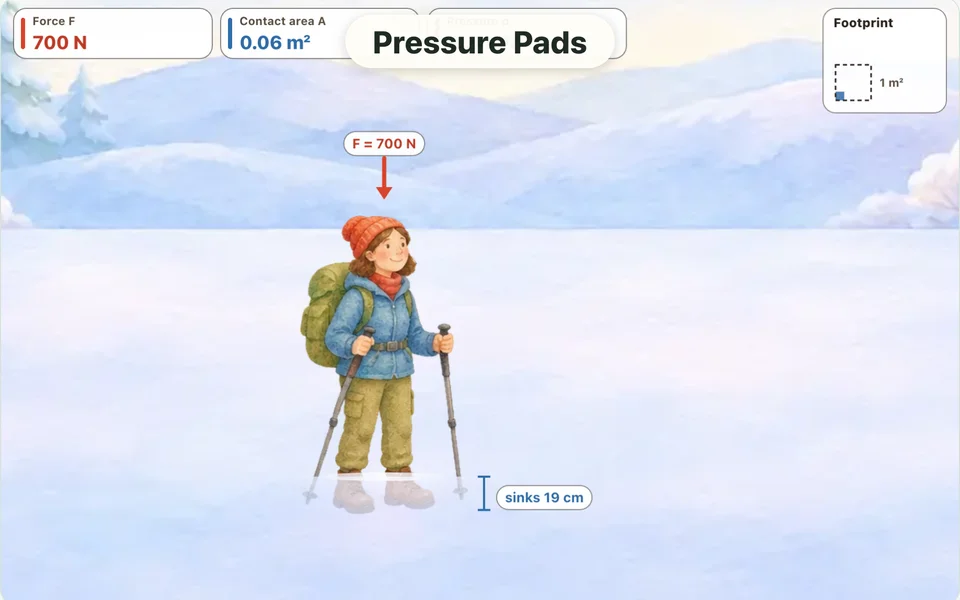
- 6A hiker sinks less into soft snow when wearing snowshoes. Which explanation is correct if the hiker's weight stays the same?Snowshoes remove the effect of gravity. · Snowshoes increase the area, so the pressure on the snow decreases. · Snowshoes increase the force on the snow. · Snowshoes decrease the area, so the pressure increases.
- 7True or false: If both the force and the contact area double, the pressure stays the same.True · False
- 8Four loads are supported on the floor with the stated weights and contact areas. Each brick mentioned weighs 20 N. Which arrangement produces the greatest pressTwo bricks stacked, bottom contact area 0.030 m² · Two bricks side by side, total contact area 0.040 m² · One brick standing on a smaller face, contact area 0.010 m² · One brick flat on its largest face, contact area 0.020 m²
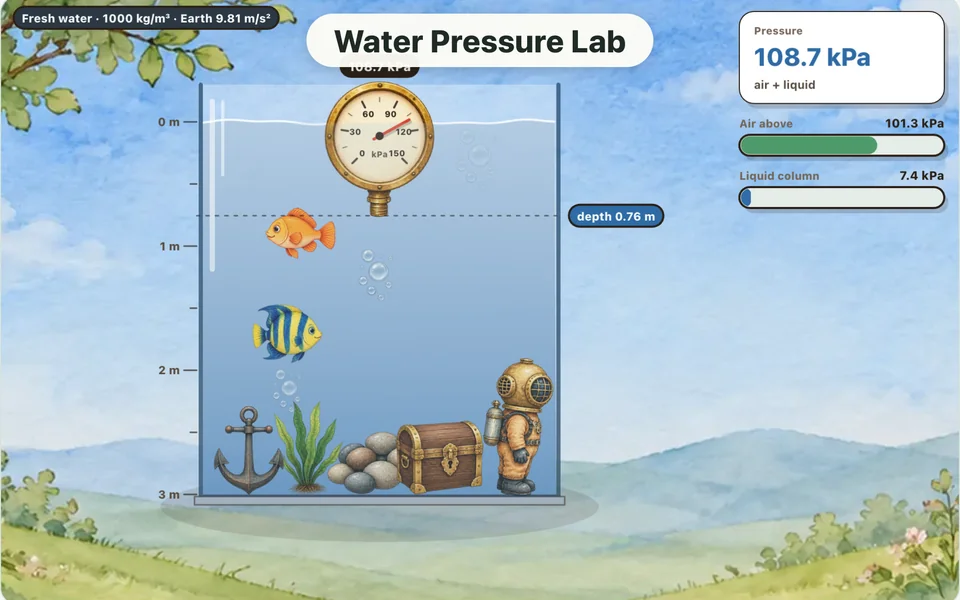
- 9Listen to the observation. Which conclusion is supported about water pressure in the tank?Water pressure depends only on the color of the tank. · Water pressure decreases with depth. · Water pressure is the same at all depths. · Water pressure increases with depth.
- 10In the same liquid, points A and B are both 2.0 m below the surface, but A is near the left wall and B is near the right wall. Which statement is correct?Pressure cannot be compared without the tank width. · Equal pressure: same depth in the same liquid. · Pressure is greater at A because it is nearer the wall. · Pressure is greater at B because it is farther from the wall.
- 11Order these positions in still water from greatest pressure to least pressure.
- 12True or false: In a still liquid, pressure on a vertical wall is greater near the bottom than near the top.True · False
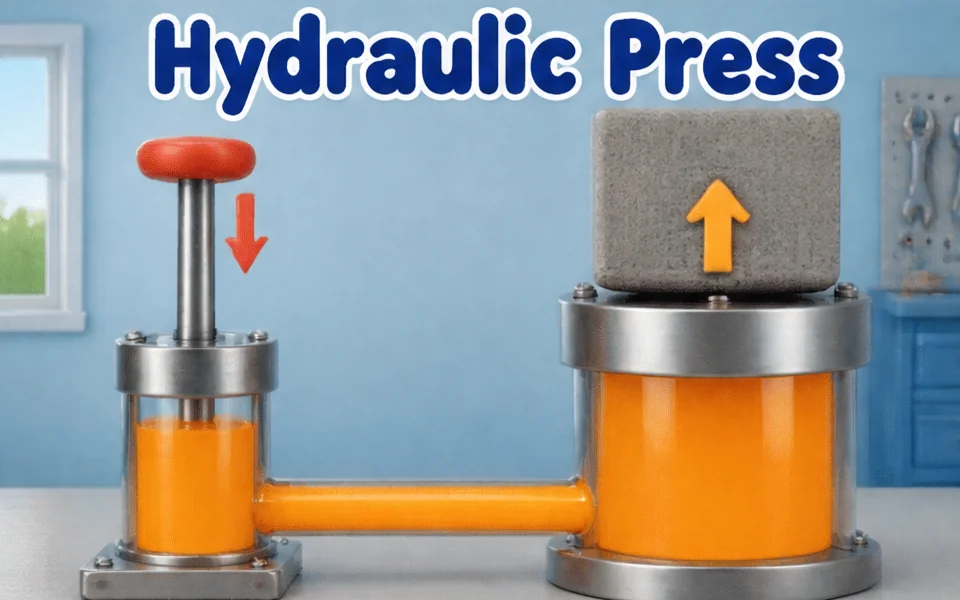
- 13A hydraulic lift has a small piston area of 0.010 m² and a large piston area of 0.50 m². If a force of 40 N is applied to the small piston and losses are ignore2000 N · 20 N · 400 N · 2 N
- 14Listen to the hydraulic explanation. Which evaluation is correct?The explanation is wrong because liquids cannot transmit pressure. · Supported: equal pressure gives more force on a larger area. · Supported: a larger piston always creates more pressure. · The explanation is wrong because pressure must be lower on the larger piston.
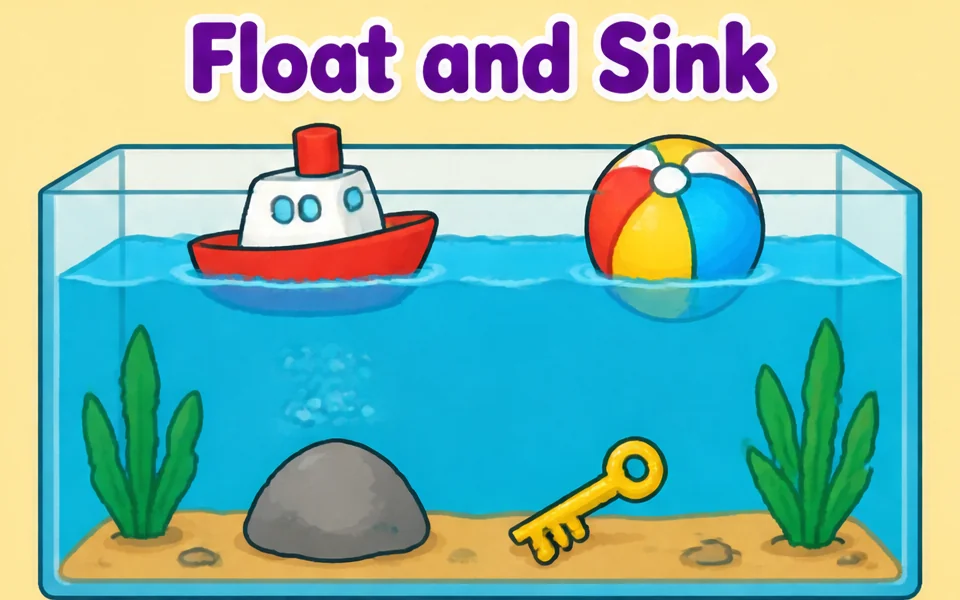
- 15A student says, 'A steel ship floats because steel is lighter than water.' Which evaluation is correct?Correct, because floating depends only on the color of the object. · Correct, because all metals are less dense than water. · Wrong: the whole ship is less dense than water; buoyancy balances weight. · Incorrect, because buoyant force acts only on objects that are already floating.
- 16Object X weighs 8 N in air. When fully submerged in water, a spring balance reads 5 N. What is the buoyant force on X?3 N · 5 N · 13 N · 8 N
- 17A class tests the claim 'A larger piston gives a larger output force in an ideal hydraulic system.' Order the steps for a fair procedure from first to last.
- 18An underwater door has dry air inside and water outside. The door opens outward, against the water. Compared with the surface, why can more opening force be neePressure does not matter because force and area are unrelated. · The required force decreases with depth because the button area stays constant. · The deeper button needs more force only because the water is darker. · Pressure rises with depth, so the same area can need more opening force.
- 19Listen to the scenario. Which diagnosis best explains why the raft sinks lower after the crate is loaded?Floating objects always become denser than the liquid below. · The raft sinks lower because water pressure is smaller deeper down. · Added weight needs more displaced water until buoyancy balances weight. · The raft sinks lower because buoyant force disappears when mass increases.
- 20True or false: In a still lake, if two equal-size inspection hatches are at different depths, the deeper hatch experiences a greater force from the water becausTrue · False
- 21A student says, 'A wide boat floats better because the water pushes up less on each square metre.' Which evaluation is most accurate?Width may spread load/change draft; displaced-water lift = weight. · Correct, because boat width removes the need for displaced water. · Incorrect, because water exerts no pressure on floating objects. · Correct, because lower pressure always means a larger buoyant force.
- 22An underwater tool operates at 4 m depth. In its ideal hydraulic actuator, the pressure DIFFERENCE across the output piston is 200000 Pa after accounting for exCannot hold: 4 m depth cancels pressure in the sealed line. · Can hold: 600 N output exceeds the 500 N load. · Cannot hold: water depth makes piston force zero. · Only at the surface: liquid pressure cannot exert piston force.
About this worksheet
A printable worksheet made from the KiwiBee game “Pressure in Fluids and Devices”. Open it in the free Worksheet Studio to choose the design and the sheet type, then print it or save a PDF.
This quiz builds from pressure basics to depth in liquids, then checks hydraulic and buoyancy explanations before combining all ideas in new situations.
- ms 139
- science
- connect force area and pressure
- interpret depth effects
- evaluate a hydraulic or buoyancy explanation
 Home
 All solutions
 Pricing
 About us
 KiwiBee for Non-profits
 Events & webinars
 For big organisations
 For schools
 For centers
 For team leaders
 For teachers
 Resources
 Printable worksheets
 Interactive simulations
 Teacher tools
 Ideas and research


Comments