
Printable worksheet
Model Selection in Mechanics
QuizScienceGrade 11English

Practise more with these
Picked by meaning from games, worksheets, simulations, teacher tools and videos.




On this sheet
The words and questions from the game
- 1A 0.50 kg puck slides across a nearly level air table and collides with another puck. Which assumption is most reasonable during the short collision?The total momentum of the two-puck system is approximately conserved. · The masses of the pucks change during impact. · No forces act on either puck during the collision. · The kinetic energy of each puck stays constant through the collision.
- 2True or false: If a block slides on a rough floor, you may safely assume its mechanical energy stays constant.True · False
- 3A student models a falling ball by ignoring air resistance. Which observation would make that assumption least reasonable?The ball is dense and small. · The ball falls only 0.40 m. · The ball quickly reaches an almost constant speed while falling. · The ball is released from rest.
- 4Listen to the observation. Which conclusion is supported?Air resistance is negligible throughout the motion. · A constant-speed model is supported after the first few seconds. · Momentum of the skydiver-Earth system is zero. · Mechanical energy of the skydiver must be increasing.
- 5Measured losses are fractions of initial energy. Order best→worst mechanical-energy-conservation approximations.
- 6A 2.0 kg block slides from rest down a ramp and across a horizontal table. The ramp is smooth, but the table is rough. Which model is most suitable?Use momentum conservation for the entire motion. · Assume the block's mass decreases on the table. · Use mechanical energy conservation for the entire motion with no extra terms. · Conserve mechanical energy on ramp; include friction on table.
- 7Two carts move on a straight, level, low-friction track. Cart A has mass 1.0 kg and speed 2.0 m/s to the right. Cart B has mass 1.0 kg and speed 1.0 m/s to the Total momentum only · Both total momentum and total kinetic energy in every sticking collision · Speed of each cart · Total kinetic energy only
- 8True or false: For a cart launched by a compressed spring on a level track, it is reasonable to include spring potential energy in the model if friction is statTrue · False
- 9A student is choosing a model for two carts that collide on a straight track and bounce apart. Which extra piece of information is most important for deciding wWhether the carts have the same colour · Whether each cart started from rest earlier in the lesson · Whether the collision is approximately elastic · Whether the track is exactly 2.0 m long
- 10A 1.5 kg pendulum bob is released from rest. A student ignores air resistance and friction at the pivot. Which statement matches that model?The bob's mass must increase at the bottom of the swing. · The bob's momentum is constant during the whole swing. · The bob's acceleration is zero during the whole swing. · The bob's mechanical energy is approximately conserved during the swing.
- 11A 0.40 kg ball is dropped from a height of 1.8 m. Air resistance is negligible. To find its speed just before hitting the ground, which method is most direct?Use momentum conservation for the ball alone. · Use conservation of mechanical energy between release and impact. · Use momentum conservation of the ball-ground system during the fall. · Assume the speed stays constant during the fall.
- 12Two carts collide and stick together on a level low-friction track. To find their common speed immediately after impact, which method is most direct?Conservation of momentum for the two-cart system · Conservation of mechanical energy only · A constant-acceleration model during the whole collision · A spring-energy model
- 13Listen to the scenario. Which statement correctly compares the methods?Neither momentum nor energy methods can apply. · Conserve momentum for both the spring launch and the hill climb. · Negligible friction: energy for spring launch and hill climb. · Use momentum only because the cart is always moving.
- 14A ballistic-pendulum style experiment has two stages: first a lump of putty hits and sticks to a hanging block, then the combined mass swings upward. Which methUse momentum for both stages. · Use mechanical energy for both stages. · Use mechanical energy for the collision, then momentum for the upward swing. · Use momentum for the collision, then mechanical energy for the upward swing.
- 15True or false: In every collision where momentum is conserved, total kinetic energy must also be conserved.True · False
- 16A student claims that a cart on a rough horizontal track keeps the same mechanical energy because its height does not change. The cart starts at 4.0 m/s and is Supported: constant height guarantees constant mechanical energy. · Unsupported: stopping shows non-conservative work, e.g. friction. · The claim is supported because momentum is conserved for the cart alone. · The claim is not supported because the cart's mass must have changed.
- 17Two 1.0 kg carts move toward each other on a low-friction track. Cart A moves right at 3.0 m/s. Cart B moves left at 1.0 m/s. A student predicts that if they stCheck whether the carts have the same colour. · Compare predicted final momentum with initial total momentum. · Check whether the masses add to 1.0 kg. · Check whether each cart keeps its original speed.
- 18Listen to the observation. Which evaluation of the student's model is supported?The model is correct because the cart eventually stopped. · Low launch speed supports the negligible-friction model. · Negligible friction is unsupported: rise was far below prediction. · The model is correct because momentum is always conserved on a hill.
- 19A student predicts a result for a collision. Order these checks from first to last for evaluating the solution against observations.
- 20True or false: If measured collision data disagree slightly with a prediction, the conservation law used must always be wrong.True · False
- 21A 0.20 kg cart is launched by a spring on a level low-friction track at 4.0 m/s. It then collides and sticks to a 0.30 kg cart at rest. Which plan correctly comNo friction: spring energy if needed; momentum when they stick. · Use energy only for both stages because speed is involved. · Ignore the spring and assume the two-cart momentum starts at zero. · Use momentum for the spring launch and energy for the sticking collision.
- 22A 0.50 kg block starts from rest at height 0.80 m on a smooth ramp, reaches the bottom, and collides with a 1.50 kg cart at rest on a level low-friction track. 0.5 m/s · 4.0 m/s · 2.0 m/s · 1.0 m/s
- 23In a lab, a 0.50 kg block starts from rest at height 0.80 m on a smooth ramp, then sticks to a 1.50 kg cart at rest on a level low-friction track. A student preThe prediction is too large; the correct post-collision speed is 1.0 m/s. · The prediction is correct because the block reaches the bottom at 2.0 m/s. · The prediction cannot be checked without the block's colour. · The prediction is too small; the correct post-collision speed is 4.0 m/s.
- 24A cart is launched by a spring, travels across a short rough patch, then collides elastically with an identical cart at rest. Which modelling choice is correct?Conserve kinetic energy from compressed spring through rough patch. · Use momentum for the spring launch and ignore observations at the end. · Spring energy, rough loss, elastic impact; test observed speeds. · Ignore the rough patch because elastic collisions conserve kinetic energy.
- 25Listen to the scenario. A student solves a problem by using momentum conservation from the top of a smooth ramp all the way to the final joined motion after a sThe student should have conserved kinetic energy during the sticking collision. · Use ramp energy first: gravity changes momentum before the collision. · The student should have ignored the collision completely. · The student should have assumed the block's mass became zero at impact.
About this worksheet
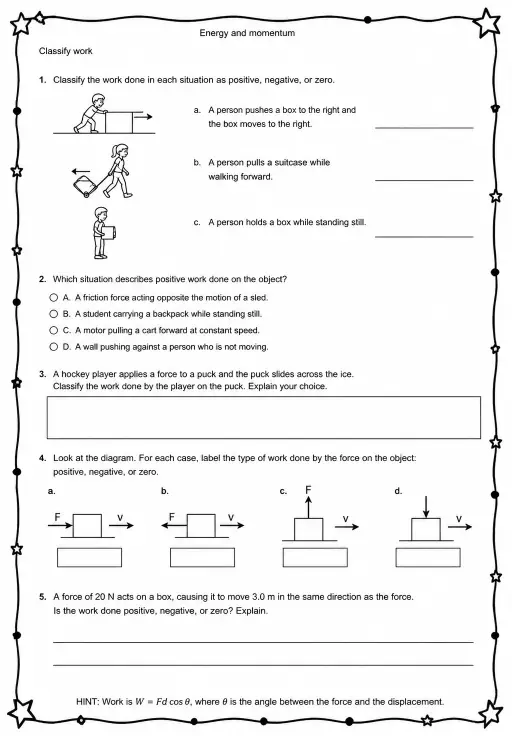
A printable worksheet made from the KiwiBee game “Model Selection in Mechanics”. Open it in the free Worksheet Studio to choose the design and the sheet type, then print it or save a PDF.
Students select suitable mechanics models, decide when momentum or energy methods are appropriate, and test solutions against given observations and data.
- ms 141
- science
- choose assumptions
- compare momentum and energy methods
- evaluate a solution against observations
 Home
 All solutions
 Pricing
 About us
 KiwiBee for Non-profits
 Events & webinars
 For big organisations
 For schools
 For centers
 For team leaders
 For teachers
 Resources
 Printable worksheets
 Interactive simulations
 Teacher tools
 Ideas and research


Comments