
Printable worksheet
How Animals Use Signals to Respond
QuizScienceGrade 3English

Practise more with these
Picked by meaning from games, worksheets, simulations, teacher tools and videos.


On this sheet
The words and questions from the game
- 1A moth turns after a light is switched on. What is the stimulus in that description?The observer's shoe size · The switched-on light · The moth’s turn · The observer’s notebook
- 2A response is an observed change in behaviour following a stimulus.True · False
- 3A fish moves away when a shadow passes overhead. Which observation is directly recorded?The fish moved closer to the shadow. · The fish planned a holiday · The fish moved away after the shadow · The shadow felt angry
- 4A model animal turns toward a flashing display but not toward a recorded call. Which signal type produced the recorded turn?Visual · Chemical · Touch alone · Sound
- 5Order these logged events by the stated times.
- 6Listen to the report. What is the recorded response?The bird’s private plan · The speaker becoming alive · The bird walks away from the speaker. · A head turn toward the speaker
- 7An ant follows a chemical trail left on the ground by other ants. Which signal channel is involved?Visual light flashes · A printed map · Chemical · An electrical cable connected to the ant
- 8A sound signal and a chemical trail always travel and persist in exactly the same way.True · False
- 9A bird call is masked by loud background noise. Which change directly targets that problem in a model test?Reduce background noise while keeping the call the same · Change only the notebook cover · Remove all observations · Paint the speaker while leaving the masking noise unchanged.
- 10In a supplied test, an insect responds to a scent behind an opaque screen. Which result is compatible with a chemical channel?The screen proves the insect read words · It can respond without seeing the scent source · An opaque screen guarantees that no scent can pass. · All signals must be visible
- 11An animal approaches a speaker after a call. Which statement goes beyond the direct observation?It moved toward the speaker · The speaker was nearer after the animal approached. · A call was played before it moved · It approached because it wanted to make a friend
- 12Listen. Which conclusion is supported without inventing an intention?The claw was raised after the model moved nearby · The crab definitely wanted to teach a lesson · The crab read the researcher’s plan · The crab's claw was never raised.
- 13Repeated responses to a signal can provide evidence of detection without proving a human-like intention.True · False
- 14An animal does not respond in one trial. What can be concluded?It cannot detect that signal under any conditions · No response was recorded in that trial · It has no senses · It is proved to respond on every later trial.
- 15A sound trial uses a louder call and a closer speaker than a comparison trial. What limits the explanation?No comparison is possible in any science · The speaker distance stayed identical. · Only one factor changed · Two relevant factors changed
- 16Order these dated investigation records.
- 17Which follow-up best checks whether background noise affects response to a call?Ask whether the speaker has a favourite colour · Change noise, call and animal species together · Repeat matched trials that vary only the background noise · Use a different call each time and never record responses.
- 18A class records fewer turns toward calls in noise and the same turns toward flashes. Which interpretation is appropriately limited?Noise may have affected the sound response in these conditions. · Noise stopped all senses in all animals · The animals consciously disliked science · The same reduction was recorded for light flashes.
About this worksheet
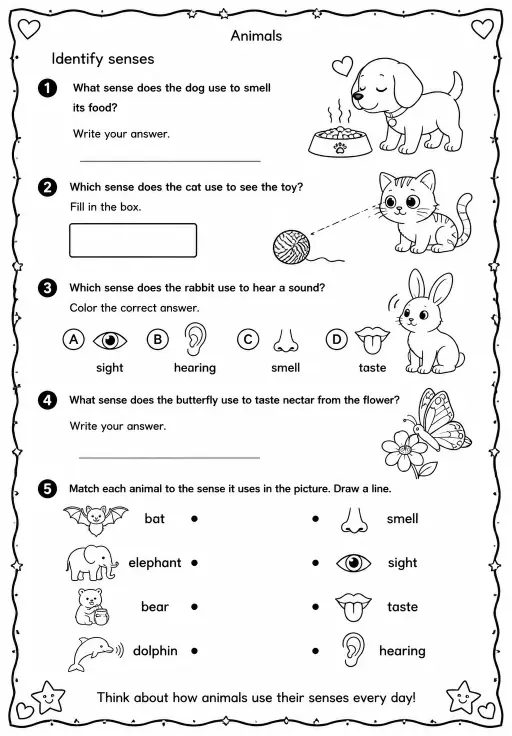
A printable worksheet made from the KiwiBee game “How Animals Use Signals to Respond”. Open it in the free Worksheet Studio to choose the design and the sheet type, then print it or save a PDF.
A 24-question progressive quiz connecting three skills through explicit observations, data and scenarios.
- ms 160
- biology
- identify a stimulus and a response
- compare visual sound and chemical signals in supplied scenarios
- use observations to distinguish detection from an inferred intention
 Home
 All solutions
 Pricing
 About us
 KiwiBee for Non-profits
 Events & webinars
 For big organisations
 For schools
 For centers
 For team leaders
 For teachers
 Resources
 Printable worksheets
 Interactive simulations
 Teacher tools
 Ideas and research


Comments