
Printable worksheet
Everyday Needs and Thoughtful Choices
QuizOtherKindergartenEnglish

Practise more with these
Picked by meaning from games, worksheets, simulations, teacher tools and videos.

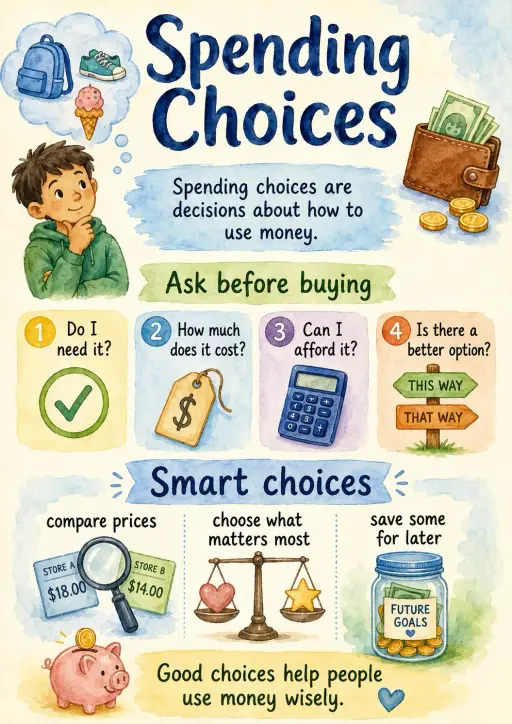
On this sheet
The words and questions from the game
- 1For this model trip, the required items are drinking water and a travel ticket. A sticker is optional. Which is a required item?Drinking water · Sticker · Either is optional under the rules · A decorative ribbon
- 2An optional item can still be enjoyable without being required for the stated task.True · False
- 3Why should “need” be connected to a stated situation?A preferred color is always required for every task. · Every item has the same role in every situation · The same item can be required for one task but optional for another · Preferences never exist
- 4A class has 10 model tokens. Water costs 3 and the required ticket costs 5. Can it buy both?No, the total is 15 · Yes, the total is 8 · Only if 3 plus 5 equals 10 · No, because the total is 11.
- 5The planning routine is first list requirements, then total their costs, then consider extras. Order it.
- 6Buying an optional extra first guarantees enough remains for required items.True · False
- 7Two suitable required notebooks cost 2 and 4 tokens. The rule is to minimise cost while meeting the notebook requirement. Which fits?The 4-token notebook · Buy both notebooks for 6 tokens. · Neither because their colours differ · The 2-token notebook
- 8Choosing the lower-price suitable item proves the other item is bad for every person.True · False
- 9The budget is 8 tokens. Required items total 7. An optional extra costs 2. Can it be added without changing the budget?Yes, because 7 plus 2 is 8 · Yes, because optional means free · Yes, because the total would be 10. · No
- 10Which reason explains a choice under the rule “meet both requirements within 10 tokens”?This option has my favourite label but omits a requirement · This option costs 12, which exceeds the limit · This option meets both and costs 9 · This option costs 8 but meets neither requirement.
- 11Order these distinct costs from least to greatest.
- 12A plan can be revised when a required item’s cost changes.True · False
- 13A required ticket rises from 5 to 7 tokens. What should the planner do first?Spend the old price without checking the new ticket cost. · Recalculate the required-item total · Assume the old total still applies · Delete the water requirement without explanation
- 14Which final explanation is supported?I chose the option that meets the stated needs and stays within the available tokens · I chose it, so everyone must choose it · The most expensive option always meets every need. · Optional preferences are always wrong
- 15A class has 10 tokens. It must spend 7 on materials and save 2 for repairs. Which extra fits the plan?Paint costing 2 tokens · A label costing 1 token · A ribbon costing 3 tokens · A display costing 4 tokens
- 16A class has 12 tokens. A required item costs 9, and a decoration costs 4. Which choice meets the requirement and stays within the budget?Buy both items. · Buy the required item and save the 3 tokens left. · Buy only the decoration. · Spend 4 on decoration and save 8 for the required item.
About this worksheet
A printable worksheet made from the KiwiBee game “Everyday Needs and Thoughtful Choices”. Open it in the free Worksheet Studio to choose the design and the sheet type, then print it or save a PDF.
A 20-question progressive quiz connecting three skills through explicit observations, data and scenarios.
- ms 275
- arts life skills
- distinguish a need from a want
- compare limited resources
- explain a simple spending choice
 Home
 All solutions
 Pricing
 About us
 KiwiBee for Non-profits
 Events & webinars
 For big organisations
 For schools
 For centers
 For team leaders
 For teachers
 Resources
 Printable worksheets
 Interactive simulations
 Teacher tools
 Ideas and research


Comments