
Printable worksheet
Evaluate an Argument Under Pressure
QuizEnglishGrade 9English

Practise more with these
Picked by meaning from games, worksheets, simulations, teacher tools and videos.
 GamePersuasion with Reasons and Evidence
 GameWhat Would Change Your Mind?
 GameCritical Reading of a Public Claim
 GameA Clear Analytical Paragraph
 WorksheetChoose the analysis that logically connects the evidence to the claim
 WorksheetEvaluate counterclaims
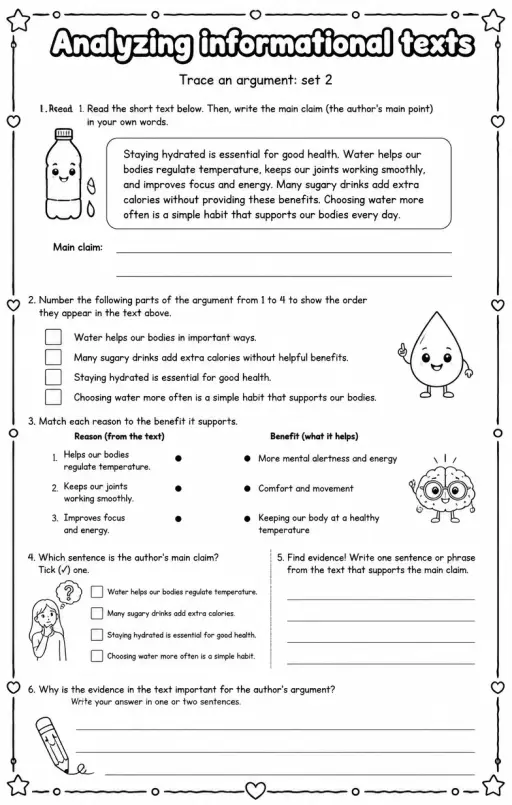 WorksheetTrace an argument: set 2
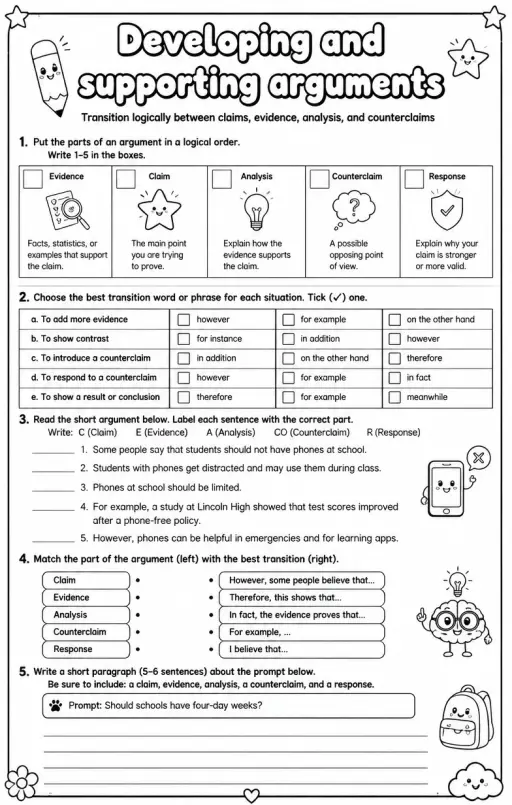 WorksheetTransition logically between claims, evidence, analysis, and counterclaims
On this sheet
The words and questions from the game
- 1Argument: The west study room has more seats than the east room. Therefore, it can accommodate our larger discussion group. No information about usable floor spThe west room has newer curtains. · The discussion group prefers blue walls. · The east room has fewer windows. · The extra seats can actually be used by the group.
- 2Argument: The west study room has more seats than the east room. Therefore, it can accommodate our larger discussion group. No information about usable floor spTrue · False
- 3Argument: The west study room has more seats than the east room. Therefore, it can accommodate our larger discussion group. No information about usable floor sp
- 4Argument: After the reading room added soft chairs, visits increased. During the same month, opening hours doubled. A speaker concludes that the chairs alone caThe room definitely lost all its books. · Every visitor disliked soft chairs. · Longer opening hours may have increased visits. · Visits fell after the room removed every chair.
- 5Argument: After the reading room added soft chairs, visits increased. During the same month, opening hours doubled. A speaker concludes that the chairs alone caTrue · False
- 6Argument: After the reading room added soft chairs, visits increased. During the same month, opening hours doubled. A speaker concludes that the chairs alone ca
- 7Claim: A new route is easier for pupils using wheelchairs. Evidence A: Wheelchair users reported fewer difficult slopes. Evidence B: A photographer liked the roC · The route's name contains six letters. · A · B
- 8Claim: A new route is easier for pupils using wheelchairs. Evidence A: Wheelchair users reported fewer difficult slopes. Evidence B: A photographer liked the roTrue · False
- 9Claim: A new route is easier for pupils using wheelchairs. Evidence A: Wheelchair users reported fewer difficult slopes. Evidence B: A photographer liked the roA measures the map’s font size. · The number and range of responding users are not supplied. · A establishes the exact travel time for every pupil. · A says every route in the town is accessible.
- 10Claim: A new route is easier for pupils using wheelchairs. Evidence A: Wheelchair users reported fewer difficult slopes. Evidence B: A photographer liked the roRelevant reports can never count as evidence. · A modern font proves complete accessibility. · The reports prove every wheelchair user everywhere can use every route. · Some user reports support improved ease, but wider coverage needs checking.
- 11Argument: Of 40 volunteers who answered a club survey, 36 wanted a longer lunch. Therefore, all 600 pupils want the same change. Responses were not collected frIt generalises from voluntary respondents to every pupil. · It contains no numerical information. · It refuses to say anything about the respondents. · The survey contains too many responses to calculate a percentage.
- 12Argument: Of 40 volunteers who answered a club survey, 36 wanted a longer lunch. Therefore, all 600 pupils want the same change. Responses were not collected frTrue · False
- 13Argument: Of 40 volunteers who answered a club survey, 36 wanted a longer lunch. Therefore, all 600 pupils want the same change. Responses were not collected frA brighter survey poster · A second quotation from the same volunteer · A well-designed survey covering pupils who did not volunteer · A third comment from the same club leader
- 14Argument: Of 40 volunteers who answered a club survey, 36 wanted a longer lunch. Therefore, all 600 pupils want the same change. Responses were not collected frSome respondents want longer lunch. · No pupil outside the respondent group wants longer lunch. · The survey recorded 40 volunteer responses. · Views of non-respondents remain unknown.
- 15Urgent proposal: “We must choose a revision guide today. Two high-scoring pupils used Guide R, so Guide R will improve every pupil’s score. Their teachers, prevThe deadline falls on a weekday. · The guide's cover is red. · The guide’s title contains one letter. · The two users’ results apply to all pupils despite unchecked differences.
- 16Urgent proposal: “We must choose a revision guide today. Two high-scoring pupils used Guide R, so Guide R will improve every pupil’s score. Their teachers, prevTrue · False
- 17Urgent proposal: “We must choose a revision guide today. Two high-scoring pupils used Guide R, so Guide R will improve every pupil’s score. Their teachers, prevTwo successful pupils used R; its effect on other pupils has not been established. · R is proved to improve all scores. · The guide definitely caused both pupils' earlier high scores before they used it. · R is proved to harm all scores.
- 18Urgent proposal: “We must choose a revision guide today. Two high-scoring pupils used Guide R, so Guide R will improve every pupil’s score. Their teachers, prevOnly the two users repeating their opinions · Only a list of the guide's chapter titles · Unrelated pupils’ favourite cover colours · Similar pupils, comparable prior scores and study time, different guides.
About this worksheet
A printable worksheet made from the KiwiBee game “Evaluate an Argument Under Pressure”. Open it in the free Worksheet Studio to choose the design and the sheet type, then print it or save a PDF.
Test assumptions, relevance and limits in fictional school arguments, including claims made under pressure.
- ms 081
- english
- identify assumptions
- test evidence relevance
- explain a limitation in a conclusion
 Home
 All solutions
 Pricing
 About us
 KiwiBee for Non-profits
 Events & webinars
 For big organisations
 For schools
 For centers
 For team leaders
 For teachers
 Resources
 Printable worksheets
 Interactive simulations
 Teacher tools
 Ideas and research


Comments