
Printable worksheet
Equilibrium Under a Changing Condition
QuizScienceGrade 11English

Practise more with these
Picked by meaning from games, worksheets, simulations, teacher tools and videos.
On this sheet
The words and questions from the game
- 1In a closed flask, the reaction A(g) ⇌ B(g) has reached dynamic equilibrium. Which statement is correct?The forward and reverse reactions happen at equal rates. · The concentrations of A and B must both be zero. · The amounts of A and B must be equal. · The forward reaction has stopped, but the reverse reaction continues.
- 2True or false: At equilibrium, the concentration of each substance must be the same as the concentration of every other substance.True · False
- 3A student measures [B] in the reaction A(g) ⇌ B(g). The values are: 0 s → 0.00 mol/L, 20 s → 0.18 mol/L, 40 s → 0.29 mol/L, 60 s → 0.33 mol/L, 80 s → 0.33 mol/L40 s · 20 s · 60 s · 100 s
- 4The reaction A(g) ⇌ B(g) starts with only A present. Order these snapshots from earliest to latest by increasing amount of B formed.
- 5For A(g) ⇌ B(g), Kc = 4.0 at this temperature. A mixture has [A] = 0.30 mol/L and [B] = 0.60 mol/L. What does the data show about this mixture?It is at equilibrium because [B] is greater than [A]. · It is at equilibrium because [A] and [B] are both present. · It is not at equilibrium because Kc should always equal 1.0. · It is not at equilibrium because Qc = 2.0, not 4.0.
- 6For A(g) ⇌ B(g), Kc = [B]/[A] = 3. Order these mixtures from smallest Qc to largest Qc.
- 7For the equilibrium H2(g) + I2(g) ⇌ 2HI(g), the equilibrium concentrations at one temperature are [H2] = 0.20 mol/L, [I2] = 0.20 mol/L, and [HI] = 1.20 mol/L. UKc = 0.36, so reactants are favoured at equilibrium. · Kc = 36, so products are favoured at equilibrium. · Kc = 1, so neither side is favoured. · Kc = 6, so reactants are favoured at equilibrium.
- 8Listen to the observation. Which conclusion is supported?Equilibrium was first reached at 15 s. · The flask never reached equilibrium. · The first observed stable-colour plateau begins at 45 s. · Equilibrium was first reached at 75 s.
- 9True or false: Adding a catalyst changes the numerical value of Kc for a reaction at a fixed temperature.True · False
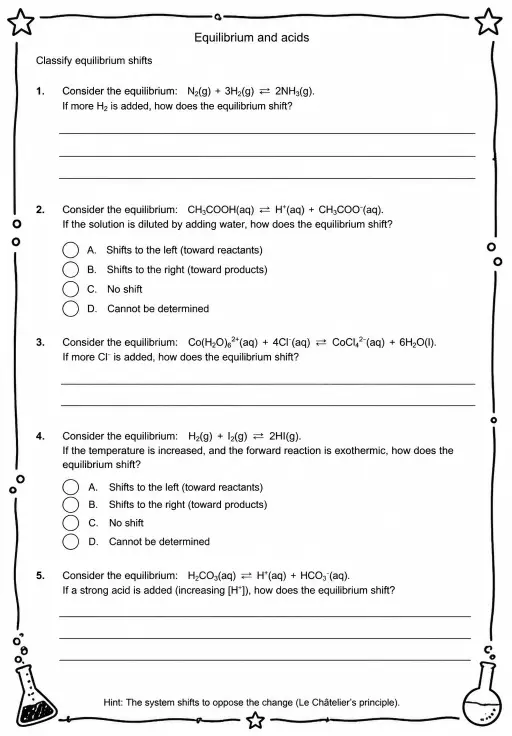
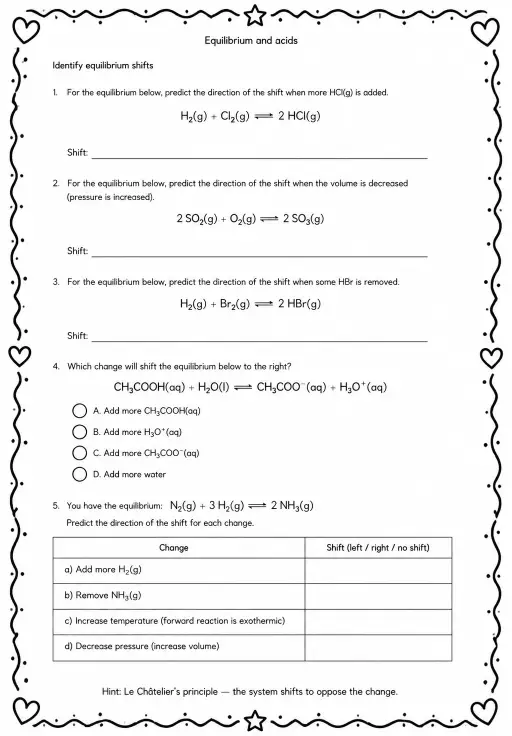
- 10For the equilibrium N2(g) + 3H2(g) ⇌ 2NH3(g), what shift is predicted if extra H2 is added at constant temperature in a closed container?No shift · Shift right, toward products · Shift left, toward reactants · The reaction stops completely
- 11For 2SO2(g) + O2(g) ⇌ 2SO3(g), the volume of a sealed container is decreased at constant temperature. Which shift is predicted?No shift, because pressure never affects equilibrium · No shift, because the container is sealed · Shift left, because the left side has fewer gas moles · Shift right, because the right side has fewer gas moles
- 12Order these steps for predicting a shift caused by a change in concentration, using this exact method.
- 13True or false: For an ideal-gas equilibrium in a rigid container, adding an inert gas at constant volume and temperature in the ideal mass-action model (no thirTrue · False
- 14For the exothermic equilibrium 2NO2(g) ⇌ N2O4(g) + heat, what happens when temperature is increased?Shift left, toward NO2 · The value of Kc stays the same · Shift right, toward N2O4 · No shift, because temperature changes only rate
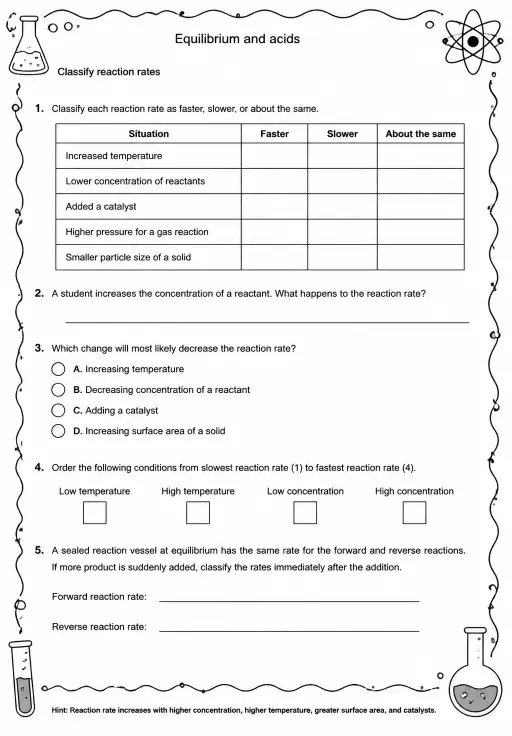
- 15A catalyst is added to a reversible reaction that is already at equilibrium. Which statement is correct?The equilibrium shifts toward reactants only. · The equilibrium shifts toward products only. · Both reaction rates rise equally; equilibrium composition stays unchanged. · The equilibrium position and Kc both change.
- 16For a reversible elementary ideal-gas reaction with positive concentration order in each direction, compress the mixture at fixed temperature. True or false: boTrue · False
- 17Listen to the observation. Which conclusion is supported?Equilibrium was reached faster; its final colour stayed the same. · The catalyst changed Kc because the reaction finished sooner. · Instant colour change means the catalyst changed equilibrium composition. · The catalyst decreased both forward and reverse reaction rates.
- 18Which statement shows a student is confusing a rate effect with an equilibrium effect?A catalyst can make a system reach equilibrium faster. · Compressing a gas mixture can change collision frequency immediately. · Temperature can change equilibrium position and Kc. · A catalyst speeds the forward reaction, so equilibrium gives more product.
- 19For A(g) ⇌ B(g), Kc = 2.0 at 300 K. A mixture has [A] = 0.90 mol/L and [B] = 0.60 mol/L. Extra A is then added so that immediately after the addition, [A] = 1.2Qc becomes 3.0, so the system shifts left toward A. · Qc becomes 0.50, so the system shifts right toward B. · Qc becomes 2.0, so the system stays exactly at equilibrium. · Kc changes to 0.50, so no prediction can be made.
- 20Equilibrium gas is compressed. After 10 s it has not re-equilibrated; a catalyst is then added. Order events.
- 21Listen to the scenario. Which conclusion is supported?The catalyst caused the shift, and the pressure change had no effect. · The catalyst changed Kc because the pressure increase made more product. · Compression favoured fewer gas moles; the catalyst only sped re-equilibration. · Neither the pressure change nor the catalyst had any effect on the system.
- 22A student studies the exothermic equilibrium P(g) ⇌ Q(g) + heat. In Trial 1 at 300 K, the equilibrium mixture contains 0.70 mol of Q. In Trial 2 at 300 K with aThe catalyst changed the rate but not the equilibrium amount of Q. · Faster equilibrium in Trial 2 means the catalyst raised Q’s equilibrium yield. · Higher temperature can favour P in this exothermic reaction. · Raising temperature changed the equilibrium amount of Q.
- 23Reaction X(g) ⇌ Y(g) is exothermic. In Experiment A at 290 K, the equilibrium mixture contains 0.80 mol of Y. In Experiment B at 330 K, the equilibrium mixture The reaction is endothermic because less Y is present at higher temperature. · The catalyst changed Kc at 290 K, but temperature did not. · Higher temperature and catalyst both raised equilibrium Y. · Higher temperature favoured X; catalyst sped rates, not equilibrium composition.
About this worksheet
A printable worksheet made from the KiwiBee game “Equilibrium Under a Changing Condition”. Open it in the free Worksheet Studio to choose the design and the sheet type, then print it or save a PDF.
This quiz develops chemical equilibrium reasoning from core features to data interpretation, shift prediction, and separating changes in reaction rate from changes in equilibrium position.
- ms 142
- science
- interpret equilibrium data
- predict shifts
- distinguish rate effects from equilibrium effects
 Home
 All solutions
 Pricing
 About us
 KiwiBee for Non-profits
 Events & webinars
 For big organisations
 For schools
 For centers
 For team leaders
 For teachers
 Resources
 Printable worksheets
 Interactive simulations
 Teacher tools
 Ideas and research


Comments