
Printable worksheet
Energy Through a Designed System
QuizScienceGrade 6English

Practise more with these
Picked by meaning from games, worksheets, simulations, teacher tools and videos.
 GameThermodynamics of a Practical System
 GameFollowing Energy
 GameReaction Pathways and Evidence
 GamePower and Efficiency
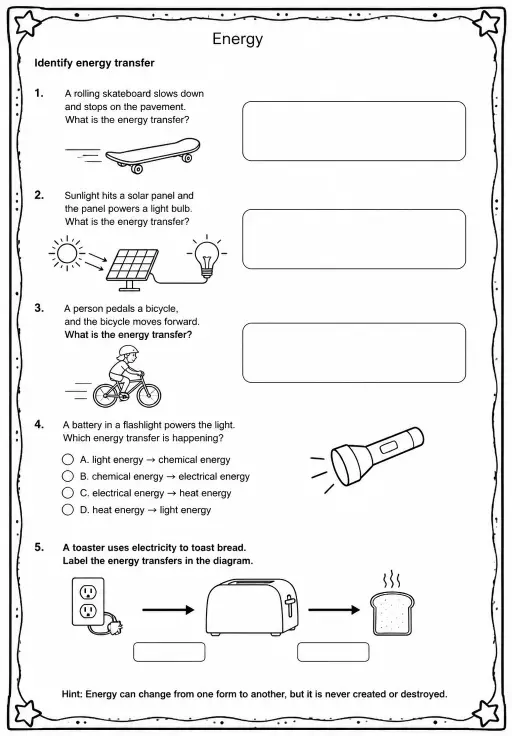 WorksheetIdentify energy transfer
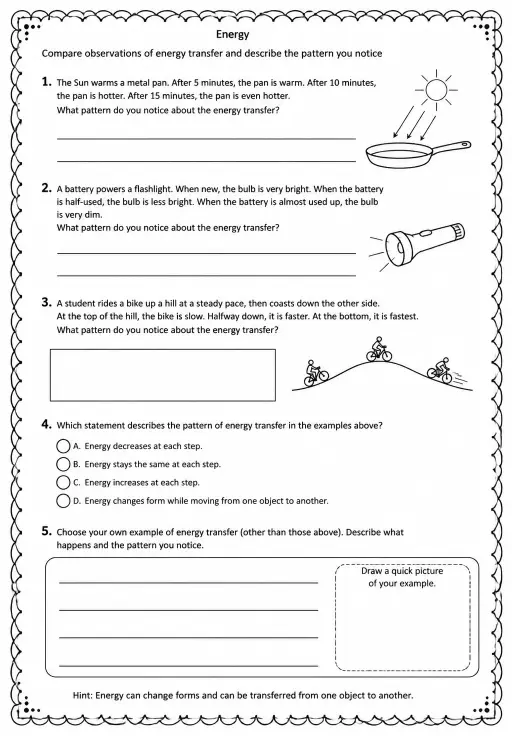 WorksheetCompare observations of energy transfer and describe the pattern you notice
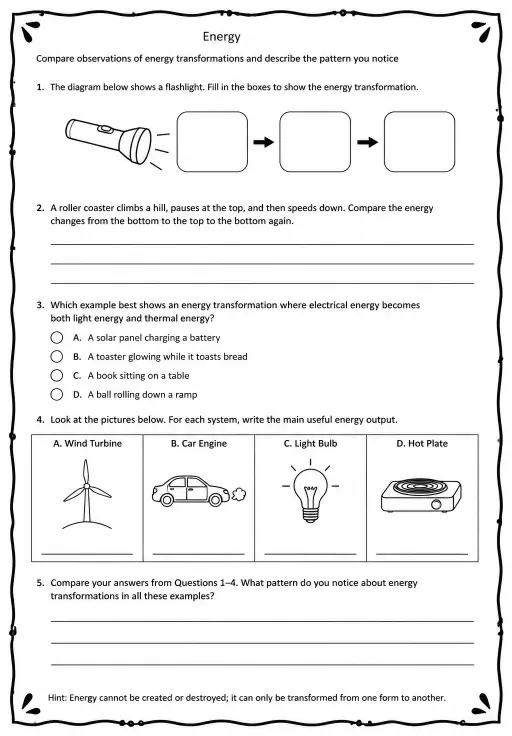 WorksheetCompare observations of energy transformations and describe the pattern you notice
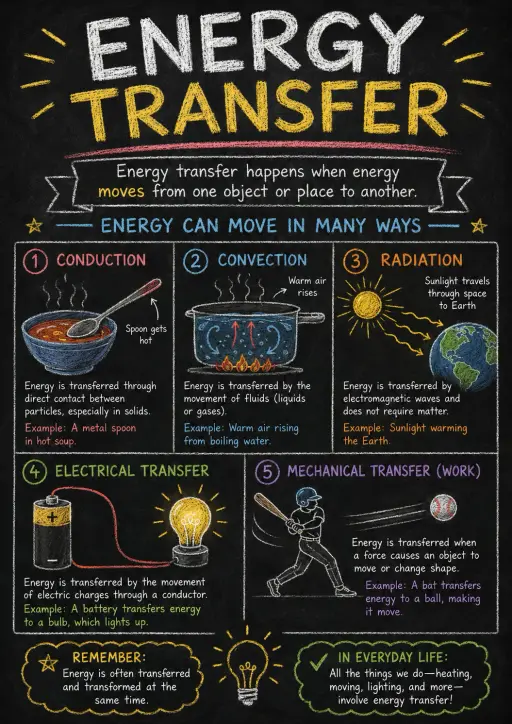 WorksheetEnergy Transfer Infographic
On this sheet
The words and questions from the game
- 1A torch uses a battery to make light. Which energy transfer happens first inside the torch?Thermal energy in the room is transferred to electrical energy in the circuit. · Light energy in the bulb is transferred to chemical energy in the battery. · Sound energy in the air is transferred to chemical energy in the battery. · Chemical energy in the battery is transferred to electrical energy in the circuit.
- 2True or false: When a device works, energy disappears after it is used.True · False
- 3A battery toy car works in this simplified order. Put the stages in order from first to last.
- 4A small speaker is designed to make music. Which output is the useful output?Light from the room lamp · Sound energy in the air · Thermal energy warming the wires · Chemical energy remaining in an unused battery
- 5An electric kettle heats water. What is its main energy transfer?Room sound → chemical energy in water. · Water’s thermal energy → electricity in wires. · Kettle’s electrical energy → thermal energy in water. · Kettle light → electricity in the plug.
- 6Listen. Which energy transfer fits the observation?Hand motion → electricity → light and some thermal energy. · Battery energy → light only; no other outputs. · Sound → chemical energy in the handle. · Cranking creates new energy as the lamp brightens.
- 7A bicycle dynamo lamp works in a chain. Put these stages in order from first to last.
- 8True or false: One device can transfer energy into more than one output at the same time.True · False
- 9A phone charger is designed to charge the battery. Which output is dissipated energy?The charger's printed voltage rating · Electrical energy in the wall socket · Chemical energy stored in the phone battery · Thermal energy warming the charger and nearby air
- 10True or false: When bicycle brakes rub on the wheel and become warmer, some energy has been dissipated to the surroundings.True · False
- 11Listen to the observation. Which conclusion is supported?The only output was light energy. · All of the electrical energy became useful movement. · Some energy was dissipated as thermal energy and sound. · The motor destroyed energy because it slowed down.
- 12Efficiency = useful output energy ÷ input energy × 100%. A desk fan takes in 30 J of electrical energy and gives 24 J of useful movement energy. What is the eff6% · 80% · 24% · 125%
- 13Device X gives 12 J of useful energy from 20 J input. Device Y gives 15 J of useful energy from 30 J input. True or false: Device Y is more efficient than DevicTrue · False
- 14Which machine is most efficient? Use efficiency = useful output ÷ input × 100%. A: 18 J useful from 30 J input B: 21 J useful from 28 J input C: 16 J useful froB · C · A · D
- 15Order these machines from highest efficiency to lowest efficiency. Use efficiency = useful output ÷ input. Machine A: 18 J useful from 24 J input Machine B: 14
- 16A fountain’s only job is spraying water upward. In 1 minute: sunlight input 200 J; useful water motion 50 J; rattling sound 20 J; rest warms pump and air. Which150 J dissipated; only 50 J does the intended job. · 100% efficient because water moves. · None dissipated; all 200 J stays in the fountain. · 70 J useful; motion and rattling are both intended.
- 17Listen. What is the student’s error?Adding useful and dissipated energy; they should be equal. · Not converting joules to kilojoules. · Dividing input by useful output, reversing the ratio. · Assuming sound can never be dissipated.
- 18Order these devices from least dissipated percentage to most dissipated percentage. Device A: 90% efficient Device B: 65% efficient Device C: 50% efficient Devi
- 19Mixer: 80 J input; 52 J useful motion; 28 J heats surroundings and makes sound. Which is correct?Impossible: useful + dissipated output must not equal input. · Over 100% efficient because there are two outputs. · 35% efficient because 28 J was dissipated. · 65% efficient: 52 ÷ 80 × 100% = 65%.
- 20Conveyor energy (input → useful motion): original 200 J → 110 J; A 200 J → 140 J; B 260 J → 140 J. Which is correct?B is best: it has the largest useful output despite more input. · A is more efficient and dissipates less than B. · Original is most efficient: it has the smallest input. · A and B are equally efficient: both give 140 J useful.
About this worksheet
A printable worksheet made from the KiwiBee game “Energy Through a Designed System”. Open it in the free Worksheet Studio to choose the design and the sheet type, then print it or save a PDF.
Students follow energy through designed systems, identify energy dissipated to surroundings, and compare efficiency using numerical data.
- ms 122
- science
- track energy transfers
- identify dissipated energy
- compare efficiency using data
 Home
 All solutions
 Pricing
 About us
 KiwiBee for Non-profits
 Events & webinars
 For big organisations
 For schools
 For centers
 For team leaders
 For teachers
 Resources
 Printable worksheets
 Interactive simulations
 Teacher tools
 Ideas and research


Comments