
Printable worksheet
Displacement Evidence for Floating and Sinking
QuizScienceGrade 6English

Practise more with these
Picked by meaning from games, worksheets, simulations, teacher tools and videos.




On this sheet
The words and questions from the game
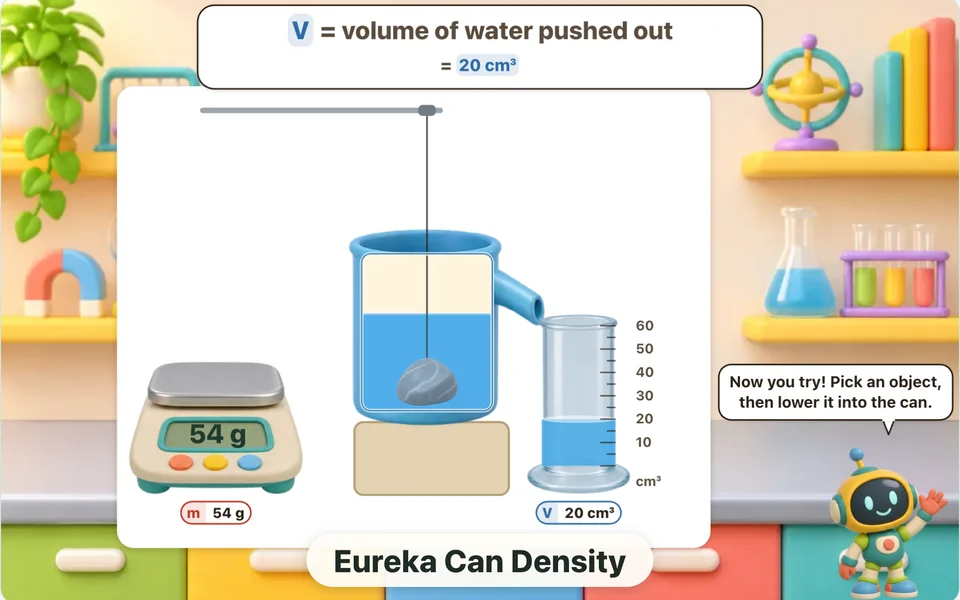
- 1A measuring cylinder starts at 40 mL. A small stone is lowered in until it is fully under water. The water level rises to 55 mL. What volume of water was displa15 mL · 95 mL · 55 mL · 40 mL
- 2True or false: If an object is fully submerged, the volume of water it displaces equals the object's volume.True · False
- 3A 1 cm³ cube of wax has mass 0.9 g. A 1 cm³ cube of steel has mass 7.8 g. Which cube has the greater density?Both cubes have zero density because their volumes match. · The steel cube · The wax cube · They have the same density
- 4Order these water-level readings from smallest displaced volume to largest displaced volume. The cylinder started at 20 mL before each trial.
- 5A rectangular block is 4 cm × 3 cm × 2 cm. It is pushed fully under water. Which displaced volume should be measured if there are no air bubbles?12 mL · 48 mL · 24 mL · 9 mL
- 6Listen to the observation. Which volume of water was displaced by the object?14 mL · 22 mL · 6 mL · 8 mL
- 7Put these steps in the correct order for finding the volume of an irregular solid by water displacement in a measuring cylinder.
- 8A solid plastic cube has mass 32 g and volume 40 cm³. Water has density 1.0 g/cm³. Which explanation best predicts what happens in water?It sinks because its mass is more than 1 g · It floats because its volume is more than 1 cm³ · It sinks because all plastic sinks · It floats because its density is 0.8 g/cm³, less than water
- 9True or false: An object can float even if the material it is made from is denser than water, as long as the object's average density is less than water becauseTrue · False
- 10Two solid spheres have the same volume. Sphere A has mass 20 g. Sphere B has mass 35 g. Both are put into the same liquid. Which statement is correct?Both must float · Sphere B has greater density than Sphere A · Sphere A has greater density than Sphere B · Sphere B has zero density.
- 11Listen to the observation. Which conclusion is supported?The block floated because its density was less than the liquid's density · The block sank because 30 cm³ is a small volume · The block sank because its mass was exactly 25 g · The block floated because heavy objects always float
- 12Order these objects from lowest density to highest density using the given mass and volume data.
- 13A student claims, "This sealed toy boat will float." The student measures a mass of 60 g and an outside volume of 100 cm³. Water has density 1.0 g/cm³. Which juThe claim is not supported because every object with mass 60 g sinks · The claim is not supported because 100 cm³ is too large to float · The claim is supported because the average density is 0.60 g/cm³ · The claim is supported because the boat must displace 1000 cm³ of water
- 14True or false: If an object's average density is 1.2 g/cm³, it will float in water with density 1.0 g/cm³.True · False
- 15A student measures an object before testing the claim "It will float in water." Which set of measurements is sufficient to calculate the object's average densitColour and mass · Mass and width only · Mass and volume · Temperature and shape
- 16A sealed hollow metal sphere has mass 120 g and outside volume 200 cm³. It is placed in water. Which statement best combines displacement and density ideas?It floats: average density 0.60 g/cm³; 120 cm³ of water displaced. · It sinks because 120 g is greater than 100 g · It floats partly above water yet displaces all 200 cm³. · It must sink because metal always sinks
- 17Listen to the test results. Which claim is supported by the measurements?The block will float because its density is 0.75 g/cm³ · The block will sink because water level always rises for floating objects · The block will float because its volume is 36 cm³ · The block will sink because its density is 1.33 g/cm³
- 18Order these objects from lowest to highest average density. These densities help predict floating, neutral buoyancy or sinking in the simplified water model.
- 19Impermeable object protocol: dry mass → water-displacement volume → density → compare with water. Will it float?
About this worksheet
A printable worksheet made from the KiwiBee game “Displacement Evidence for Floating and Sinking”. Open it in the free Worksheet Studio to choose the design and the sheet type, then print it or save a PDF.
Students interpret liquid displacement, compare density and buoyancy ideas, and use measured data to evaluate whether objects float or sink.
- ms 128
- science
- connect displaced liquid volume to an immersed object
- compare density and buoyancy explanations
- use measurements to test a floating claim
 Home
 All solutions
 Pricing
 About us
 KiwiBee for Non-profits
 Events & webinars
 For big organisations
 For schools
 For centers
 For team leaders
 For teachers
 Resources
 Printable worksheets
 Interactive simulations
 Teacher tools
 Ideas and research


Comments