
Printable worksheet
Design for Users with Different Needs
QuizOtherGrade 6English
Practise more with these
Picked by meaning from games, worksheets, simulations, teacher tools and videos.
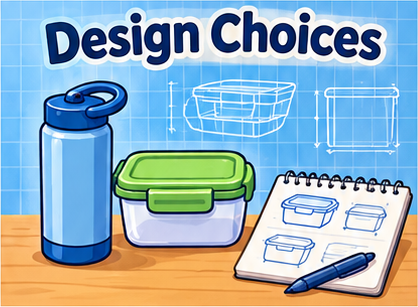 GameA Design Brief with Competing Constraints
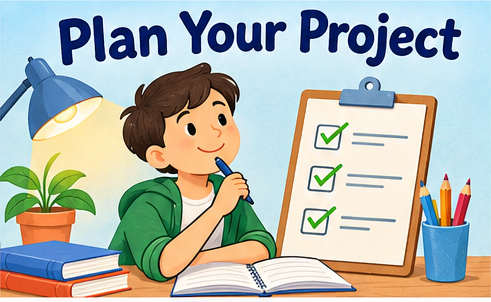 GameA Personal Project from Goal to Review
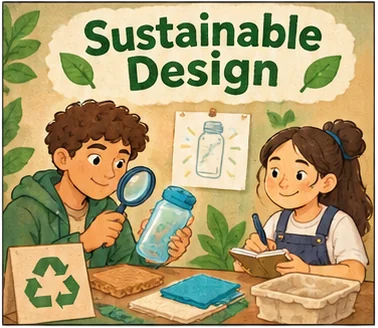 GameA Sustainable Product Design Review
 GameA Poster That Communicates Clearly
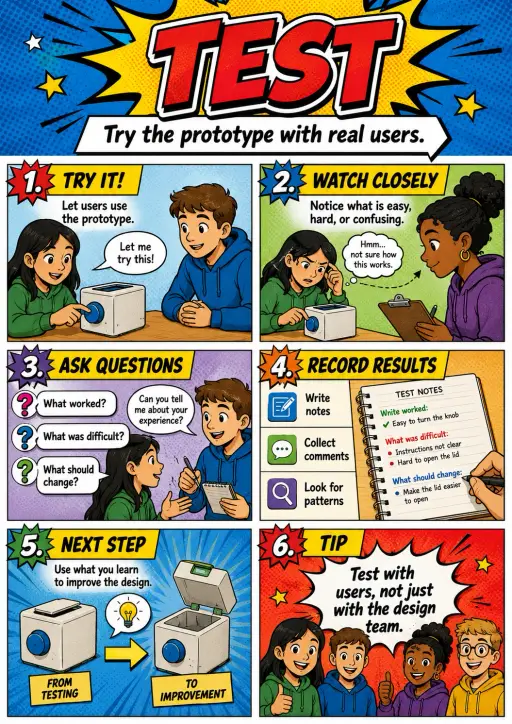 WorksheetTest Design Thinking Infographic
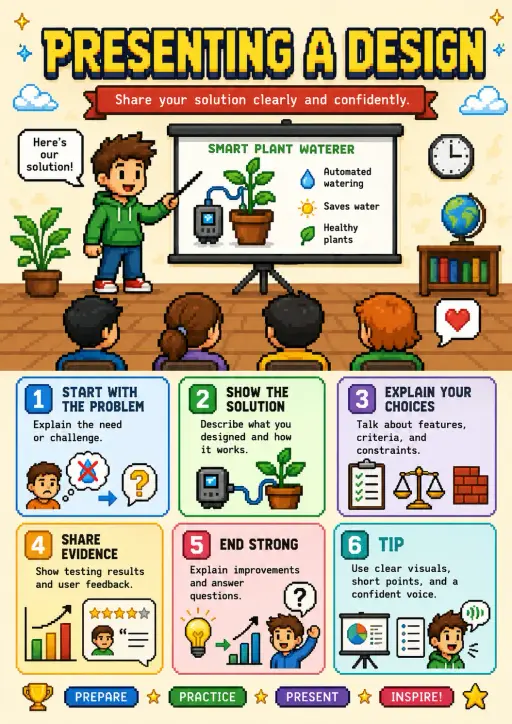 WorksheetShow Testing Results and User Feedback. Design Thinking Infographic
 WorksheetMake-Your-Own Quiz Template
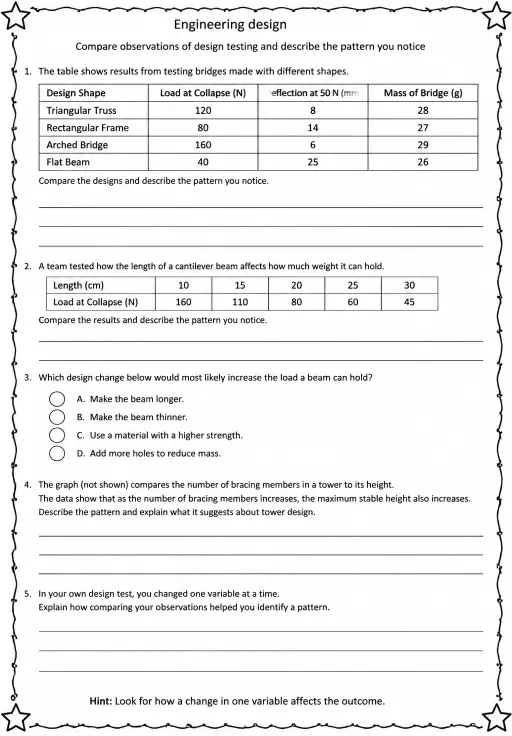 WorksheetCompare observations of design testing and describe the pattern you notice
On this sheet
The words and questions from the game
- 1A design brief states that User A must operate the control without a mouse. Which is a functional requirement?The designer’s favourite colour · Keyboard operation · A longer product name · The designer's signature style
- 2Different users can have different requirements for the same task.True · False
- 3User B requires text at least 18 model size units. Prototype P uses 20 and Q uses 14. Which meets this stated size rule?Q · Both · P · Neither
- 4Why test with users performing the actual task?Appearance alone guarantees success · No observations are needed · A name chosen by the designer proves every task is usable. · A design’s usability depends on real interaction with the task
- 5The agreed workflow is requirements, prototype, then task test. Order it.
- 6Meeting one user’s requirement proves every other user can complete the task.True · False
- 7P supports keyboard use and large text; Q has large text but requires a mouse. A user needs both keyboard operation and large text. Which is feasible under thosP · Neither because large text always prevents keyboard use. · Q · Both
- 8A colour-only signal necessarily works for everyone in every viewing condition.True · False
- 9A brief requires that a status not depend only on colour. Which revision meets it?Add a text label that uses the same word for every different status. · Change red to another colour only · Remove the status entirely · Add a meaningful text or shape indicator
- 10A wide doorway is shown in a picture, but no dimensions or usage test are given. What remains uncertain?Whether it meets the actual stated access requirement · The existence of a picture · The image proves every possible user can pass through. · That the image contains a doorway
- 11Two prototypes differ in many features. What limits assigning improved task success to one feature?Task success cannot be measured · The changed features are confounded · More changes prove one cause · All altered features are proven irrelevant.
- 12A design can offer more than one way to complete the same task.True · False
- 13Order these dated records.
- 14What would make a “works for everyone” claim too strong?Disclosing exactly which user group was tested · Acknowledging an untested group · Testing only a narrow group under one set of conditions · Recording the exact sample
- 15A redesign improves legibility but removes required keyboard access. What follows?It gains one benefit but fails another mandatory requirement · The keyboard requirement can be hidden · Keyboard access is automatically restored by larger text. · Every visual improvement settles all access needs
- 16Which feedback most directly guides an inclusive control revision?The package arrived in a cardboard delivery box. · I prefer the product name · I could not activate this control using the required keyboard method · Everyone must like the same shade
- 17Recording who was tested and what was not tested improves transparency.True · False
- 18Which final choice is justified?A designer’s preference replaces user evidence · The selected prototype meets the stated user requirements in documented tests, with untested needs disclosed · Every untested need is proven satisfied by the documented sample. · A large picture proves all access forever
About this worksheet
A printable worksheet made from the KiwiBee game “Design for Users with Different Needs”. Open it in the free Worksheet Studio to choose the design and the sheet type, then print it or save a PDF.
A 26-question progressive quiz connecting three skills through explicit observations, data and scenarios.
- ms 288
- arts life skills
- identify functional requirements
- compare prototypes
- choose an inclusive design revision
 Home
 All solutions
 Pricing
 About us
 KiwiBee for Non-profits
 Events & webinars
 For big organisations
 For schools
 For centers
 For team leaders
 For teachers
 Resources
 Printable worksheets
 Interactive simulations
 Teacher tools
 Ideas and research


Comments