
Printable worksheet
Conservation Decisions with Incomplete Data
QuizScienceGrade 11English

Practise more with these
Picked by meaning from games, worksheets, simulations, teacher tools and videos.
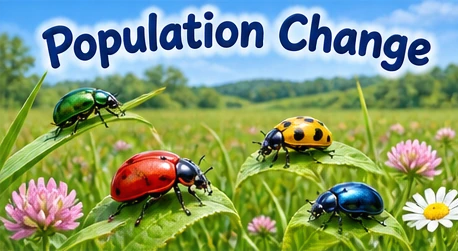 GameSelection, Drift and Population Data
 GamePopulation Samples Can Miss Part of a Habitat
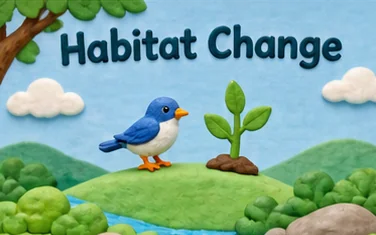 GameA Habitat Under Change
 GameEcosystem Recovery After Disturbance
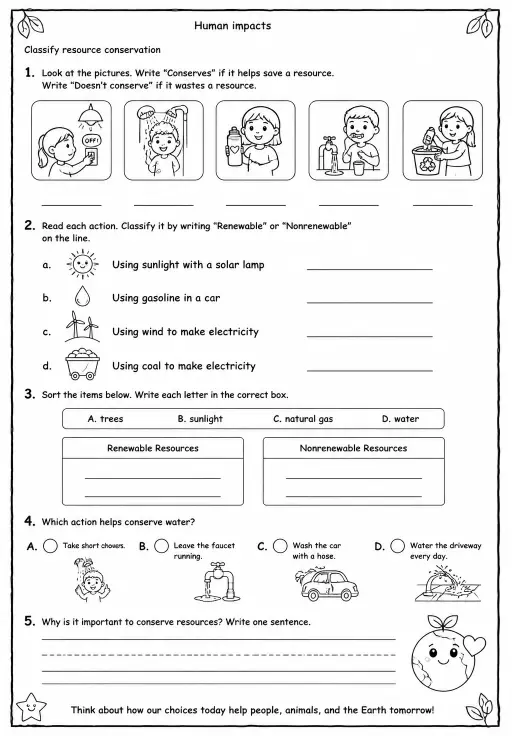 WorksheetClassify resource conservation
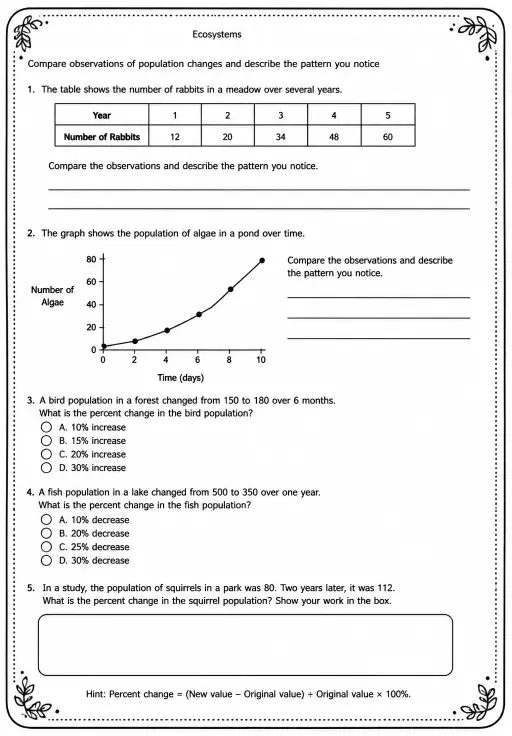 WorksheetCompare observations of population changes and describe the pattern you notice
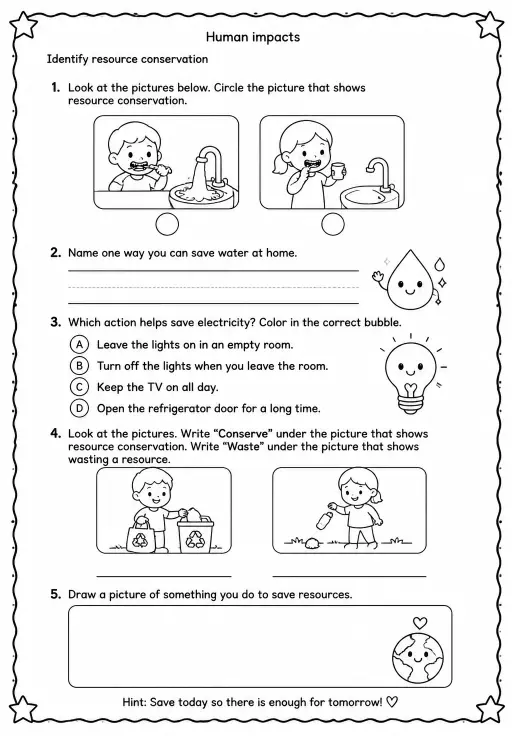 WorksheetIdentify resource conservation
On this sheet
The words and questions from the game
- 1A population model predicts future abundance from what?A guarantee that the future is fixed · Only the last digit of the site postcode · Specified starting data, processes and assumptions · Only the species name
- 2Different plausible models can produce different predictions from limited data.True · False
- 3An observed decline could reflect lower births, higher deaths or movement. What evidence helps distinguish them?Only one total count again · Separate demographic and movement measurements · Only a photograph of one adult · The number of letters in the site label
- 4An exact numerical model output means the input parameters are known exactly.True · False
- 5Order the stated annual accounting sequence.
- 6Why can genetic diversity matter to conservation?It guarantees survival under every change · It guarantees every individual has identical fitness · It replaces all habitat requirements · It can influence adaptive potential and inbreeding-related risks
- 7A corridor proposal connects isolated suitable patches. What mechanism should be tested?Movement and successful establishment between patches · The colour of the proposal cover · Whether every animal instantly migrates · Only whether the corridor appears green in an aerial image
- 8Listen. Which conclusion is appropriately cautious?Genetics proves habitat cannot matter · Genetic risk deserves attention alongside missing ecological evidence · Extinction next year is certain · The genetic indicator proves no further data can help
- 9A large total population always guarantees all subpopulations are well connected.True · False
- 10Two models fit past counts equally well but predict different drought responses. What is useful next?Choose the more pleasing forecast · Average labels without examining mechanisms · Discard every drought observation because both models fit past counts · Collect data that distinguish their drought mechanisms
- 11Why compare intervention and suitable reference sites over time?To make baseline data irrelevant · To eliminate the need to state the intervention · To separate action-related patterns from shared background changes · To guarantee the intervention works
- 12Listen. Which plan is adaptive rather than fixed regardless of evidence?The monitoring-and-revision plan · A plan that never measures outcomes · A plan with a fixed action that ignores the monitoring threshold · A plan that deletes every unfavourable record
- 13Why should a model’s assumed habitat capacity be examined after major land-use change?Capacity is a universal constant · Land use cannot affect habitat · The parameter may no longer represent current conditions · The old parameter is valid merely because the species name is unchanged
- 14An intervention with uncertain effects cannot be compared rationally with alternatives.True · False
- 15Order these explicitly dated conservation records.
- 16A proposal improves adult survival but recruitment remains below the stated target. What follows?Improved adult survival proves recruitment also reached its target · One outcome improved, but the full objective is not yet met · Recruitment measurements are unnecessary · Every population process improved
- 17What makes a monitoring indicator relevant?It is unrelated to outcomes but easy to count · It is simply easiest to decorate · It always produces the largest number · It changes in a way connected to the decision objective
- 18A translocation proposal has possible genetic benefits and disease-transfer risks. How should it be assessed?Evaluate both under appropriate specialist evidence and monitoring · Approve solely because the animals look healthy · Assume genetics settles every risk · Assume every movement is harmless
- 19What finding would most directly challenge a model assuming no movement between patches?A census is printed on a different page · A patch has the same name · A label states patches are isolated without tracking evidence · Reliable tracking shows repeated movement between them
- 20Which plan best fits incomplete evidence? Consider uncertainty, relevant outcomes and agreed revision criteria.Wait for impossible perfect knowledge while claiming no trade-offs · Claim certainty and avoid monitoring · Justify a trial; state uncertainty; track and revise by criteria. · Apply the same action permanently even if monitoring shows harm
About this worksheet
A printable worksheet made from the KiwiBee game “Conservation Decisions with Incomplete Data”. Open it in the free Worksheet Studio to choose the design and the sheet type, then print it or save a PDF.
A 30-question progressive quiz connecting three skills through explicit observations, data and scenarios.
- ms 180
- biology
- compare population models
- evaluate genetic and habitat evidence
- justify an adaptive monitoring plan
 Home
 All solutions
 Pricing
 About us
 KiwiBee for Non-profits
 Events & webinars
 For big organisations
 For schools
 For centers
 For team leaders
 For teachers
 Resources
 Printable worksheets
 Interactive simulations
 Teacher tools
 Ideas and research


Comments