
Printable worksheet
Charge Without a Complete Circuit
QuizScienceGrade 9English

Practise more with these
Picked by meaning from games, worksheets, simulations, teacher tools and videos.
 GameStatic Charge Surprises
 GameCurrent Needs a Circuit
 GameFields, Potentials and Trajectories
 SimulationElectrostatics Lab
 GameSimple Electrical Circuits Quiz for Grade 4
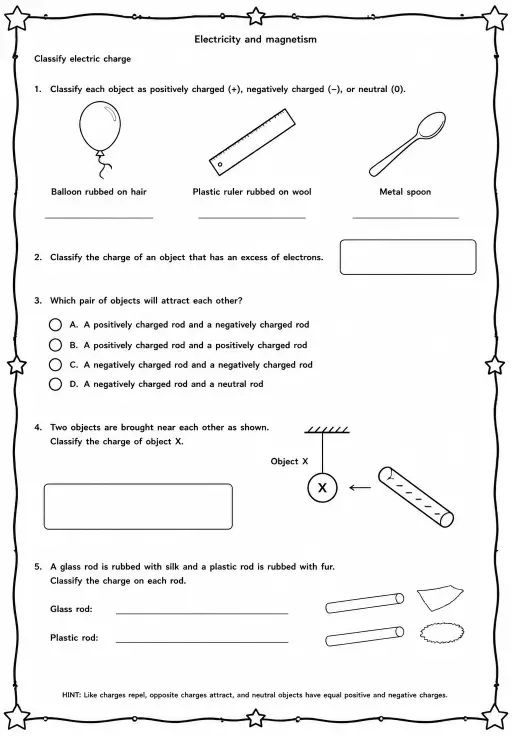 WorksheetClassify electric charge
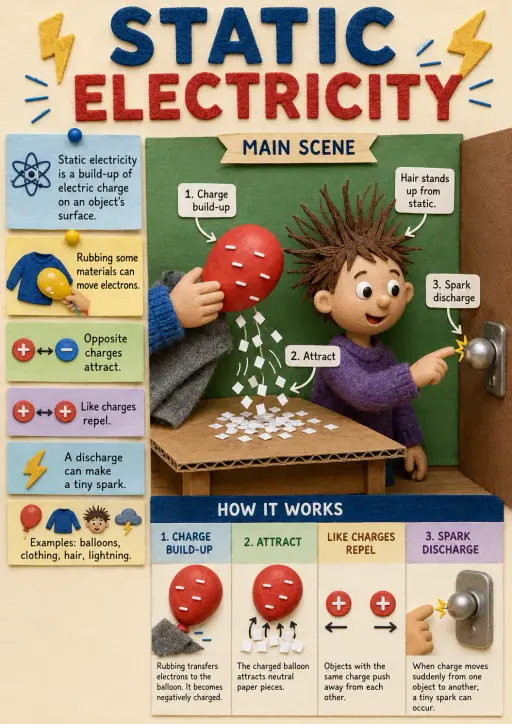 WorksheetStatic Electricity Electricity and Magnetism Infographic
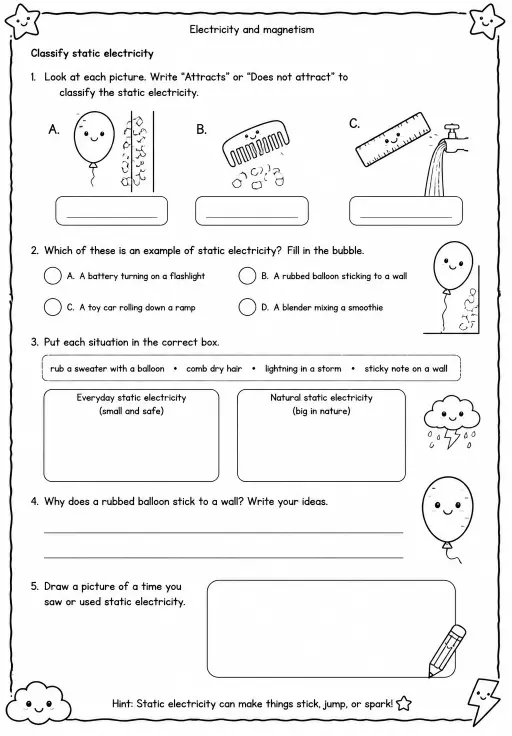 WorksheetClassify static electricity
On this sheet
The words and questions from the game
- 1In the simplified static-charging model used in this quiz, which particle moves from one object to another when two materials are rubbed?Whole atoms · Electrons · Protons · Neutrons
- 2True or false: An initially neutral object gains extra electrons without any other charge transfer. Its net charge becomes negative.True · False
- 3Listen to the observation. Which conclusion is supported?Charges can attract even when no current flows through a complete circuit · Attraction shows the paper scraps became positive ions · Attraction proves electrons moved through the air as a steady current · Only a closed circuit can make objects attract
- 4A charged rod is brought near a neutral metal sphere on an insulating stand. Before any touching occurs, what is the best description of the sphere?The sphere stays completely unchanged inside · The sphere must gain protons from the rod · A current in a closed circuit starts immediately · Charges shift: one side becomes more negative, the other more positive.
- 5A neutral plastic rod is rubbed with a wool cloth. After rubbing, the rod has a charge of -8 unit charges. According to the simplified model, what happened?The rod lost 8 electrons to the cloth · The rod gained 8 protons from the cloth · The rod gained 8 electrons from the cloth · The rod created 8 electrons inside itself
- 6Put these events in the correct order for charging a plastic rod by rubbing with a cloth in the simplified model.
- 7True or false: If a neutral cloth loses 5 electrons to a rod, the cloth becomes negatively charged.True · False
- 8Two objects start neutral. After contact and separation, object A has a net charge of +3 unit charges. What must be true in the simplified model?Object A gained 3 protons · Object A lost 3 electrons · Object A stayed neutral but changed temperature · Object A gained 3 electrons
- 9Which situation definitely includes electric current in a closed circuit?A charged rod is held near a metal can without touching it · A charged balloon sticks to a wall · A bulb lights in a gap-free wire loop linking both battery terminals. · A charged comb attracts paper scraps
- 10A student brings a negatively charged rod near a neutral paper scrap. The scrap moves toward the rod. Which statement best explains this observation?Charges shift slightly; the nearer side becomes relatively more positive. · The scrap must already have been negatively charged · The rod destroyed the mass of the scrap · The rod and scrap formed a closed circuit with steady current
- 11True or false: In the simple steady DC battery-and-wire model, an open gap prevents sustained conduction current around the entire loop.True · False
- 12Listen to the scenario. Which statement is supported?The can moved only because protons flowed from the rod into the can · The can moved only if the rod touched the can first · Rolling proves battery current passed through the floor. · Electrostatic force moved the can without a complete battery circuit.
- 13Required lab order: balloon sticks to wall → open-switch battery/bulb circuit → close switch; bulb lights.
- 14Which statement correctly compares static attraction with current in a closed circuit?Static attraction proves charges are neutralized instantly · Static attraction needs no loop; sustained current needs a conducting loop. · Both always require a complete loop of wire · Current in a closed circuit happens only when two objects rub together
- 15A negatively charged rod is brought near the left side of a neutral metal sphere on an insulating stand. Which charge pattern on the sphere is correct before anLeft side positive, right side negative · Both sides equally positive · Left side negative, right side positive · Both sides equally negative
- 16A negatively charged rod is held near a neutral metal sphere. While the rod stays nearby, the sphere is touched to ground. In the simplified model, what mainly Protons leave the sphere and flow to ground · Electrons enter the sphere from ground because the rod is negative · No charge movement can occur because the sphere was initially neutral · Electrons leave the sphere and flow to ground
- 17Arrange these steps in the correct order to leave a metal sphere positively charged by induction using a negatively charged rod.
- 18Which observation is the strongest evidence of polarization rather than charge transfer by touching?A battery warms slightly while powering a motor · A switch is closed and a bulb lights · A nearby charged rod attracts a neutral metal sphere without contact. · A rod touches a metal sphere and both later have the same sign of charge
- 19A neutral aluminum can sits on a table. A negatively charged plastic rod is brought near it without touching. The can rolls toward the rod. Which explanation bePolarization: near side relatively positive; no circuit needed. · Protons move through the can toward the rod · The can rolls only because warm air rises around the rod · Contact transfers electrons permanently; battery current starts.
- 20Listen to the setup. Which final result is correct?The sphere ends neutral because no battery was used · The sphere ends positive only if a bulb lights during the process · The sphere ends negative because electrons entered it from the rod · Positive: electrons went to ground while the negative rod was nearby.
- 21Follow this plan: charge a balloon, test it at a wall, build an open-switch circuit, then close the switch. Order the events.
- 22Four claims are made about a negatively charged balloon that sticks to a wall after rubbing. Which claim is best supported by the simplified model?The wall must already be negatively charged everywhere · Protons moved from the wall into the balloon during rubbing · Rubbing added electrons to the balloon; it can polarize the nearby wall. · It sticks only because current flows in a closed wire loop in the wall.
- 23A student says, "If an object attracts another object, there must be electric current flowing in a closed circuit." Which evidence most directly shows that the A bulb lights when connected to a battery in a complete loop · A rubbed comb attracts neutral paper with no battery or wire loop. · A positive object has lost electrons · A metal sphere can be grounded with a wire
About this worksheet
A printable worksheet made from the KiwiBee game “Charge Without a Complete Circuit”. Open it in the free Worksheet Studio to choose the design and the sheet type, then print it or save a PDF.
This quiz develops a simplified model of static charging, contrasts electrostatic attraction with current in closed circuits, and applies grounding and polarization to new situations.
- ms 140
- science
- trace electron transfer in a simplified static charging model
- distinguish charge attraction from current in a closed circuit
- explain grounding and polarization using supplied diagrams
 Home
 All solutions
 Pricing
 About us
 KiwiBee for Non-profits
 Events & webinars
 For big organisations
 For schools
 For centers
 For team leaders
 For teachers
 Resources
 Printable worksheets
 Interactive simulations
 Teacher tools
 Ideas and research


Comments