
Printable worksheet
Cell Division Keeps Track of Information
QuizScienceGrade 6English

Practise more with these
Picked by meaning from games, worksheets, simulations, teacher tools and videos.
On this sheet
The words and questions from the game
- 1A simplified cell has 4 chromosomes before DNA replication. Immediately after replication, how many chromosomes are present if each joined pair of sister chroma8 · 2 · 4 · 16
- 2A duplicated chromosome can contain two sister chromatids.True · False
- 3A homologous pair in a diploid model consists of what?Only two identical daughter cells · Corresponding chromosomes inherited from two parents · Two ribosomes making the same protein · Two arbitrary different organs
- 4What must happen before a typical cell division can distribute a complete copied genome to two cells?DNA is replicated · All DNA becomes a protein · The cell grows larger without making any DNA copies. · Every chromosome is removed
- 5Chromosome number and the number of DNA molecules always mean the same thing at every cell-cycle stage.True · False
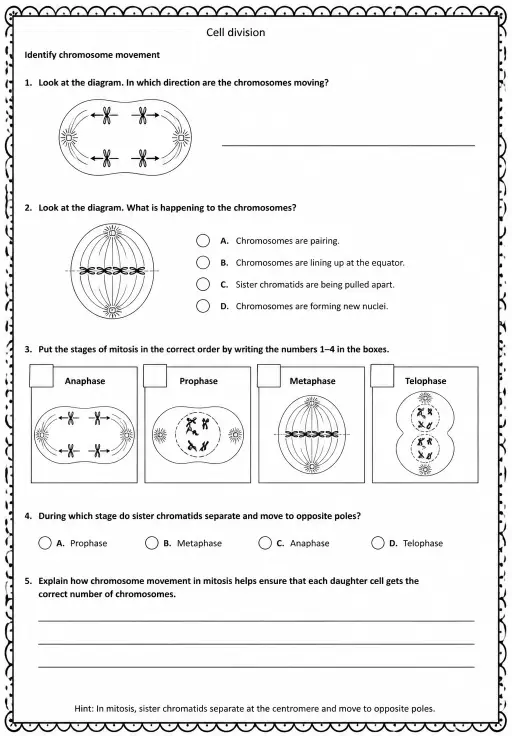
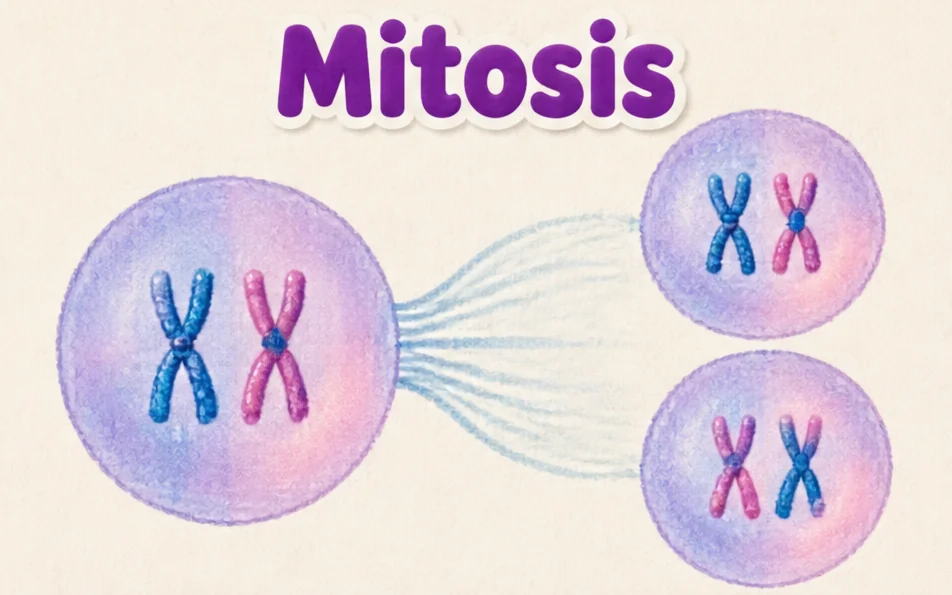
- 6Order these simplified mitotic stages.
- 7A diploid model has 6 chromosomes in 3 homologous pairs. How many chromosomes are in one set?6 · 18 · 12 · 3
- 8Listen. Which count is correct under the stated rule?5 chromosomes and 5 chromatids · 5 chromosomes and 10 chromatids · 10 chromosomes and 5 chromatids · 10 chromosomes and 10 chromatids
- 9After normal mitosis in this simplified model, each daughter nucleus retains the parent nucleus’s chromosome-set number.True · False
- 10A cell with 4 chromosomes undergoes ordinary mitosis. What is the expected chromosome count in each daughter nucleus?8 · 2 · 4 · 16
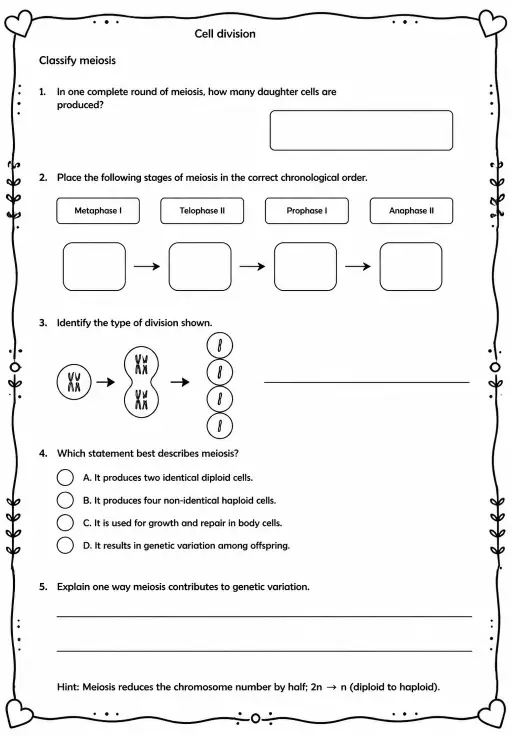
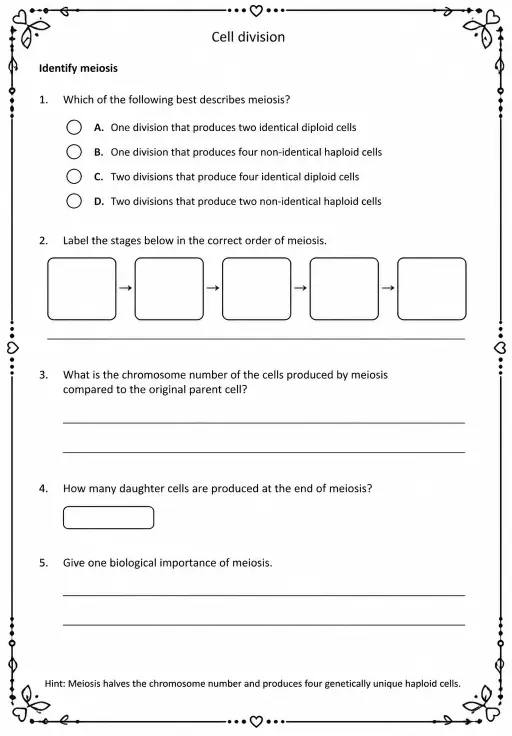
- 11Which process normally reduces the chromosome-set number for gamete formation in the diploid sexual life-cycle model?Meiosis · Digestion · Ordinary mitosis alone · Fertilisation
- 12Order the chromosome separations in the stated meiosis model.
- 13Listen. Which outcome fits the model?Each product has 6 complete diploid sets · Each final product has no chromosomes · Each final product has 12 chromosomes · Each final product has 3 chromosomes
- 14Why is it important to distinguish DNA replication from reduction division?They are identical descriptions · Replication always halves all chromosome sets · Replication destroys all DNA · Replication copies DNA; reduction changes chromosome-set number.
- 15DNA replication normally occurs again between meiosis I and meiosis II in this model.True · False
- 16A diagram shows two daughter cells with the original set number. Which additional evidence best distinguishes a mitotic outcome from a completed meiotic outcomeThe position of the page corner · Which chromosome structures separated and how many divisions occurred · Only the drawing's frame thickness · Only the ink colour
- 17A learner says a duplicated chromosome must be a homologous pair. What correction is needed?Duplicated copies and homologous partners are different relationships · Chromosomes never duplicate · Homologues must be identical copies with exactly the same alleles. · The statement is always correct
- 18Which complete explanation fits growth and sexual reproduction in the stated model?Both processes always double sets every generation · Gamete fusion must remove every chromosome · Mitosis preserves sets for growth; meiosis reduces sets before gamete fusion · Meiosis preserves diploid sets while fusion halves them
About this worksheet
A printable worksheet made from the KiwiBee game “Cell Division Keeps Track of Information”. Open it in the free Worksheet Studio to choose the design and the sheet type, then print it or save a PDF.
A 26-question progressive quiz connecting three skills through explicit observations, data and scenarios.
- ms 167
- biology
- trace duplicated chromosomes through simplified cell division diagrams
- compare chromosome sets before and after division
- distinguish growth division from gamete formation
 Home
 All solutions
 Pricing
 About us
 KiwiBee for Non-profits
 Events & webinars
 For big organisations
 For schools
 For centers
 For team leaders
 For teachers
 Resources
 Printable worksheets
 Interactive simulations
 Teacher tools
 Ideas and research


Comments