
Printable worksheet
Atomic Models and Chemical Patterns
QuizScienceGrade 9English

Practise more with these
Picked by meaning from games, worksheets, simulations, teacher tools and videos.
 GameMaterials from Molecular Structure
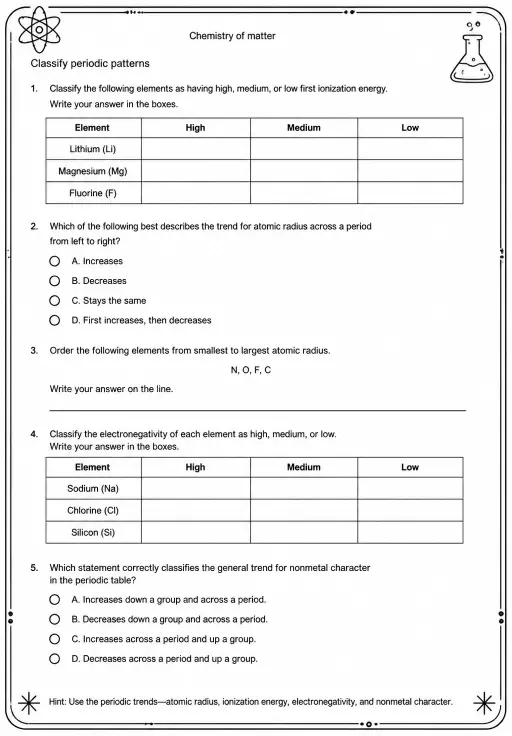 WorksheetClassify periodic patterns
 WorksheetIdentify atomic models
 GameAtoms, Elements and Compounds
 GameReading the Periodic Table
 GameHow Atoms Bond
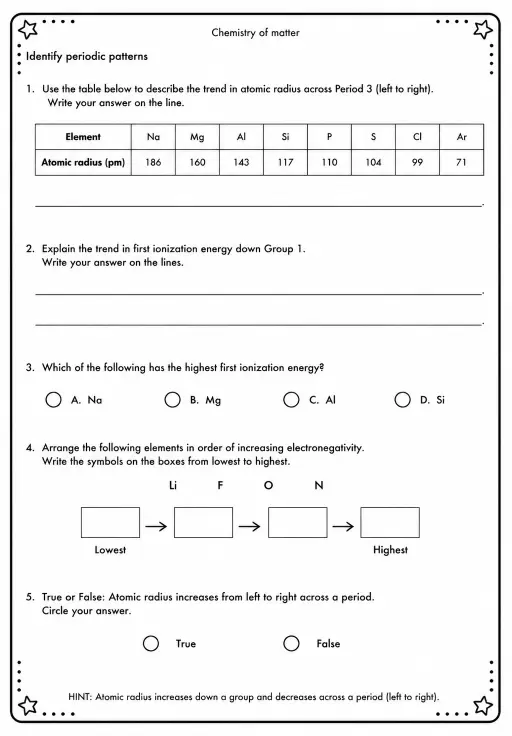 WorksheetIdentify periodic patterns
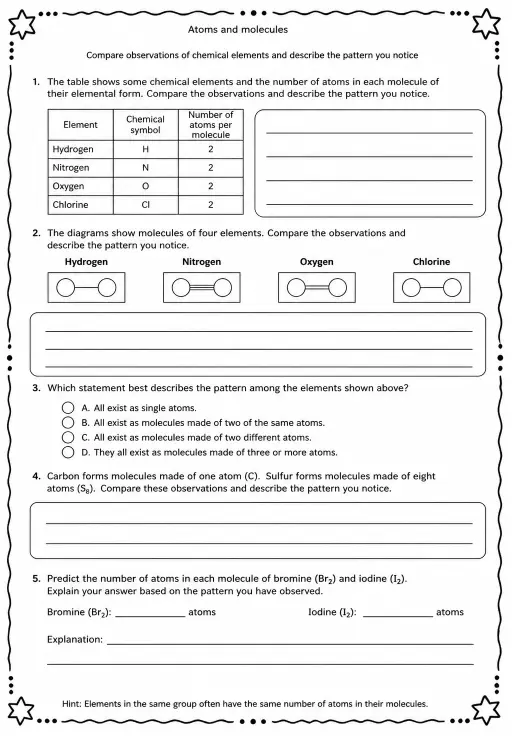 WorksheetCompare observations of chemical elements and describe the pattern you notice
On this sheet
The words and questions from the game
- 1Which particle decides which element an atom is?the total mass of the electron cloud · proton · electron shell · neutron
- 2True or false: Main-group elements in the same periodic-table column generally have the same number of outer-shell electrons (with helium as a familiar exceptioTrue · False
- 3Element X has electron arrangement 2,8,1. Which element is most likely in the same group as X?2,8,8 · 2,8,7 · 2,7 · 2,1
- 4Order these atoms by increasing atomic number, from smallest to largest. Their electron arrangements are given.
- 5An atom has electron arrangement 2,8,3. In which period is this element?period 3 · period 8 · period 1 · period 2
- 6Listen to the observation. Which conclusion is supported about the three elements in one group?The element lower in the group is less reactive. · All three elements have different numbers of outer-shell electrons. · The element lower in the group is more reactive. · All three elements are in the same period.
- 7Using the simplified trend that atomic radius decreases across period 3 from left to right, order these elements from largest radius to smallest radius: Na, Mg,
- 8Four period-3 atoms are listed: Na = 2,8,1; Mg = 2,8,2; Al = 2,8,3; Cl = 2,8,7. Which atom is expected to hold its outer electrons most strongly?Na · Al · Cl · Mg
- 9What type of bonding is most likely between magnesium and oxygen?Gravity holding neutral atoms together, without a chemical bond. · metallic · covalent · ionic
- 10True or false: A bond between two non-metals is usually covalent.True · False
- 11Aluminium forms Al3+ ions and oxygen forms O2− ions. What is the correct formula of the compound?AlO2 · Al2O3 · Al3O2 · AlO
- 12Listen to the test results. Which type of bonding best matches substance R?ionic · No bonding, because every solid that fails to conduct must be unbonded · covalent molecular · metallic
- 13Why does copper conduct electricity well as a solid?It has free-moving delocalised electrons. · Its protons move through the wire. · Its atoms become ions only when hit. · Its electrons are locked into separate molecules.
- 14Listen to the observation. Which explanation is supported for substance S?S is metallic because electrons move freely in the solid. · Ionic: shifted layers align like charges, which repel and shatter the solid. · S is a simple covalent gas because its particles are far apart. · S is a soft polymer because long chains slide easily.
- 15Which statement correctly compares the electrical conductivity of these materials at the stated conditions: solid sulfur, solid sodium chloride, liquid sodium cOnly solid sodium chloride conducts well because it contains ions. · Copper wire does not conduct as a solid, but solid sulfur does. · Solid sulfur and liquid NaCl conduct because their particles move. · No conduction: solid sulfur, solid NaCl. Conduction: liquid NaCl, copper wire.
- 16Which property set best matches diamond, a giant covalent structure?soft and easily bent · low melting point and good electrical conductor · very hard and does not conduct electricity · conducts only when molten
- 17Fictional element X has electron arrangement 2,8,1. Fictional element Y has electron arrangement 2,8,7. Which statement is most likely correct if X reacts with They form XY, an ionic compound that conducts when molten but not as a solid. · They form X2Y, a metal that bends easily. · They do not react because both already have full outer shells. · They form XY by covalent bonding, and the substance conducts well as a solid.
- 18Listen to the scenario. Which conclusion about substance T is best supported?T is made from two metals joined by metallic bonding. · Ionic compound: group 2 metal + group 17 non-metal. · T is a giant covalent network because it melts easily. · T is a simple molecular substance because it conducts as a solid.
- 19True or false: A student says, "A chlorine atom has 17 protons, but a chloride ion has 18 protons because it gained one electron."True · False
- 20Order this reasoning path from first step to last step for deciding the likely property of a compound made from element M (2,8,2) and element N (2,8,6).
- 21Fictional element P has atomic number 12 and element Q has atomic number 16. Assume neutral atoms have shell arrangements 2,8,2 and 2,8,6. Which statement is coP and Q do not form a compound because both are non-metals. · P and Q form PQ2, which is ionic and is likely brittle. · P and Q form P2Q, which is metallic and bends easily. · P and Q form PQ, which is ionic and is likely brittle.
- 22A student studies a new pair of fictional elements. R has electron arrangement 2,8,1. S has electron arrangement 2,8,6. Which final conclusion is most consistenR and S do not react because both need to gain electrons. · RS; metallic bonds; bends easily as a solid. · R2S; ionic bonds; conducts when molten. · RS2; covalent bonds; gas at room temperature.
About this worksheet
A printable worksheet made from the KiwiBee game “Atomic Models and Chemical Patterns”. Open it in the free Worksheet Studio to choose the design and the sheet type, then print it or save a PDF.
This quiz links atomic structure, periodic patterns, bonding, and material properties through progressively more demanding questions, including short listening observations.
- ms 136
- science
- connect atomic structure to periodic patterns
- predict bonding
- explain a material property
 Home
 All solutions
 Pricing
 About us
 KiwiBee for Non-profits
 Events & webinars
 For big organisations
 For schools
 For centers
 For team leaders
 For teachers
 Resources
 Printable worksheets
 Interactive simulations
 Teacher tools
 Ideas and research


Comments