
Printable worksheet
An AI Prediction Is Not a Fact
QuizICTGrade 9English

Practise more with these
Picked by meaning from games, worksheets, simulations, teacher tools and videos.


On this sheet
The words and questions from the game
- 1In this exercise a model predicts whether a picture contains a cat. What is its output?A predicted category · A guarantee that the picture is a cat · A physical printed cat by definition · The physical camera
- 2A prediction can be wrong even when a model gives an answer.False · True
- 3What is a training example in this exercise?A secret promise that all future predictions are correct · An example reserved exclusively for later testing · An unrelated power cable · An example used to fit the model
- 4A chart should show 4 correct cases in group A and 2 in group B. Which picture matches?
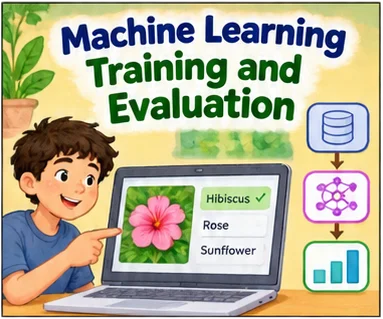
- 5The stated workflow is: collect labelled examples, train the model, then evaluate it on a separate test set. Put the steps in order.
- 6Why reserve examples that were not used to fit the model for a test?To avoid recording any prediction errors during evaluation · To remove the need to check labels · To check performance on examples not used for fitting · To guarantee perfect performance everywhere
- 7A model that performs well on its training examples necessarily performs equally well on every future input.True · False
- 8Listen to the test note. How many predictions were correct?3 · 8 · 10 · 7
- 9A model predicts “cat” for a picture known to contain no cat. In this exercise “cat” is the positive class. What kind of error is this?A true positive · A correct negative · A false positive · A false negative
- 10A chart should show 2 errors in group A and 4 in group B. Which picture matches?
- 11A model predicts “no cat” for a picture known to contain a cat. “Cat” is the positive class. What kind of error is this?A false negative · A true negative · A false positive · A correct positive
- 12A false positive and a false negative are the same kind of mistake.True · False
- 13A model sees only daylight photographs during training. It is proposed for nighttime images. What is an appropriate next check?Discard all nighttime examples without checking. · Assume daylight training guarantees nighttime accuracy. · Check only whether nighttime image files have short names. · Test it on separately labelled nighttime images.
- 14A test set contains the exact training examples, and the score is presented as evidence for unseen examples. What is the issue?The evaluation does not use separate unseen examples. · The model has automatically been tested on every future case. · The score measures how quickly the model was trained. · The examples have no labels by definition.
- 15The specified evaluation plan is: prepare a separate labelled test set, run predictions on it, then compare predictions with labels. Put the steps in order.
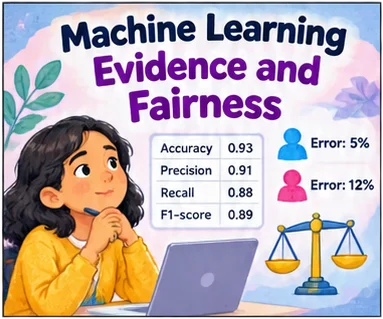
- 16An overall score alone necessarily reveals the error rate for every subgroup.False · True
- 17Group A has 8 correct predictions out of 10; group B has 6 correct out of 10. Which statement is supported for this test?Both groups had exactly eight correct cases. · Group A has two more correct cases than group B in this test. · Every future case in A will be correct. · Group B has more correct cases.
- 18Listen to the comparison. Which group had more errors in the stated test?Neither group made any errors. · Group A · Group B · They had the same number
- 19A model outputs a high-confidence prediction, but an independent check contradicts it. What is the best supported response?Change the independent evidence solely to match the model. · Treat the prediction as automatically true. · Investigate the contradiction and assess the independent evidence. · Discard the check solely because the model is confident.
- 20A test should consider whether its examples resemble the conditions where the model will be used.False · True
- 21A model has 9 correct predictions on 10 test examples. Which claim follows?The model made nine errors in those ten examples. · It was correct on 9 of the 10 stated test examples. · It will be correct on every future example. · It made no errors on the test.
- 22A model misses 4 actual positive cases and incorrectly labels 1 negative case positive. Which error type is more frequent in this test?False negatives · False positives · True positives · The two counts are equal
- 23A team wants evidence for a new setting with different lighting. Which evaluation plan best addresses that need?Delete every example from the new lighting. · Report only the old training score. · Assume lighting cannot matter without testing. · Test on separately labelled examples from the new lighting.
About this worksheet
A printable worksheet made from the KiwiBee game “An AI Prediction Is Not a Fact”. Open it in the free Worksheet Studio to choose the design and the sheet type, then print it or save a PDF.
Interpret training and test examples, compare stated error types and evaluate the limits of a prediction.
- ms 264
- computing
- interpret training and test examples
- compare error types
- evaluate a prediction s limits
 Home
 All solutions
 Pricing
 About us
 KiwiBee for Non-profits
 Events & webinars
 For big organisations
 For schools
 For centers
 For team leaders
 For teachers
 Resources
 Printable worksheets
 Interactive simulations
 Teacher tools
 Ideas and research


Comments