
Printable worksheet
A Reliable Research Note
QuizEnglishGrade 6English

Practise more with these
Picked by meaning from games, worksheets, simulations, teacher tools and videos.
 GameSummarise Without Losing the Point
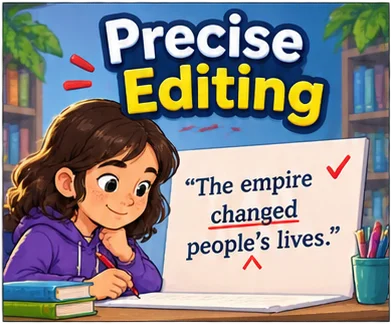 GameEditing for Precision and Integrity
 GameResearch Questions and Source Conversations
 GameA Clear Analytical Paragraph
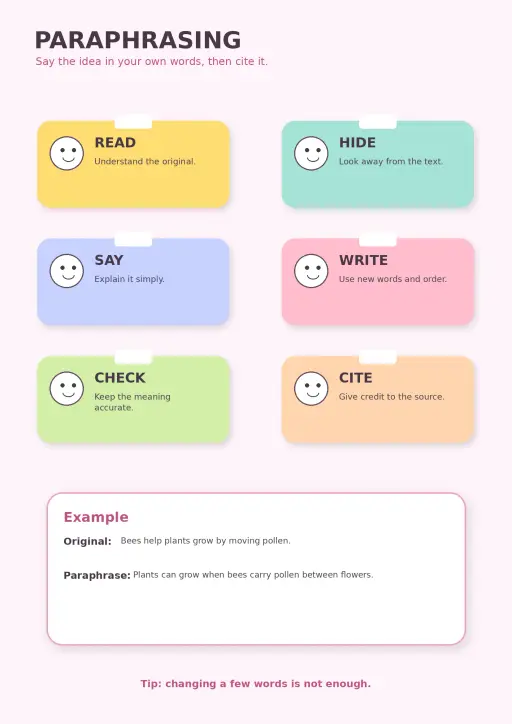 WorksheetParaphrasing Research Infographic
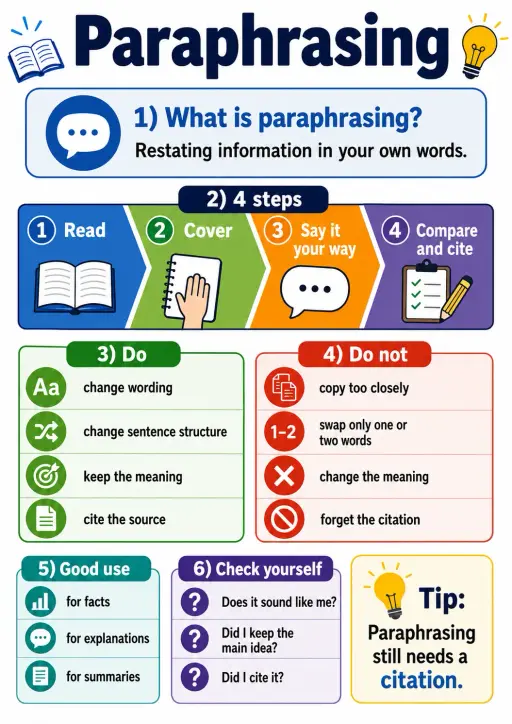 WorksheetParaphrasing Research Infographic
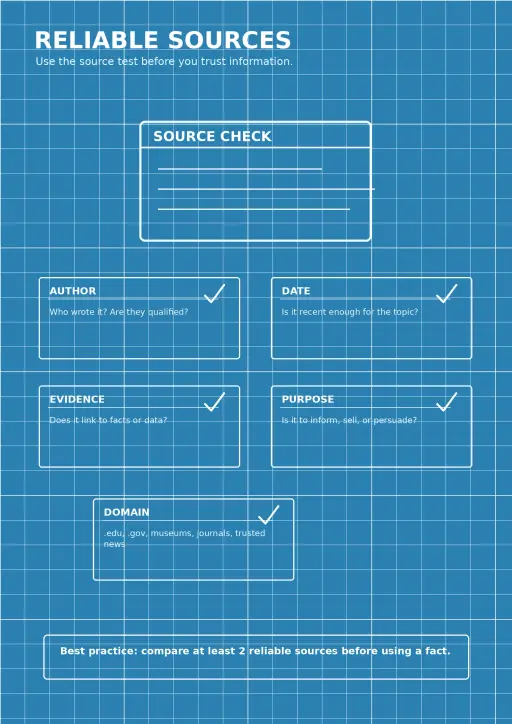 WorksheetReliable sources Research Infographic
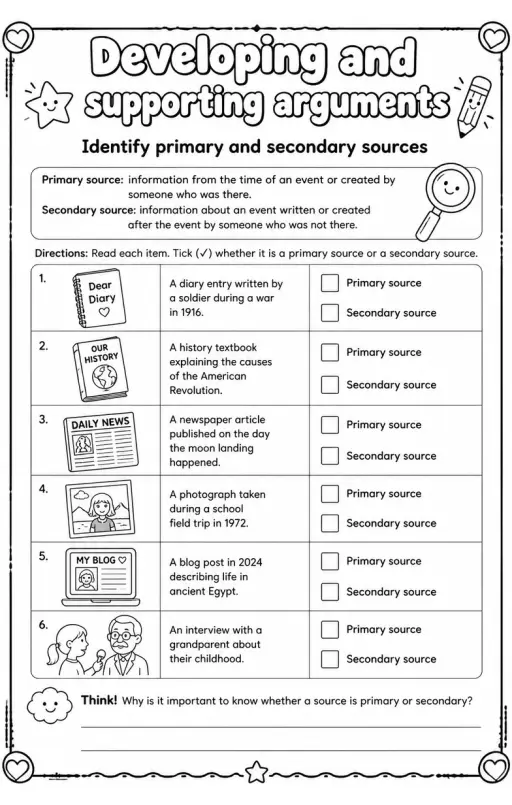 WorksheetIdentify primary and secondary sources
On this sheet
The words and questions from the game
- 1Source A, club log: “Seven volunteers sorted the books on Tuesday.” Which note is an accurate paraphrase?According to the club log, seven volunteers sorted books on Thursday. · The club log says all pupils sorted books daily. · According to the club log, seven volunteers organized the books on Tuesday. · The club log says seven teachers wrote books on Tuesday.
- 2Source A, club log: “Seven volunteers sorted the books on Tuesday.” A paraphrase may replace volunteers with teachers without changing the meaning.True · False
- 3Which visual workflow creates a paraphrase that preserves meaning and identifies its source?
- 4Source B, pupil report: “The reading corner was quieter after the curtains were fitted, although the report did not measure sound levels.” Which note preserves The pupil report described a quieter corner after curtains were fitted, without sound measurements. · The pupil report proved curtains reduced noise by half. · The report measured silence in every room. · The report measured a ten-decibel reduction after fitting curtains.
- 5Source B, pupil report: “The reading corner was quieter after the curtains were fitted, although the report did not measure sound levels.” The source explicitlyTrue · False
- 6Source B, pupil report: “The reading corner was quieter after the curtains were fitted, although the report did not measure sound levels.” Which change would maKeeping the source label B · Replacing described with scientifically proved · Retaining the pupil’s exact words inside quotation marks · Including the absence of measurements
- 7Which diagram correctly handles a direct quotation?
- 8Source C: “The roof garden opened in May. It held six planter boxes and a shaded bench.” Which sentence is a summary rather than a direct quotation?Source C states, “The roof garden opened in May. It held six planter boxes and a shaded bench.” · Source C describes a roof garden that opened in May. · Source C states, “The roof garden opened in May.” · Source C states, “It held six planter boxes and a shaded bench.”
- 9Source C: “The roof garden opened in May. It held six planter boxes and a shaded bench.” “Six shaded benches opened in May” is an accurate summary.True · False
- 10Order the actions for recording a quotation, using the stated dependencies.
- 11Source D, caretaker note: “The west gate sticks after rain.” Source E, timetable: “The east gate opens at eight.” Which note correctly matches claim and source?D reports the west-gate problem after rain. · D reports the east gate’s opening time. · E reports that the east gate sticks after rain. · E reports that the west gate sticks.
- 12Source D, caretaker note: “The west gate sticks after rain.” Source E, timetable: “The east gate opens at eight.” A note citing only E supports the claim that rTrue · False
- 13Source D, caretaker note: “The west gate sticks after rain.” Source E, timetable: “The east gate opens at eight.” Which combined note avoids mixing the gates?D and E state that both gates always open at eight. · D gives an east-gate problem; E gives the west gate's opening time. · Both sources prove the east gate sticks after rain. · D reports a rain-related west-gate problem; E gives an east-gate opening time.
- 14Source F, trial note: “In our two-week trial, most users found the new labels easier to read.” Source G, visitor comment: “I could not read the labels from the G proves no users could read any label. · Both sources measured every viewing position for a full year. · F and G prove the labels were readable from every position. · F reports a mostly positive short trial; G records a difficulty at one viewing position.
- 15Source F, trial note: “In our two-week trial, most users found the new labels easier to read.” Source G, visitor comment: “I could not read the labels from the True · False
- 16Source F, trial note: “In our two-week trial, most users found the new labels easier to read.” Source G, visitor comment: “I could not read the labels from the Cite G as proof that F measured all viewing positions. · Keep proved and replace everyone with every future visitor. · Restore the reported rather than proved status and change everyone to most users. · Remove the trial duration and keep everyone.
- 17Source F, trial note: “In our two-week trial, most users found the new labels easier to read.” Source G, visitor comment: “I could not read the labels from the Readability at different viewing distances remains to be tested systematically. · Every viewing distance has already been tested. · No further evidence could be relevant. · The doorway comment proves no systematic tests are possible.
About this worksheet
A printable worksheet made from the KiwiBee game “A Reliable Research Note”. Open it in the free Worksheet Studio to choose the design and the sheet type, then print it or save a PDF.
Build accurate research notes from original source extracts, preserving wording, attribution and limits.
- ms 076
- english
- paraphrase a source
- distinguish quotation from summary
- match a claim to its source
 Home
 All solutions
 Pricing
 About us
 KiwiBee for Non-profits
 Events & webinars
 For big organisations
 For schools
 For centers
 For team leaders
 For teachers
 Resources
 Printable worksheets
 Interactive simulations
 Teacher tools
 Ideas and research


Comments