
Printable worksheet
A Coast That Keeps Changing
QuizSocial StudiesGrade 3English

Practise more with these
Picked by meaning from games, worksheets, simulations, teacher tools and videos.



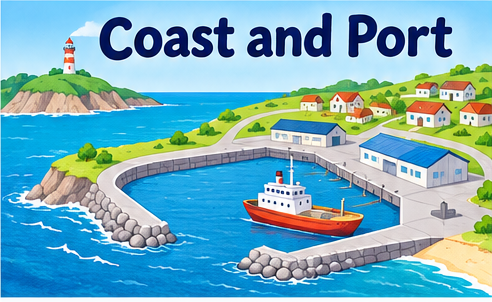
On this sheet
The words and questions from the game
- 1Waves remove sediment from a model shore. Which process is described?Erosion · Weathering without removal · Deposition · Photosynthesis
- 2Deposition adds transported material to a location.True · False
- 3A supplied beach record shows sand accumulating beside a barrier. What is directly supported?The whole coastline gained sand everywhere · No sediment moved · Deposition occurred at that observed location · The recorded sand amount at that location decreased.
- 4A cliff edge moves inland in matched dated surveys. What does that indicate?Creation of a new mountain necessarily · Proof that every coast changes identically · The cliff edge advanced seaward · Retreat of the measured cliff edge
- 5Order these dated shoreline positions.
- 6Listen. Which observation indicates deposition?Loss from the cliff · Growth of the sand bar · A fall in the sand bar’s sediment volume · Both observations show only removal
- 7Why can one beach gain sediment while another loses it?Every local sediment balance must match · Sediment must be created from nothing · Sediment can be transferred between locations · Transport cannot cross between beaches
- 8A single photograph establishes the rate of coastal retreat.True · False
- 9A supplied model barrier traps sand before it reaches a down-current beach. What is a possible consequence under that model?Less sediment supply to the down-current beach · More sand necessarily reaches the down-current beach · The current no longer exists by definition · Guaranteed growth of every beach
- 10Why compare shoreline surveys at stated tidal conditions?Tides can never affect visible shoreline position · Different water levels can change the apparent shoreline · Only camera colour matters · Tidal height proves the cliff’s rock type
- 11A protection proposal prevents erosion at one model site but increases erosion at another. What should be evaluated?Only the protected site’s photograph · A guarantee that all barriers are identical · Only the intervention’s purchase price · Both local benefit and the transferred impact
- 12Listen. Which option meets the specified model rule?Neither proposal · Both · P · Q
- 13A mean past retreat rate guarantees the exact retreat next year.True · False
- 14Which extra evidence helps evaluate a dune-restoration proposal?Only the colour of the planting labels · Only the project name · Sediment movement, habitat effects and the stated protection outcome · An assumption that vegetation solves every coastal problem
- 15Order these stages in the specified monitoring plan.
- 16What claim is supported by sediment accumulating on one side of a barrier?Every distant beach gained the same amount · The barrier may affect local sediment distribution · Every nearby barrier has identical effects · All coastal processes have stopped
- 17A proposal aims to protect two linked beaches. Under comparable survey conditions after a barrier trial, Beach A widens from 20 to 23 m while Beach B narrows frChanges differed; monitor connected sediment pathways. · A single image gives every future rate · Both beaches widened during the trial · One protected point proves permanent coast-wide success
About this worksheet
A printable worksheet made from the KiwiBee game “A Coast That Keeps Changing”. Open it in the free Worksheet Studio to choose the design and the sheet type, then print it or save a PDF.
A 24-question progressive quiz connecting three skills through explicit observations, data and scenarios.
- ms 191
- geography
- identify erosion and deposition evidence
- compare coastal features
- evaluate a simple protection choice
 Home
 All solutions
 Pricing
 About us
 KiwiBee for Non-profits
 Events & webinars
 For big organisations
 For schools
 For centers
 For team leaders
 For teachers
 Resources
 Printable worksheets
 Interactive simulations
 Teacher tools
 Ideas and research


Comments