MathHigh School
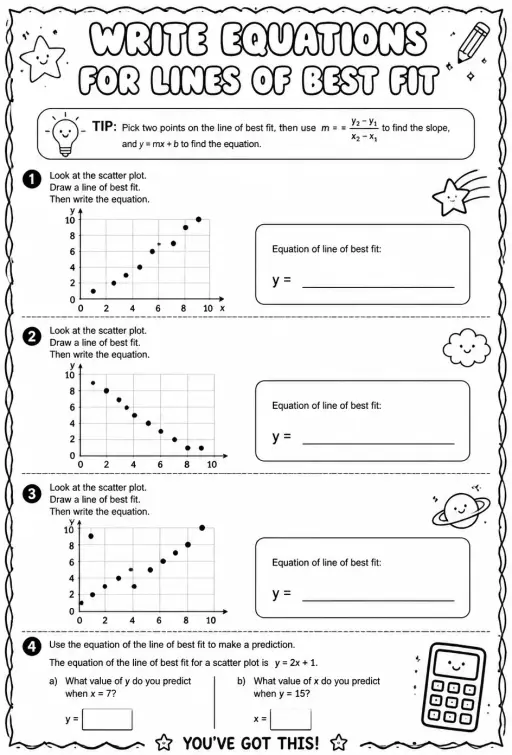
Write equations for lines of best fit
Free printable Algebra 1 math worksheet for "Write equations for lines of best fit" — practice bivariate statistics. No-prep, print or assign online.
——
KiwiBee uses optional Google Analytics, Google Ads, and Meta Pixel cookies to understand adult visitors, measure completed sign-ups, and improve campaigns. Essential cookies always stay on. OpenAI’s ChatGPT Ads Pixel also measures page views and completed enquiries after advertising consent, and may use hashed contact details for matching. Privacy policy

Picked by meaning from games, worksheets, simulations, teacher tools and videos.
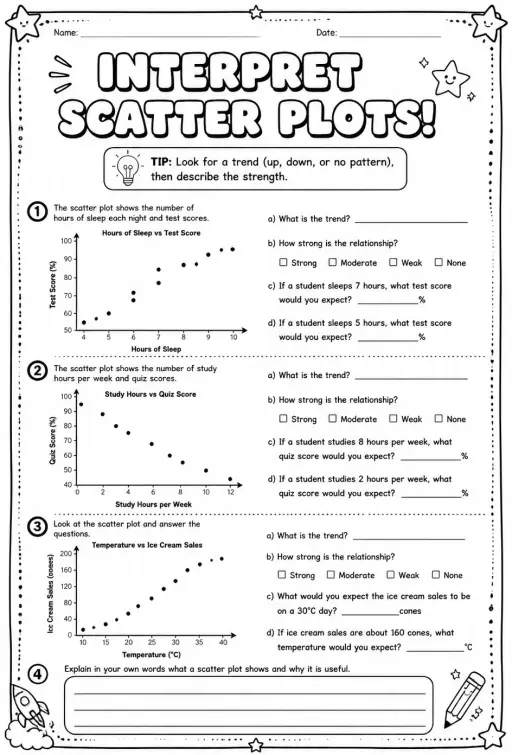 WorksheetInterpret scatter plots
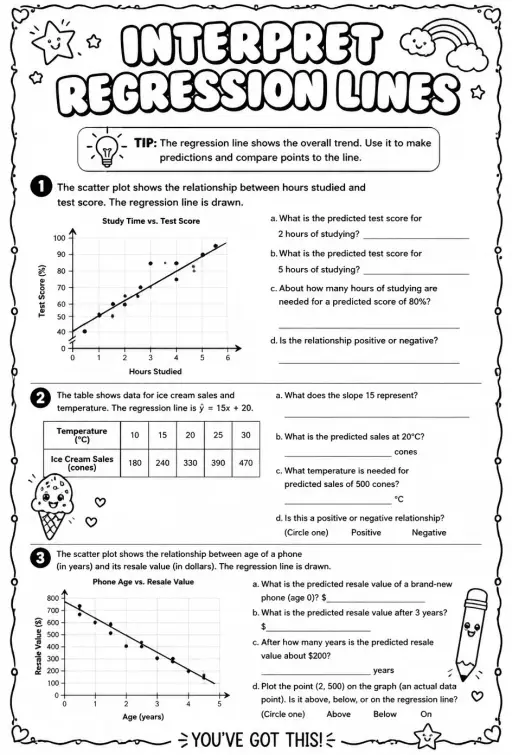 WorksheetInterpret Regression Lines: Test Scores, Ice Cream and Phones
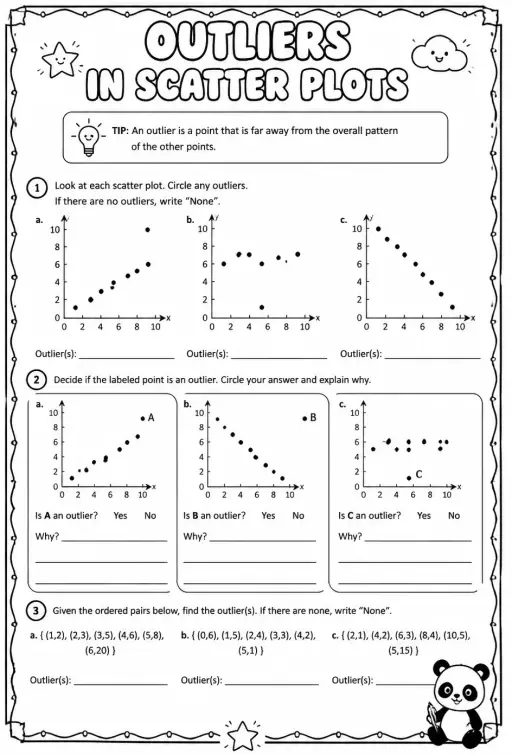 WorksheetOutliers in Scatter Plots: Circle, Explain and Find from Pairs
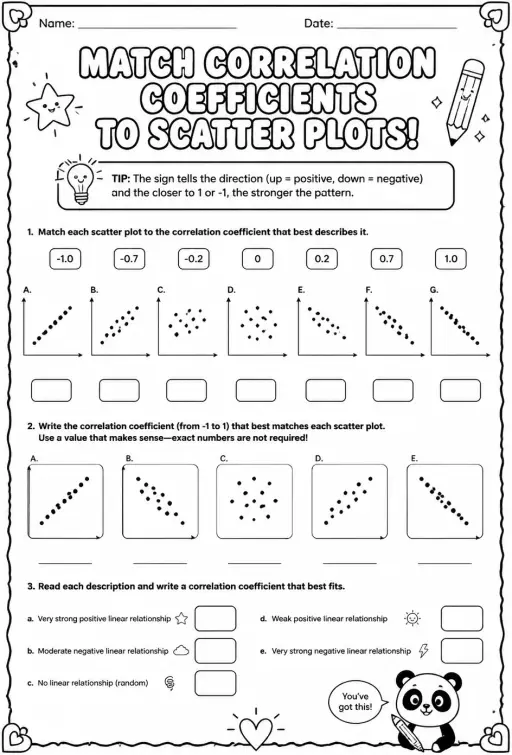 WorksheetMatch Correlation Coefficients to Scatter Plots and Descriptions
 SimulationSlope and Intercept Grapher
 GameChoosing a Statistical Model
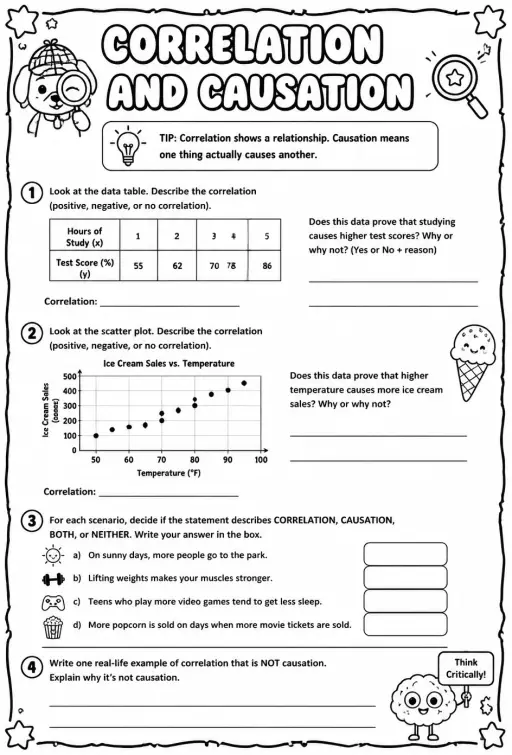 WorksheetCorrelation and causation
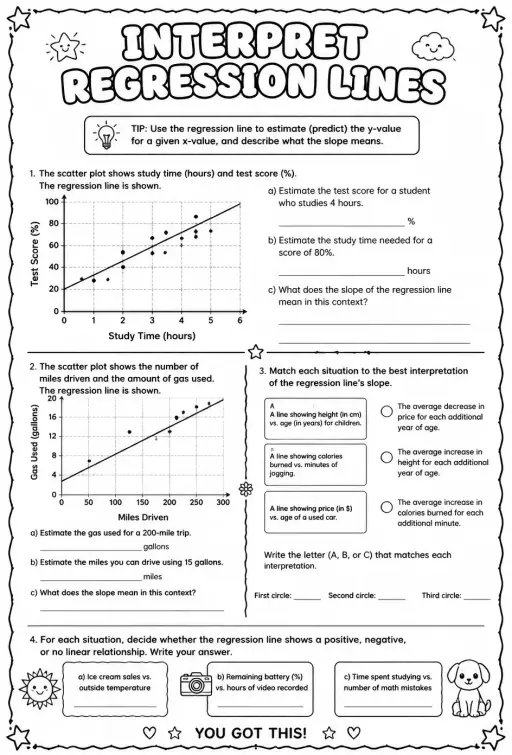 WorksheetInterpret regression lines
This worksheet provides challenging scatter plot interpretation exercises designed for Algebra 1 students. Teachers can use it to reinforce understanding of bivariate statistics by having students analyze data points, recognize correlation types, and draw conclusions from graphical representations. Ideal for developing critical thinking skills in data analysis and enhancing proficiency in interpreting statistical graphs.
Learning objectives © UCLES (Cambridge University Press & Assessment), quoted with attribution.
Skill lists aligned to IXL Learning skill plans, carried over from KiwiBee's System presets; the Maths section names are KiwiBee's own. IXL is a trademark of IXL Learning; no endorsement is implied.
Free printable Algebra 1 math worksheet for "Write equations for lines of best fit" — practice bivariate statistics. No-prep, print or assign online.
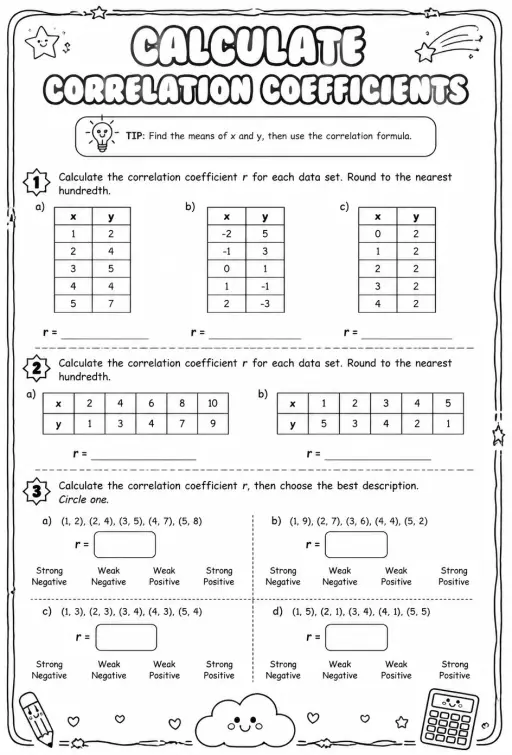
Students calculate the correlation coefficient r, rounded to the nearest hundredth, for five data tables, including one with a constant y value. Then they find r for four lists of points and circle a description from strong negative to strong positive.
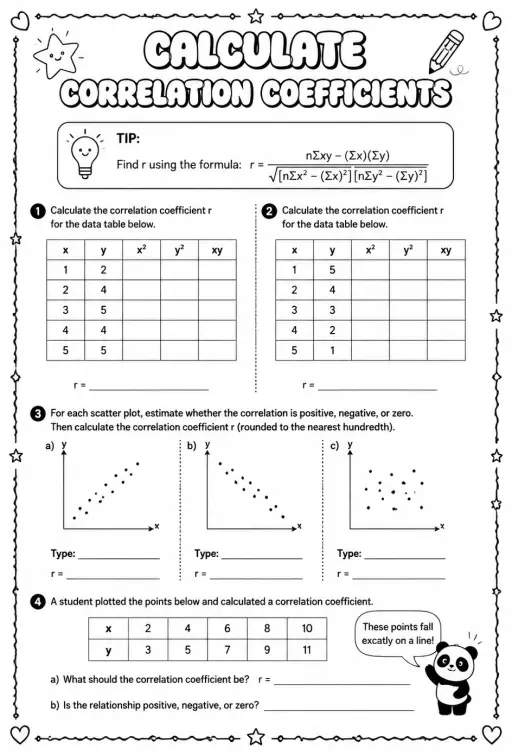
Students use the formula for r with x², y² and xy columns to fill in on two five-point data tables, estimate the type of correlation for three scatter plots, and find r for points that fall exactly on a line.
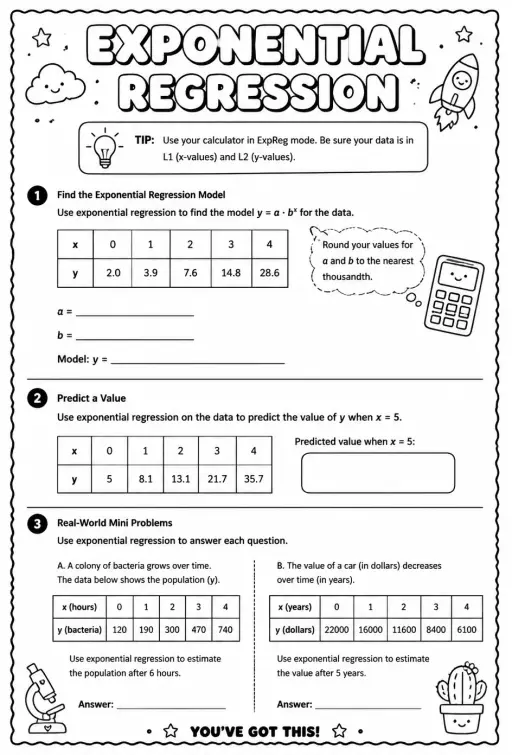
Students use a calculator in ExpReg mode to find a and b for y = a · b^x from a table, predict y when x = 5, then estimate a bacteria population after 6 hours and a car's value after 5 years.
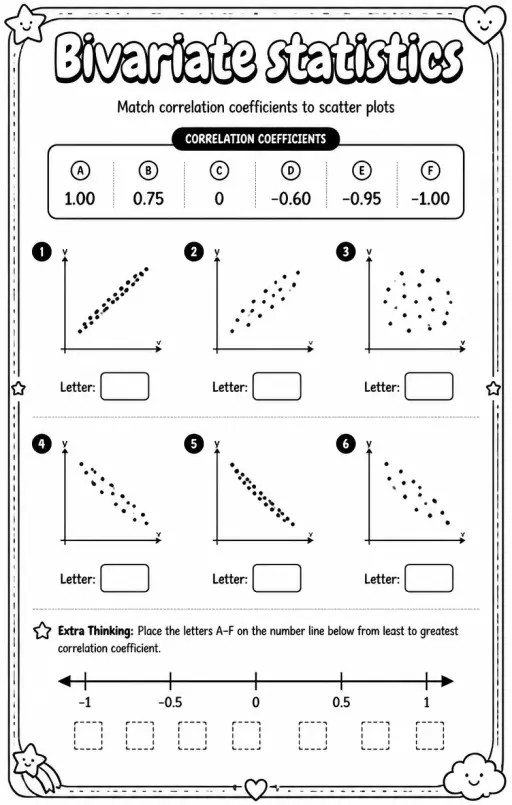
Students match six scatter plots to a bank of coefficients labeled A to F, from 1.00 to -1.00, by writing a letter under each plot. An Extra Thinking task asks them to place the letters on a number line from least to greatest.
See what other teachers think and share a helpful note.
Generate a fresh worksheet for any grade, topic and language. Free.
 Home
 All solutions
 Pricing
 About us
 KiwiBee for Non-profits
 Events & webinars
 For big organisations
 For schools
 For centers
 For team leaders
 For teachers
 Resources
 Printable worksheets
 Interactive simulations
 Teacher tools
 Ideas and research


