
Exponential Functions over Unit Intervals: Three Tables
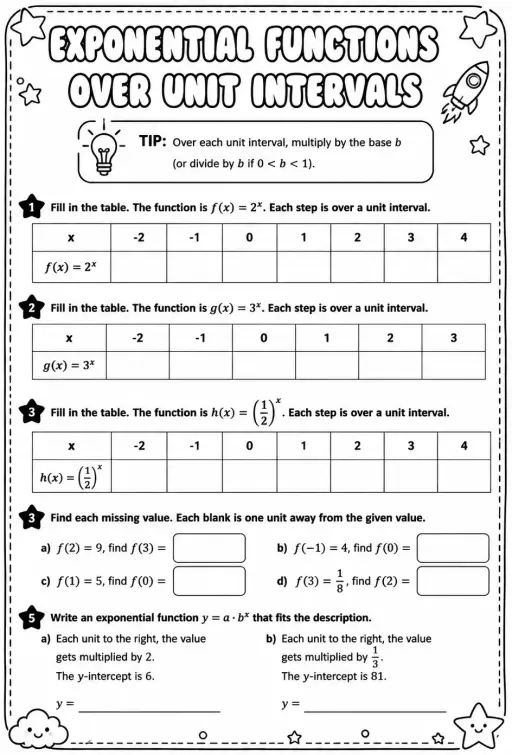
Students fill in tables for 2^x, 3^x and (1/2)^x over unit intervals, find four missing values one unit away from a given value, and write two functions y = a · b^x from a description.
KiwiBee uses optional Google Analytics, Google Ads, and Meta Pixel cookies to understand adult visitors, measure completed sign-ups, and improve campaigns. Essential cookies always stay on. OpenAI’s ChatGPT Ads Pixel also measures page views and completed enquiries after advertising consent, and may use hashed contact details for matching. Privacy policy
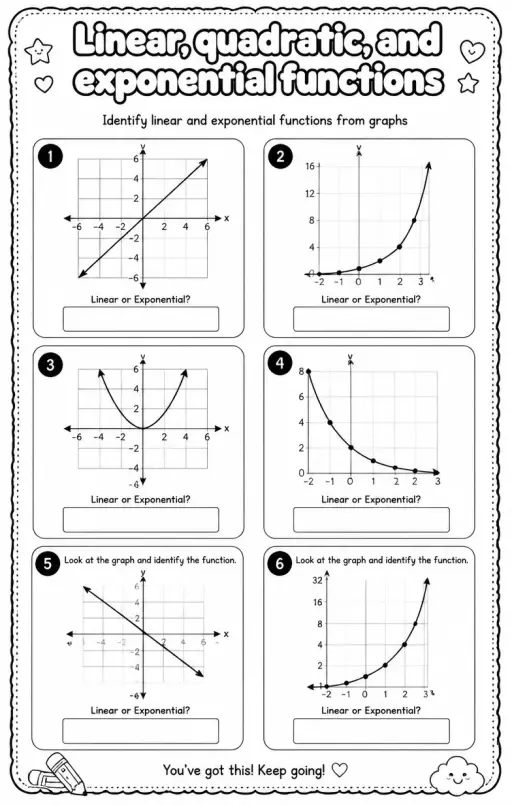
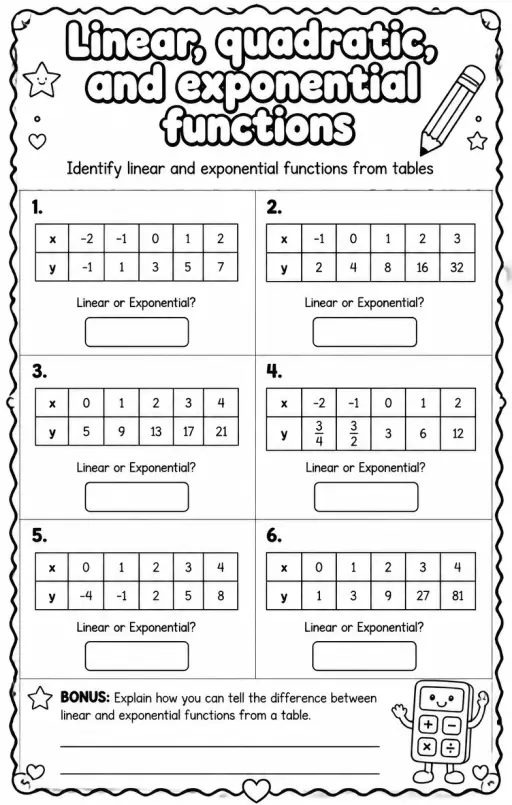
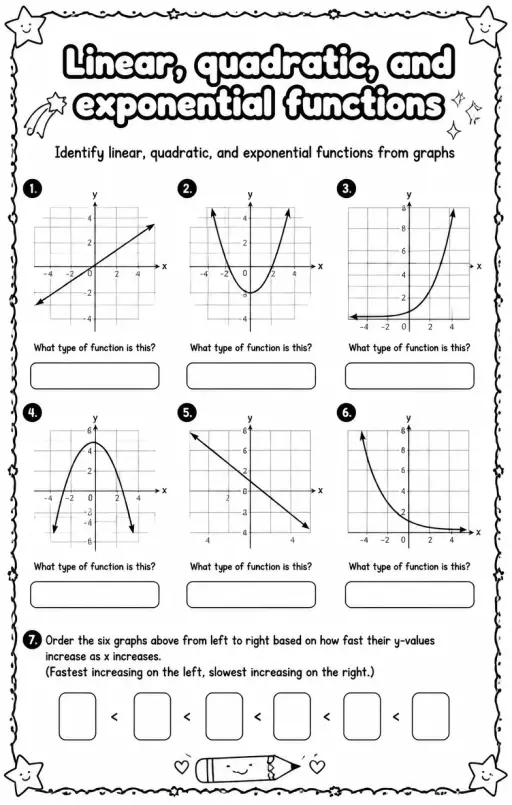
This worksheet challenges students to identify and differentiate between linear and exponential functions through a variety of problems involving equations, graphs, and data tables. Teachers can use this resource to reinforce students' understanding of function types and enhance their analytical skills in precalculus. Ideal for high school math classes focusing on exponential functions and function classification.
Learning objectives © UCLES (Cambridge University Press & Assessment), quoted with attribution.
Skill lists aligned to IXL Learning skill plans, carried over from KiwiBee's System presets; the Maths section names are KiwiBee's own. IXL is a trademark of IXL Learning; no endorsement is implied.
Students fill in tables for 2^x, 3^x and (1/2)^x over unit intervals, find four missing values one unit away from a given value, and write two functions y = a · b^x from a description.
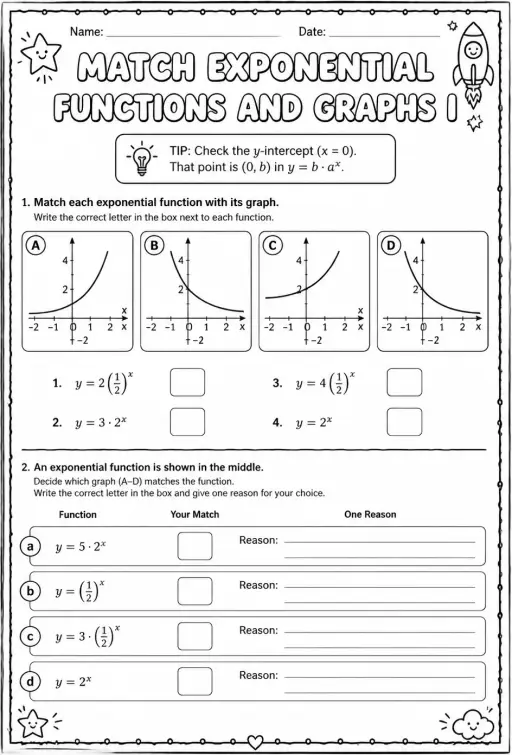
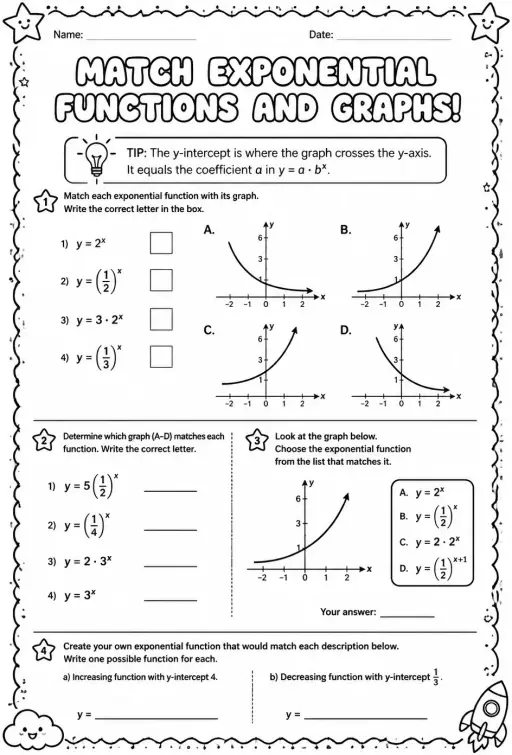
Free printable Algebra 1 math worksheet for "Match exponential functions and graphs I" — practice exponential functions. No-prep, print or assign online.
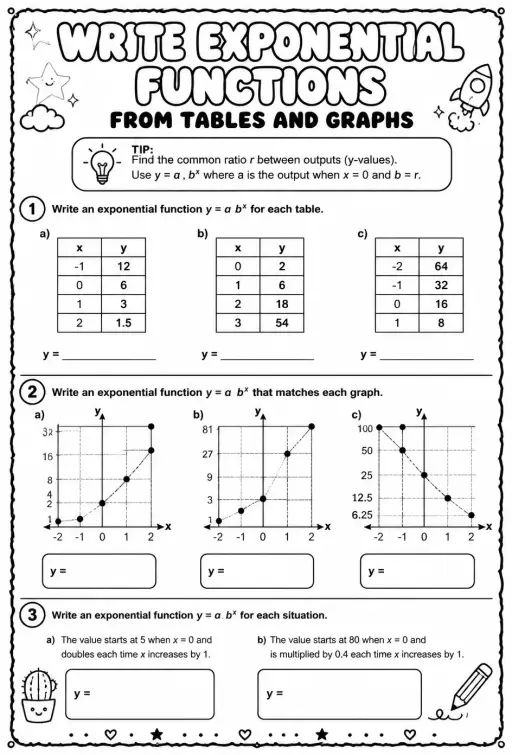
Free printable Algebra 1 math worksheet for "Write exponential functions from tables and graphs" — practice exponential functions. No-prep, print or assign online.
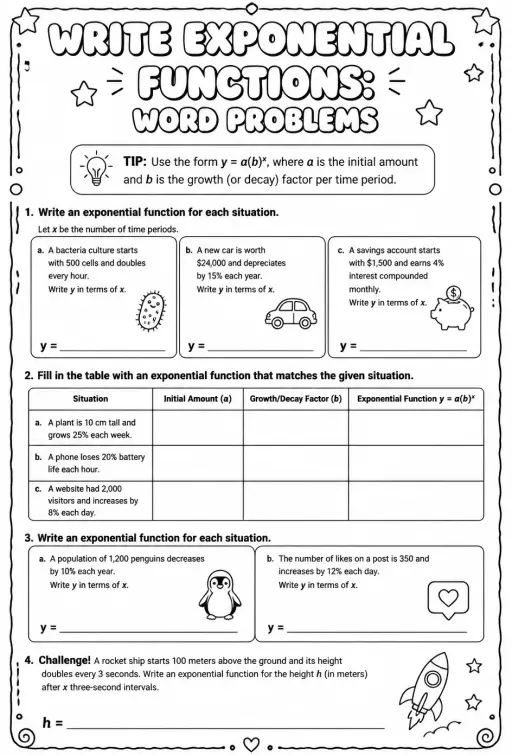
Students write exponential functions of the form y = a(b)^x for growth and decay situations: bacteria that double, a car that loses 15% a year, a savings account, a plant and more. A table and a rocket challenge finish the sheet.
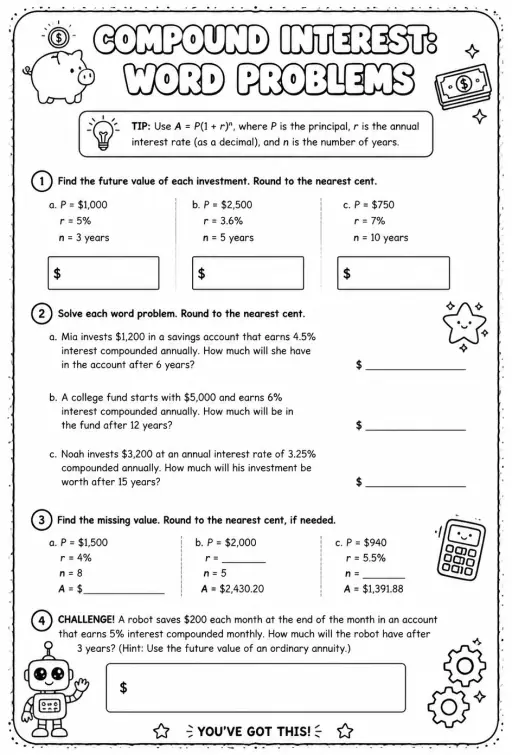
Students use A = P(1 + r)^n to find future values, solve savings stories about Mia, a college fund and Noah, find a missing amount, rate or time, and answer a robot savings challenge. Answers round to the nearest cent.
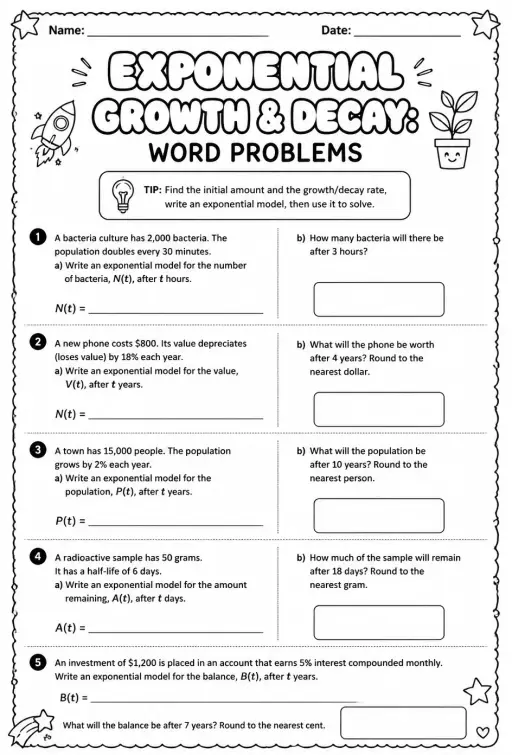
Students write an exponential model for five situations, such as bacteria doubling every 30 minutes, a phone losing 18% a year and a $1,200 investment compounded monthly, then use each model to answer a question.
See what other teachers think and share a helpful note.
Generate a fresh worksheet for any grade, topic and language. Free.