Turn One Classroom Activity into a Reusable Teaching Kit
 By KiwiBee Team
Last updated September 13, 2026
Save the teaching decisions, not just the file
A folder full of activities is not automatically a usable teaching kit. When you return to an old resource, you still need to know what learners were meant to practise, which materials belong together and what you would change. Start with one activity that you have already tried, rather than reorganising your entire collection.
The approach below is a practical planning suggestion, not a tested programme or a promise of reduced workload. Its purpose is modest: leave enough context for your future self, or a colleague, to make a sensible decision about reusing an activity.
Make a one-page activity card
Record the learning goal as something you can observe. “Explain why these shapes belong together” gives more direction than “fun sorting game.” Add the intended age range, prerequisite knowledge, materials, setup and a short sequence of instructions.
Include an example response and one question that exposes a likely misunderstanding. Write down how you will hear from each learner, not just the quickest volunteer. Keep the original printable or editable file beside this card. A colleague should not have to guess which attachment matches the instructions.
Separate the stable routine from replaceable content. For a sorting activity, taking turns and explaining a choice may stay the same; the pictures, number of choices and vocabulary may change. Mark these adjustable parts clearly so reuse does not mean repeating everything unchanged.
A fictional shape-sorting kit
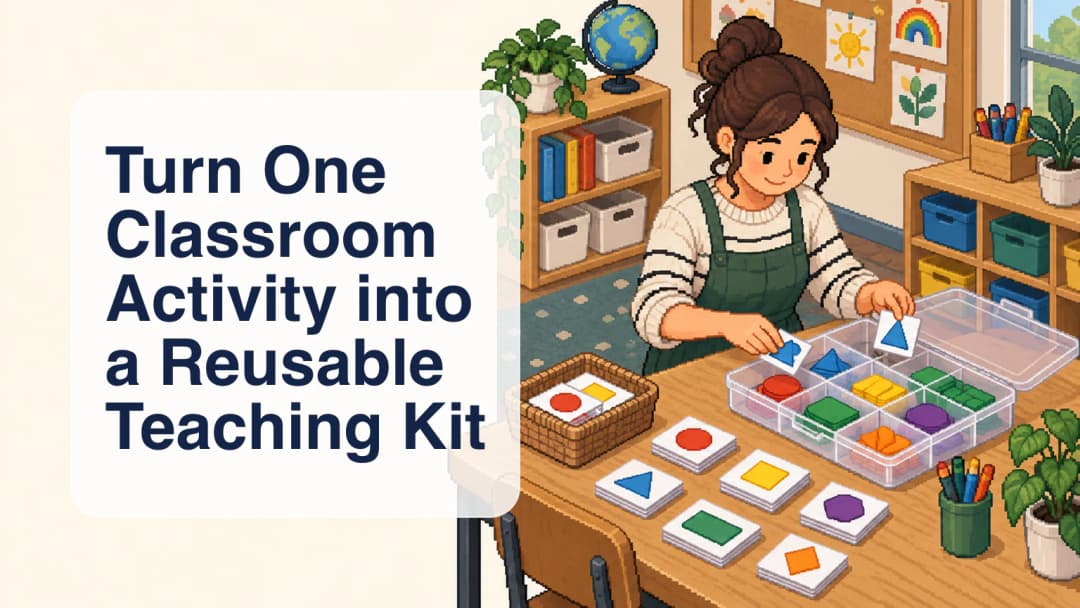
Imagine a primary teacher whose class has sorted triangles and non-triangles. The kit contains varied triangle cards, other shapes, two sorting mats and a prompt: “What makes this a triangle?” The teacher includes rotated and narrow triangles so appearance alone does not settle the task.
During the lesson, one pair rejects a triangle because its point faces sideways. The teacher asks them to trace and count its straight sides, then reconsider. Afterwards, the activity card records this misunderstanding and the prompt that was used; it does not attach children's names.
For the next class, the teacher keeps the goal but offers larger cards and fewer choices. A separate check asks each learner to explain one unfamiliar example. The kit preserves a teaching decision while leaving room for a different group.
Store a small, complete set
Use one envelope, box or digital folder for the instructions, materials and answer guidance. Give it a descriptive name, an age or curriculum note and a revision date. Mark whether it is ready to use or still needs checking.
If sharing digitally, confirm that files open for the intended colleague and that images may be reused. Keep identifiable student work out of a shared kit unless appropriate permission and school procedures are in place. Do not turn a resource folder into an informal pupil record.
Review before using it again
Ask three questions: Does the goal fit this class? Can everyone access the materials? What will I observe to decide the next step? Retire an activity that no longer serves a useful purpose.
Browse printable resources or teaching tools only when a specific missing item would help. For tomorrow, choose one existing activity and add its goal, a worked example and one adaptation. A small kit you understand is a better starting point than a large collection you cannot confidently use.
Explore the platform
Continue with KiwiBee
Choose the KiwiBee workspace or resource library that fits what you need next.
 For big organisations
 For schools
 For centers
 For team leaders
 For teachers
 AI and resources
 Printable worksheets
 Interactive simulations
 Teacher tools
 AI studio
 Ideas and research