Managing Physical Library Copies, Loans, and Holds in One School Catalog
 By KiwiBee Team
Last updated August 30, 2026
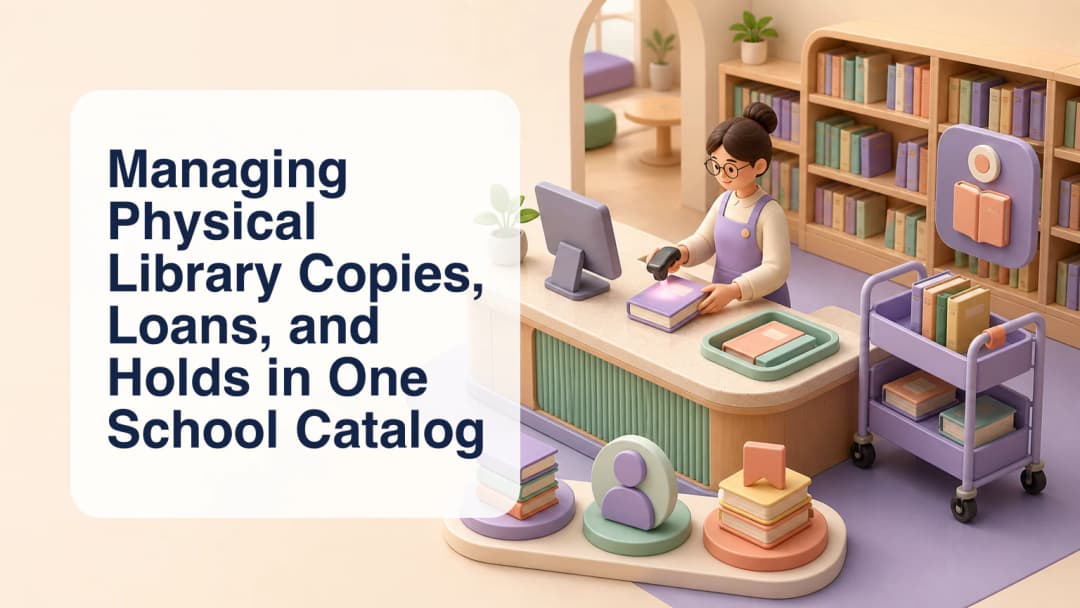
School library circulation software needs to distinguish a book title from the physical items a school can actually lend. KiwiBee’s physical library workspace uses catalog records for the work and independently tracked copies for the objects on the shelf. That foundation supports clearer loans, holds, returns, and inventory decisions.
Catalog the title, then track each copy
A catalog record describes the book. Its copies can carry their own barcode or accession details, call number, shelf location, condition, and status. If a school owns several copies of the same title, librarians can manage those items without creating a disconnected book record for every copy.
Physical operations remain school-scoped. An organization-wide librarian still selects a school for catalog and circulation work, while a school- or campus-restricted librarian can work only within assigned scope. If scope cannot be resolved, the library workspace is designed to fail closed rather than expose another school’s records.
Connect circulation and holds
The circulation area supports checkout, return, renewal, lost-item handling, holds, and hold cancellation through server-validated operations. Members, current loans, and holds sit alongside the catalog so the librarian can understand who has an item and what should happen next. Actual policy and permissions depend on the organization’s settings.
The school library overview explains this physical workflow. For a separate view of student reading activity, see the reading log overview; it should not be confused with a physical checkout record.
Review imports before registering books
Bulk catalog work often begins in a spreadsheet. KiwiBee’s documented import flow accepts Excel or CSV data into a staged review. The librarian maps columns, resolves invalid or missing values, and reviews the proposed rows before choosing to register valid books. No catalog write occurs merely because a file was selected.
AI can suggest mappings for unresolved columns, but it cannot register or mutate the catalog. Librarians should verify identifiers, titles, authors, copy counts, locations, and any local conventions before the final import action.
A practical setup sequence is:
- Confirm the correct school scope and library settings.
- Create or import catalog records through the review stage.
- Register and label each physical copy.
- Configure member and hold policies appropriate to the school.
- Use circulation actions for checkout, renewal, return, loss, and holds.
- Review reports and copy status to plan follow-up.
Routine data quality still matters after launch. Librarians can periodically review duplicate identifiers, items without locations, overdue loans, unresolved holds, and copies marked lost or damaged. The reports support that review, while local policy determines notices, replacement decisions, and member follow-up.
Digital Reading is a separate organization-wide capability and should not be presented as universally available or as a promise of licensed content. Contact KiwiBee to discuss physical library workflows for your schools.
Explore the platform
Continue with KiwiBee
Choose the KiwiBee workspace or resource library that fits what you need next.
 For big organisations
 For schools
 For centers
 For team leaders
 For teachers
 AI and resources
 Printable worksheets
 Interactive simulations
 Teacher tools
 AI studio
 Ideas and research