Connect Units, Skills, Objectives, and Lessons in One Curriculum View
 By KiwiBee Team
Last updated September 1, 2026
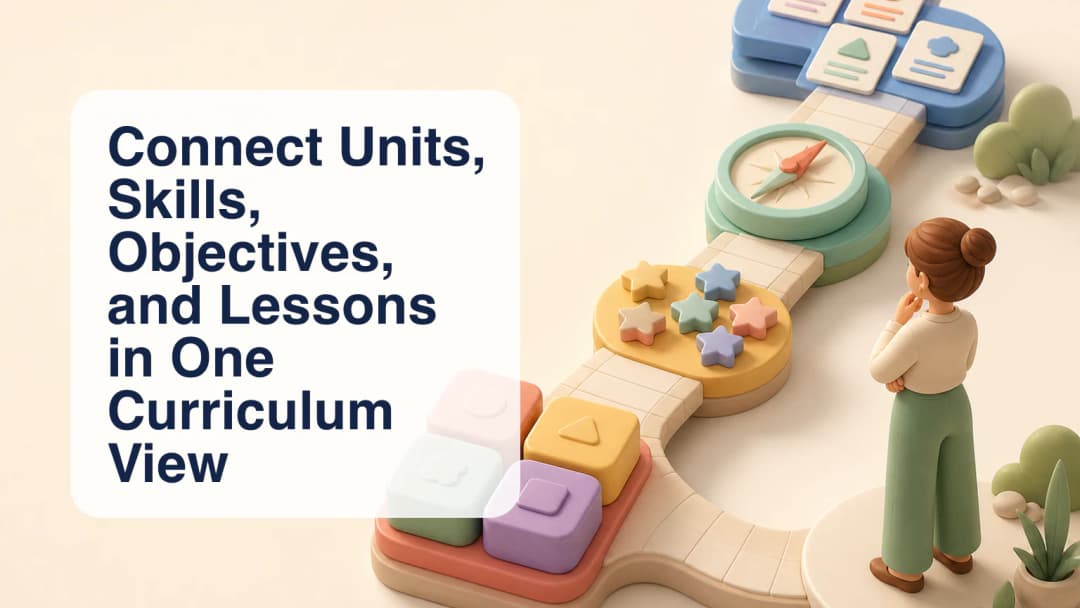
A curriculum becomes difficult to use when its sequence, teaching intentions, and standards live in separate places. KiwiBee's Curriculum Platform brings pacing and design information into one connected board. Depending on the workspace, that board can show terms, units, weeks, lessons, strands, standards or skills, lesson objectives, rubrics, and teacher-book guidance. It is a documented navigation and authoring workflow, not a promise that every role can edit every field. Access depends on the active role, organization configuration, class and curriculum links, available data, and enabled modules.
Follow the pacing structure from units to lessons
The pacing hierarchy is Term → Unit → Week → Lesson. After an authorized user chooses an accessible curriculum, selecting a unit narrows the weeks, and selecting a week reveals its assigned lessons. Where data exists, the board can auto-select the first available item so related columns populate. An individual-teacher workspace may create the hierarchy from the top down, while organization-managed teachers generally receive a read-only pacing view and curriculum management stays with the academic department.
Explore AI lesson planning in KiwiBee.
Keep lesson objectives and skills in their proper roles
Opening a lesson reveals its design context. Lesson objectives describe what that lesson intends learners to achieve. Linked standards or skills add curriculum alignment and can enrich activities and assessment, but they do not silently replace the objectives. Objective rows are canonical and mirrored to legacy lesson consumers, so edits remain visible across supported views. A selected standard may also have rubric descriptors when the organization has configured them.
Treat the visible connections as structured evidence, not as an automatic curriculum judgment. Missing panels may mean there is no configured data or that the current role lacks access. Do not infer that a hidden field is absent from the curriculum, and do not change shared structures unless the active workspace grants that authority.
Review KiwiBee curriculum tools.
Review one connected curriculum context
The practical value is traceability: a reviewer can move from a unit's place in the sequence to a lesson, inspect its objectives, and see the standards connected to that work. Selected class, curriculum, lesson, objectives, standards, and permitted sources can also become bounded context for planning tools. That context does not prove that generated material is pedagogically correct; a teacher still reviews accuracy, level, sequencing, inclusion, and assessment fit.
- Choose a class and curriculum available to the active role.
- Select the relevant term and unit, or use the permitted flat pacing view.
- Open the week and lesson that match the intended point in the sequence.
- Read the lesson objectives before interpreting linked skills or standards.
- Review linked standards and any configured rubric descriptors as supporting alignment.
- Use the connected context for planning only after checking permissions and pedagogical fit.
One curriculum view is useful because it preserves the relationship between sequence, intention, and alignment. The human reviewer remains responsible for deciding whether those relationships make sense for the learners in front of them.
Explore the platform
Continue with KiwiBee
Choose the KiwiBee workspace or resource library that fits what you need next.
 For big organisations
 For schools
 For centers
 For team leaders
 For teachers
 AI and resources
 Printable worksheets
 Interactive simulations
 Teacher tools
 AI studio
 Ideas and research