Using Avatar-Based Rewards to Reinforce School Values
How to make classroom rewards more meaningful by connecting recognition to identity, behavior categories, and teacher routines
 By KiwiBee· KiwiBee
Last updated July 11, 2026
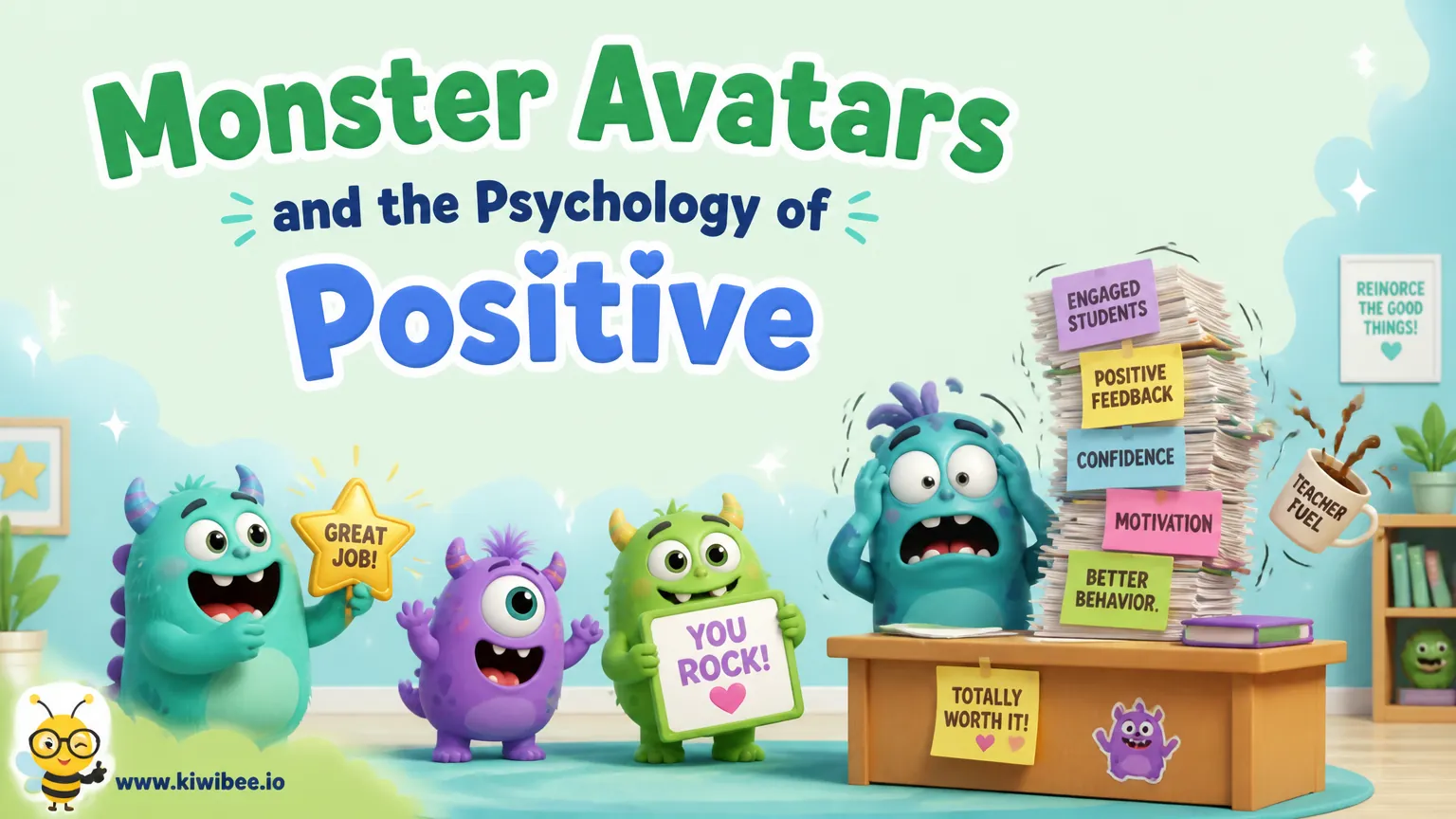
Many classrooms use points, stickers, or tokens to recognise positive behaviour. These systems can help at first, but they often become less effective when students stop finding the reward meaningful.
One practical alternative is to shift the focus from collecting points to building identity. Instead of treating recognition as a tally, teachers can connect it to personal growth, classroom values, and visible progress.
One version of this approach uses an evolving avatar. The avatar is not the goal on its own. It works best as a simple visual way to show that a student’s actions reflect habits such as curiosity, resilience, or kindness.
Why points can lose their impact
A point system can become too abstract. Students may understand that points are good, but not connect them to the specific behaviours adults want to reinforce.
This matters most for students who need behaviour support the most. A generic system may reward compliant students without helping others understand what to do differently next time.
When recognition is tied to a named behaviour and a visible form of progress, the feedback becomes clearer. The message shifts from 'you earned something' to 'you demonstrated a valued habit.' That subtle change can make praise feel more concrete and less transactional.
- Check whether students can explain what actions lead to recognition without being prompted.
- Replace broad labels such as 'good behaviour' with specific habits students can actually demonstrate.
- Notice whether the same students keep succeeding under the current system while others remain stuck.
- Treat rewards as a way to clarify expectations, not just to count compliance.
Why an avatar can support identity rather than simple compliance
An avatar can work as a visual record of growth. If a student’s character gains a trait, feature, or skill when the student shows a positive behaviour, the reward becomes a story about development rather than accumulation.
This can be especially helpful with younger students, who often respond well to visible progression. It may also help older students if the design feels age-appropriate and not childish.
The key is the language around it. If adults say only 'you got a reward,' the system stays shallow. If adults say 'you showed resilience during a difficult task, so your avatar developed,' the recognition is tied back to a meaningful action.
- Use the avatar to represent growth in habits, not status over classmates.
- Choose changes in the avatar that are easy for students to notice and understand.
- Explain each update using behaviour language first and the visual reward second.
- Review whether the avatar still feels respectful and motivating for the age group you teach.
Build behaviour categories around school values
Generic categories such as participation, homework, and behaviour may be easy to set up, but they often hide what teachers are actually trying to encourage.
A stronger model is to define categories based on the values the class or school says it cares about. Curiosity might include asking thoughtful questions. Resilience might include persisting after difficulty. Kindness might include helping a peer rejoin learning.
This makes recognition more understandable for students and more useful for families. Instead of seeing a score with little context, they see which habits were noticed.
- List the school or classroom values you want students to practise consistently.
- Write a plain-language description of what each value looks like during normal lessons.
- Limit the number of categories so staff and students can remember them easily.
- Check that each category describes an observable action rather than a vague personality trait.
- Use the same category names in classroom talk, reports, and behaviour reflection.
Define observable behaviours before you track anything
Teachers are more likely to use a system consistently when the categories are concrete. 'Curiosity' is easier to reinforce fairly when staff agree that it might look like asking a clarifying question, testing a new approach, or making a connection to prior learning.
Without this step, recognition can become subjective. One adult may reward enthusiasm, another may reward quiet compliance, and students receive mixed messages.
A short shared definition for each category reduces confusion and improves consistency across classrooms or across the school day.
- Create two to four observable examples for each value-based category.
- Remove examples that depend too heavily on personality, confidence, or speaking style.
- Discuss edge cases with colleagues so categories are interpreted in similar ways.
- Revisit the examples after a few weeks if students seem confused or if staff use the categories unevenly.
Use recognition moments deliberately across the day
One useful lesson from behaviour tracking is that adults do not notice student effort evenly. Teachers may give more positive feedback in the morning, during favourite subjects, or when their own energy is higher.
That creates an avoidable problem. A student may appear to need less recognition later in the day when in fact the adult is simply less attentive to positive moments.
Reviewing when recognition happens can reveal patterns in teacher practice, not just student behaviour. That makes the system more useful as a reflection tool.
- Scan your records to see whether positive feedback is clustered in particular periods.
- Plan one or two times later in the day when you will actively look for target behaviours.
- Match recognition to moments of genuine effort, especially during harder transitions or less preferred tasks.
- Avoid assuming that a low number of afternoon recognitions means students were less successful.
Keep rewards from overshadowing the behaviour
Visible rewards can help maintain interest, but they should stay secondary to the behaviour being reinforced. If students focus only on unlocking a feature or collecting a prize, the system can drift away from its purpose.
That does not mean tangible or redeemable rewards are always inappropriate. It means they need clear limits. The reward should support motivation without replacing the value of the behaviour itself.
A balanced approach is to keep the recognition immediate and specific, while any extra reward remains modest, occasional, and connected to the classroom culture.
- Give behaviour-specific praise at the same time as the reward so the reason stays clear.
- Keep any redeemable rewards small enough that they do not dominate student attention.
- Watch for bargaining language such as 'What do I get if I do this?' and reteach the purpose of the system if it appears often.
- Pause or simplify the reward layer if students become more focused on collecting than improving.
A hypothetical classroom workflow
Hypothetical example: A primary teacher wants to reinforce three class values: curiosity, resilience, and kindness. Each student has a simple monster avatar that changes slightly when one of those values is recognised.
During a maths lesson, a student tries a second strategy after the first one fails. The teacher names the behaviour: 'That was resilience. You stayed with the problem and changed your approach.' The student’s avatar gains a new feature linked to resilience.
Later, during afternoon reading, the teacher deliberately looks for another recognition opportunity because earlier records showed that most positive feedback happened before lunch. A student helps a classmate find the correct page and settle quickly. The teacher names kindness and updates the avatar. At the end of the week, the family report shows not just that the student was rewarded, but which values were noticed.
- Use hypothetical scenarios like this in staff training to model the language teachers might use.
- Practise naming the behaviour in a short sentence before updating the avatar or reward record.
- Include examples from different subjects and times of day so recognition is not confined to one context.
- Show families the meaning of each value category so weekly summaries are easier to interpret.
Questions school leaders should ask before adopting this approach
An avatar-based system can be useful, but only if it fits the school’s aims and staff capacity. Leaders should evaluate the design, not just the appeal of the visuals.
The strongest implementations are usually simple: a small set of shared values, clear definitions, manageable routines, and regular review of who is being recognised and when.
- Ask whether the system reinforces the school’s actual values or just offers a more attractive points chart.
- Check how much teacher input is required during live lessons and whether that workload is realistic.
- Look for ways to avoid public comparison between students.
- Decide how families will receive information and whether the categories will make sense to them.
- Plan a review point to examine consistency, student response, and any unintended effects.
Make recognition specific, visible, and fair
Avatar-based rewards can be useful when they help students see themselves as practising valued habits, not just earning tokens. The strongest element is not the avatar itself, but the clarity of the feedback attached to it.
For teachers, the practical lessons are straightforward: define the behaviours clearly, tie them to school values, spread recognition across the day, and watch for patterns in adult attention as well as student response. When those pieces are in place, a visual reward system can become a support for consistent positive reinforcement rather than a layer of decoration on top of an unclear behaviour policy.
Explore the platform
Continue with KiwiBee
Choose the KiwiBee workspace or resource library that fits what you need next.
Related posts
Effective Reward Systems for Kids: ClassDojo and Collectibles
Compare ClassDojo's digital point system with collectible-based rewards like stickers, cards, and gems. Learn the pros, cons, and best practices for each approach.
Mastering ClassDojo: Smart Strategies for Engagement and Classroom Management
Go beyond the basics with advanced ClassDojo strategies including avatar customization as rewards, the Challenge Character concept for class-wide goals, and strategic attendance features that drive real behavior change.
Choosing the Right Game for Maximum Class Participation
Learn the 75/25 skill-luck ratio for designing classroom games that maximize participation, plus practical tips for age-appropriate gamification.
 For big organisations
 For schools
 For centers
 For team leaders
 For teachers
 AI and resources
 Printable worksheets
 Teacher tools
 AI studio
 Ideas and research