Boxing Up a Story: The Talk for Writing Planning Template
 By KiwiBee
Last updated July 17, 2026
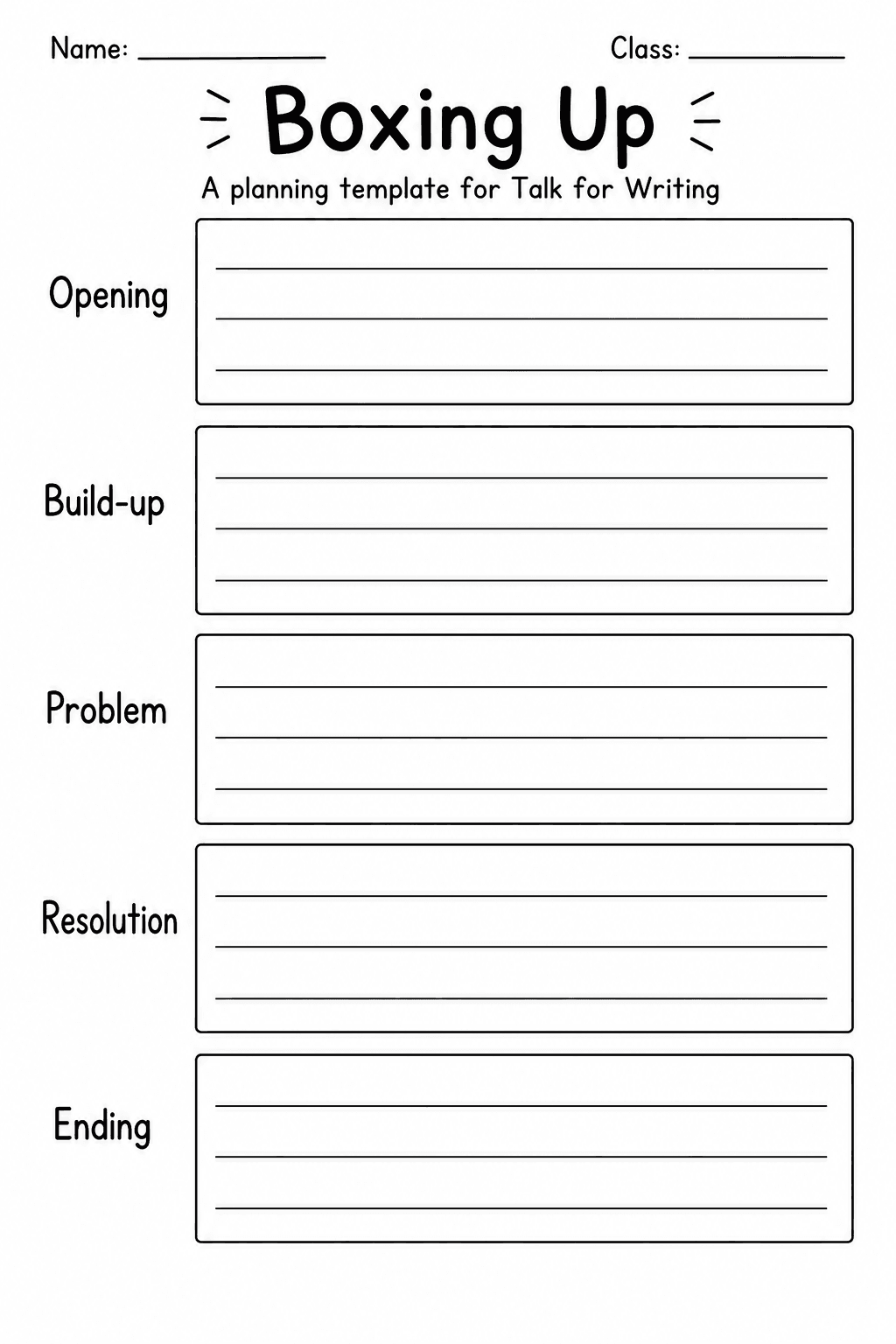
Boxing up is the bridge between retelling a story and writing one. Children use a familiar story map first, then turn each part into short notes that become their paragraph plan.
Learning objectives
- Retell a story in sequence using a story map.
- Adapt a known story by changing one element.
- Plan a new story with characters, setting, beginning, build-up, problem, and ending.
1. Retell the model story before boxing it up
Choose a short story that the class already knows. Tell it aloud with actions, then draw a simple story map together: one quick picture for each key moment. Ask pairs to point to each picture and retell the story in order. If children cannot yet retell the story from the map, stay at this stage for another session — the boxes will only help once the sequence is secure.
2. Turn the story map into five boxes
Draw five boxes labelled beginning, build-up, problem, resolution, and ending. Go back to the story map one picture at a time and model how to jot notes, not full sentences. For example, a box might say: "Little Red — forest — takes cake to Grandma." Add one or two useful words or phrases that you want children to use when they write.
3. Innovate one element of the familiar story
Keep the five-box structure but change just one thing: the character, setting, problem, or object. Model your own change first, then let children choose one change of their own. For example, Little Red Riding Hood could become a child taking a parcel through a city, while the story still has a beginning, build-up, problem, resolution, and ending. This gives children a safe first step into creating rather than copying.
4. Use the boxes to plan a new story
When children are ready, use the same five boxes for an original story. Prompt each box with a question:
- Beginning: Who is the main character? Where are they? What is happening at the start?
- Build-up: What changes or makes the story more interesting?
- Problem: What goes wrong or needs to be solved?
- Resolution: How does the character try to solve the problem?
- Ending: What happens in the end, and how does the character feel?
Children can now write one paragraph from each box. The plan keeps the story in sequence, while the oral rehearsal and story map give them language to draw on.
Get the Talk for Writing resources
Use the printable Boxing Up template from the Assets box below for this lesson. For story maps, innovation activities, and more ready-to-use planning resources, download the Talk for Writing bundle.
Explore the platform
Continue with KiwiBee
Choose the KiwiBee workspace or resource library that fits what you need next.
 Home
Home All solutions
 Pricing
 About us
 KiwiBee for Non-profits
 Events & webinars
 For big organisations
 For schools
 For centers
 For team leaders
 For teachers
 AI and resources
 Resources
 Printable worksheets
 Lesson Packs
 Interactive simulations
 Teacher tools
 AI studio
 Ideas and research