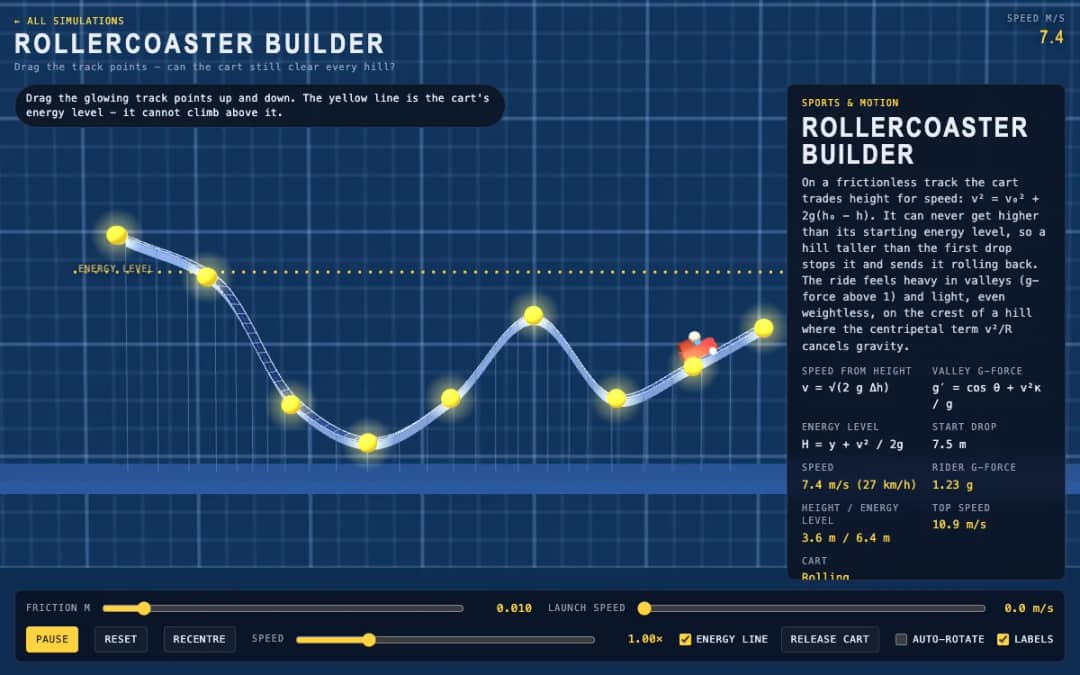
A smooth coaster track runs through glowing control points. Students drag points up and down to reshape hills, press Release cart, and see whether the cart can clear every hill below the yellow energy line.
—
KiwiBee 使用 Google Analytics、Google Ads 及 Meta Pixel 的可選 Cookie,以了解成年訪客、統計已完成的註冊及改善推廣活動。必要 Cookie 會一直保持啟用。 OpenAI 的 ChatGPT 廣告像素亦會在您同意廣告追蹤後衡量頁面瀏覽及已提交的查詢,並可能使用經雜湊處理的聯絡資料作配對。 私隱政策
This simulation models the mat as a spring with damping. The jumper stores energy in the stretched mat and gets it back as speed, but real mats lose some energy, so each peak is lower by the factor e squared, where e is the restitution. Students drag the jumper to set a drop height and read drop height, last peak, first peak ratio, mat depth and force over weight. Sliders set restitution, mat stiffness, mass and gravity, so students can bounce on the Moon. Teachers can use it for springs and energy loss.
Yes. It is free, needs no sign-up, and runs in any modern browser, including whiteboards, tablets and phones.
The mat and jumper lose some energy as heat. With coefficient of restitution e, each peak is lower than the previous one by a factor of e squared.
Drag the jumper up and let go, or push them down into the mat and release. The Last peak marker shows the height reached after each bounce.
It pushes back with force F equals k times the depth x. A stiffer mat has a larger k, so it compresses less under the same load and the rest sag is mass times g over k.
免費嵌入你的學習平台、網誌或班級網頁。
<iframe src="https://kiwibee.io/zh/simulations/trampoline-bounce-3d-simulation/embed" title="Trampoline Bounce | KiwiBee" loading="lazy" allowfullscreen style="width:100%;height:min(70vh,620px);min-height:420px;border:0;border-radius:16px"></iframe>繼續探索
A smooth coaster track runs through glowing control points. Students drag points up and down to reshape hills, press Release cart, and see whether the cart can clear every hill below the yellow energy line.
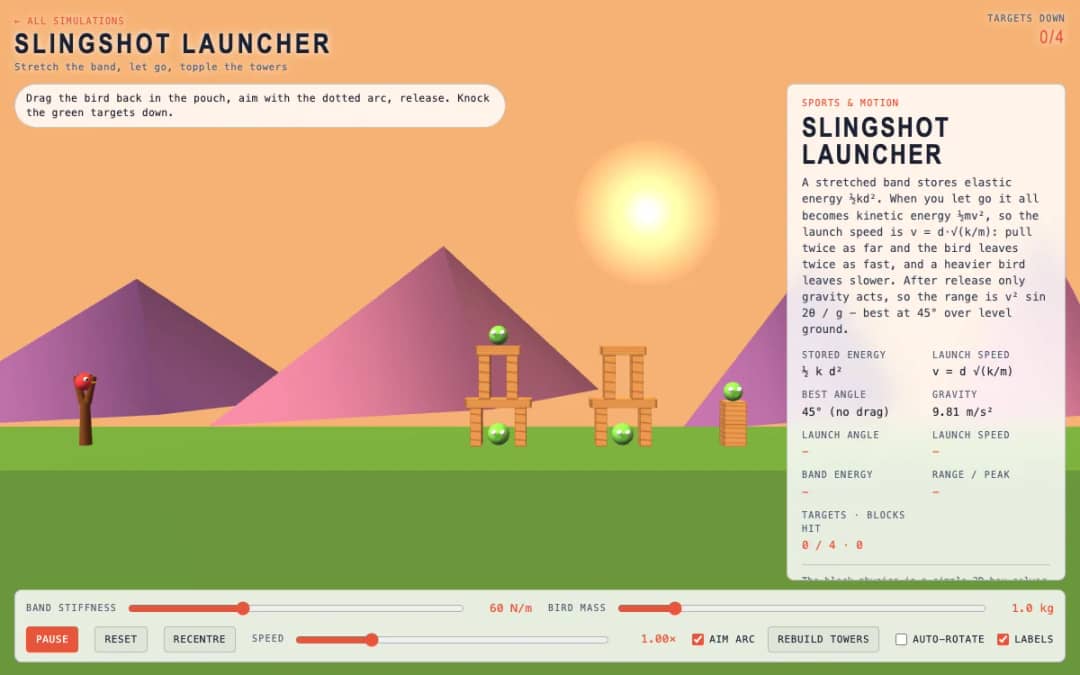
A slingshot faces towers with green targets. Students drag the bird back in the pouch, follow the dotted aim arc, release, and try to knock down the targets using the right stretch and angle.
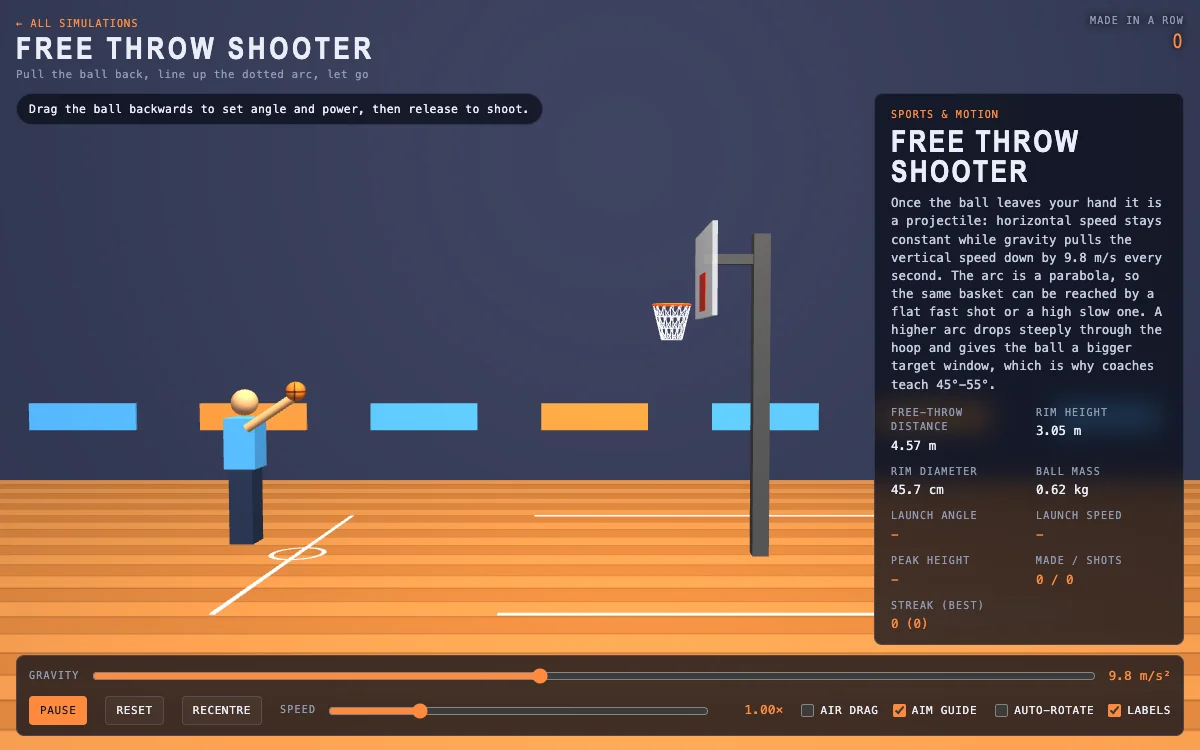
A basketball court shows the free throw line, hoop and a dotted aim arc. Students drag the ball backward to set launch angle and power, release to shoot, and read speed, peak height and streak.
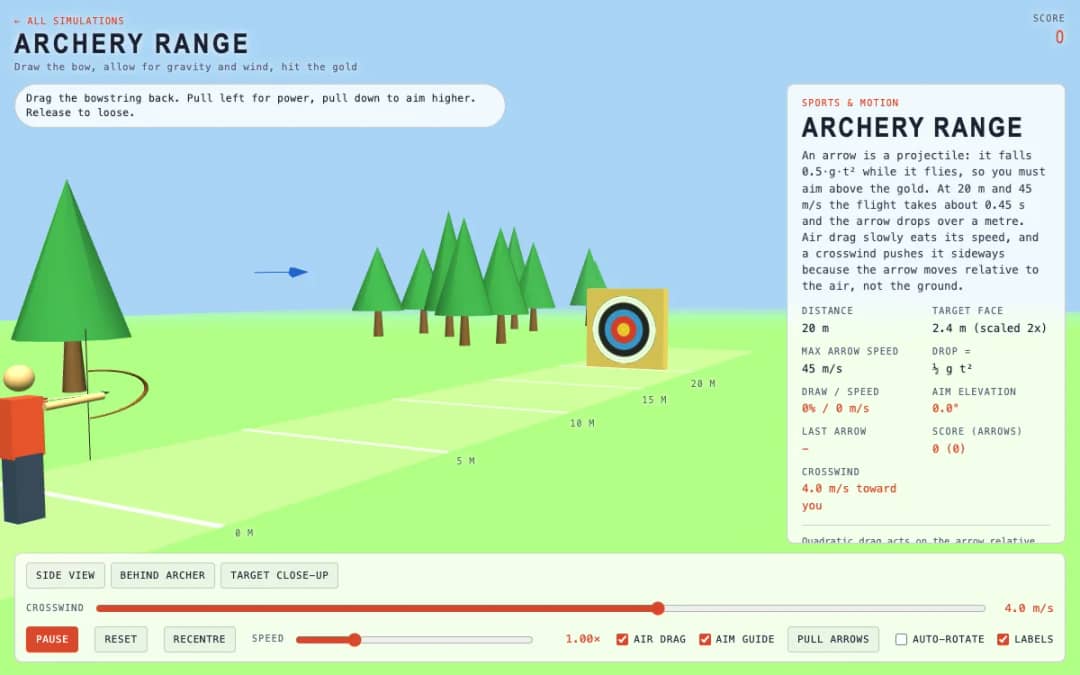
An archery range with a target 20 meters away lets students drag the bowstring back to set power and aim, then loose six arrows while allowing for gravity, drag and a crosswind.
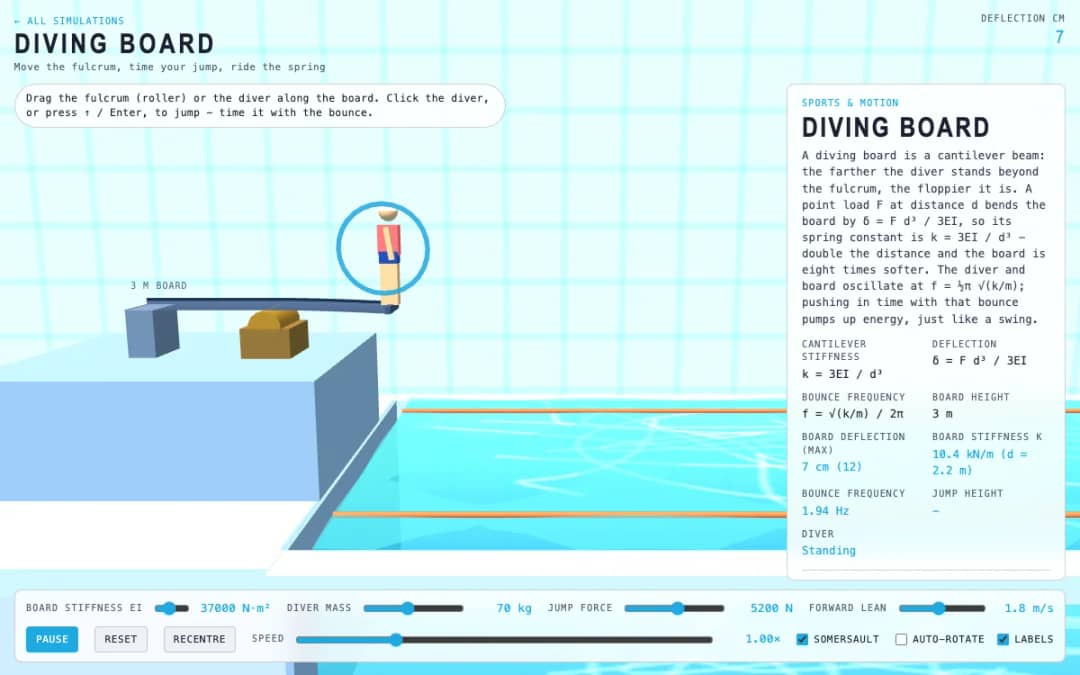
A diving board hangs over a pool at three meters. Students drag the fulcrum roller or the diver along the board, click the diver or press Enter to jump, and time pushes with the board's bounce.
KiwiBee 的免費教師工作空間,把備課、工作紙、課堂工具和成績冊集中在同一處。
免費開始,建立你的第一個班別 首頁
 所有解決方案
 價格
 關於我們
 KiwiBee 非牟利機構計劃
 活動及網上研討會
 適合大型教育機構
 適合學校
 適合教育中心
 適合團隊主管
 適合教師
 AI 和教學資源
 教學資源
 可列印工作紙
 課程包
 互動模擬
 教師工具
 AI 工作室
 教學構思與研究