Compare a two-body orbit with three-body figure-eight motion, then add up to twelve bodies. Change initial masses, velocities and positions; watch orbit trails and numerical energy error.
—
KiwiBee 使用 Google Analytics、Google Ads 及 Meta Pixel 的可選 Cookie,以了解成年訪客、統計已完成的註冊及改善推廣活動。必要 Cookie 會一直保持啟用。 OpenAI 的 ChatGPT 廣告像素亦會在您同意廣告追蹤後衡量頁面瀏覽及已提交的查詢,並可能使用經雜湊處理的聯絡資料作配對。 私隱政策
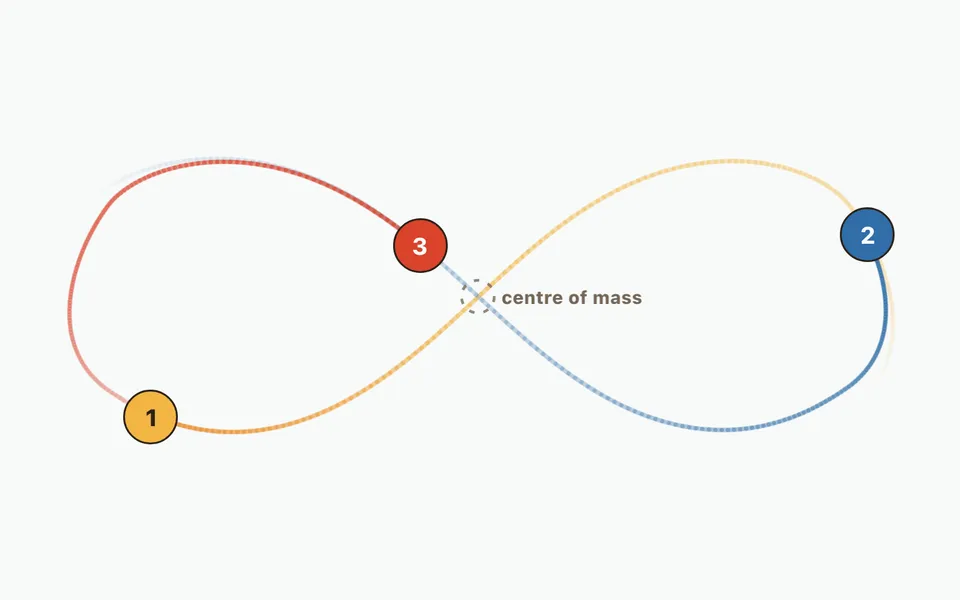
Three-Body Problem is a hands-on 3D simulation of three masses attracting each other with gravity. Students drag any star to a new position, drag the diamond on its arrow to change its velocity, and change each star's mass. Six starting setups are included: the figure-eight orbit, the Lagrange triangle, the butterfly, the Pythagorean 3-4-5 problem, a binary star with a planet and a random start. Readouts show total energy, energy drift, angular momentum and the closest pair, and a twin run shows how a tiny change in the start grows into a completely different future.
Yes. It runs in any modern browser, including interactive whiteboards, tablets and phones, with no sign-up or download.
It asks how three masses move when each pulls on the others with gravity. Two bodies follow neat ellipses, but with three there is no general formula for the future. A few special starting setups repeat exactly, and most others are chaotic.
Three equal masses can chase each other around a single figure-eight shaped path. Cristopher Moore found it numerically in 1993, and Chenciner and Montgomery proved it exists in 2000. In this simulation one lap takes about 6.33 time units.
Drag a star to move it. Drag the small diamond at the end of its arrow to set its speed and direction. Pause first if you want time to set things up, then press Play.
The twin starts one millionth of a unit away from the first star. In a chaotic setup that small gap grows quickly, so the two runs soon look different. In the stable figure-eight the gap stays tiny for a long time.
免費嵌入你的學習平台、網誌或班級網頁。
<iframe src="https://kiwibee.io/zh/simulations/three-body-problem-3d-simulation/embed" title="Three-Body Problem | KiwiBee" loading="lazy" allowfullscreen style="width:100%;height:min(70vh,620px);min-height:420px;border:0;border-radius:16px"></iframe>繼續探索
Compare a two-body orbit with three-body figure-eight motion, then add up to twelve bodies. Change initial masses, velocities and positions; watch orbit trails and numerical energy error.
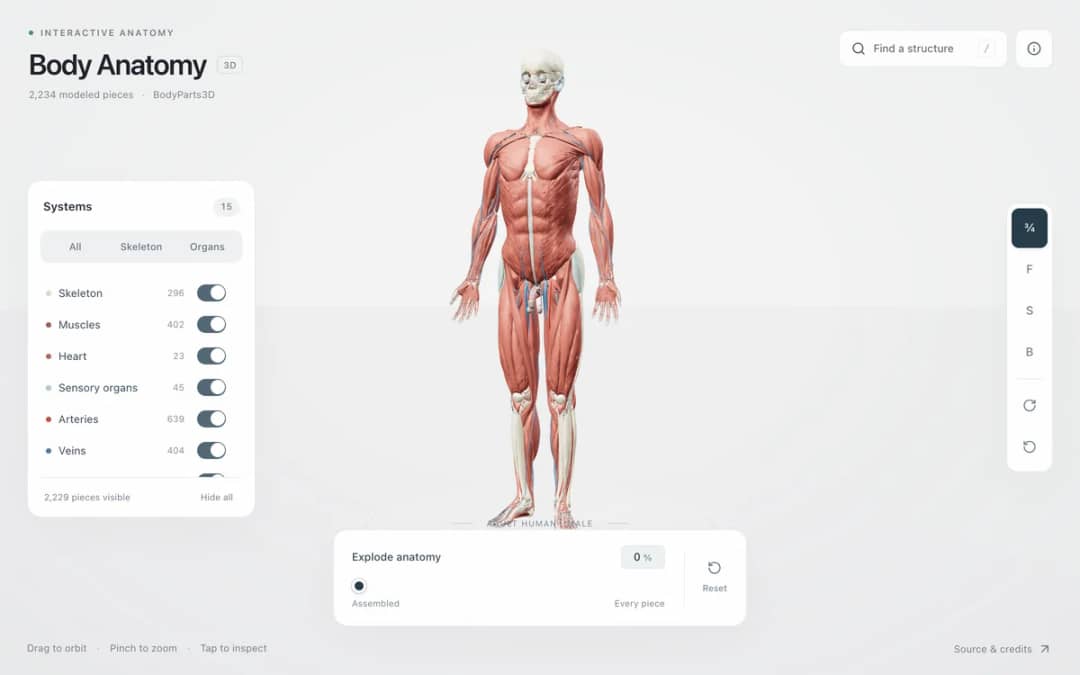
Explore an adult male reference body in 3D. Reveal 14 anatomical systems, search thousands of named structures, isolate organs, and pull 2,209 modeled pieces apart to see how the body is organized.
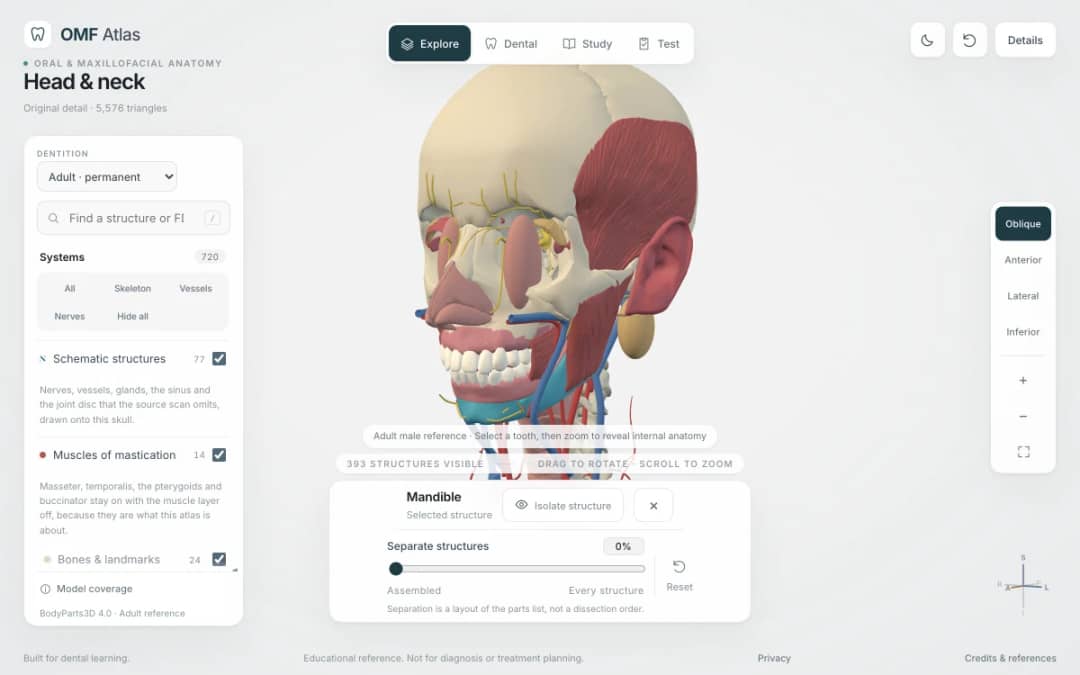
Explore the head and neck in 3D: 643 source meshes across 14 layers, 47 facial and masticatory muscles, and 77 drawn nerves, vessels and glands the source scan omits. Open any tooth onto its own pulp canal, and follow the seven stages of tooth development.

Free interactive photosynthesis simulation. Explore photosynthesis hands-on online — great for whole-class or independent practice.

Free interactive states of matter simulation. Explore states of matter hands-on online — great for whole-class or independent practice.
KiwiBee 的免費教師工作空間,把備課、工作紙、課堂工具和成績冊集中在同一處。
免費開始,建立你的第一個班別 首頁
 所有解決方案
 價格
 關於我們
 KiwiBee 非牟利機構計劃
 活動及網上研討會
 適合大型教育機構
 適合學校
 適合教育中心
 適合團隊主管
 適合教師
 AI 和教學資源
 教學資源
 可列印工作紙
 課程包
 互動模擬
 教師工具
 AI 工作室
 教學構思與研究