Simulations for High School
Free interactive simulations for High School. Explore teacher-made K-12 simulations — projector-ready, and built for the classroom.
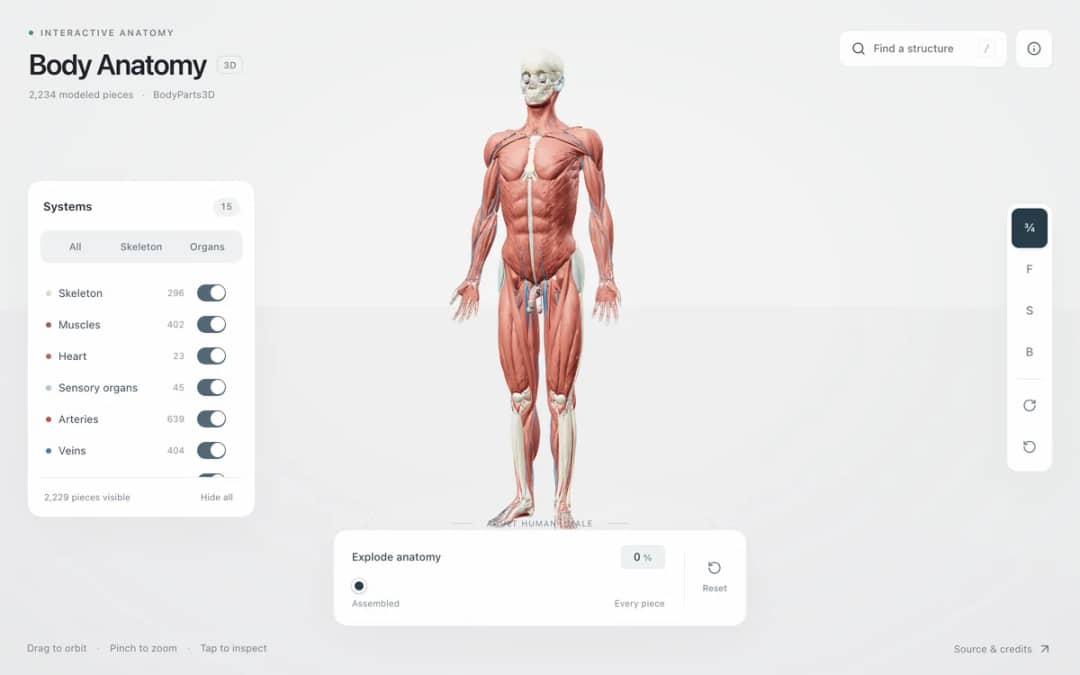
Explore an adult male reference body in 3D. Reveal 14 anatomical systems, search thousands of named structures, isolate organs, and pull 2,209 modeled pieces apart to see how the body is organized.
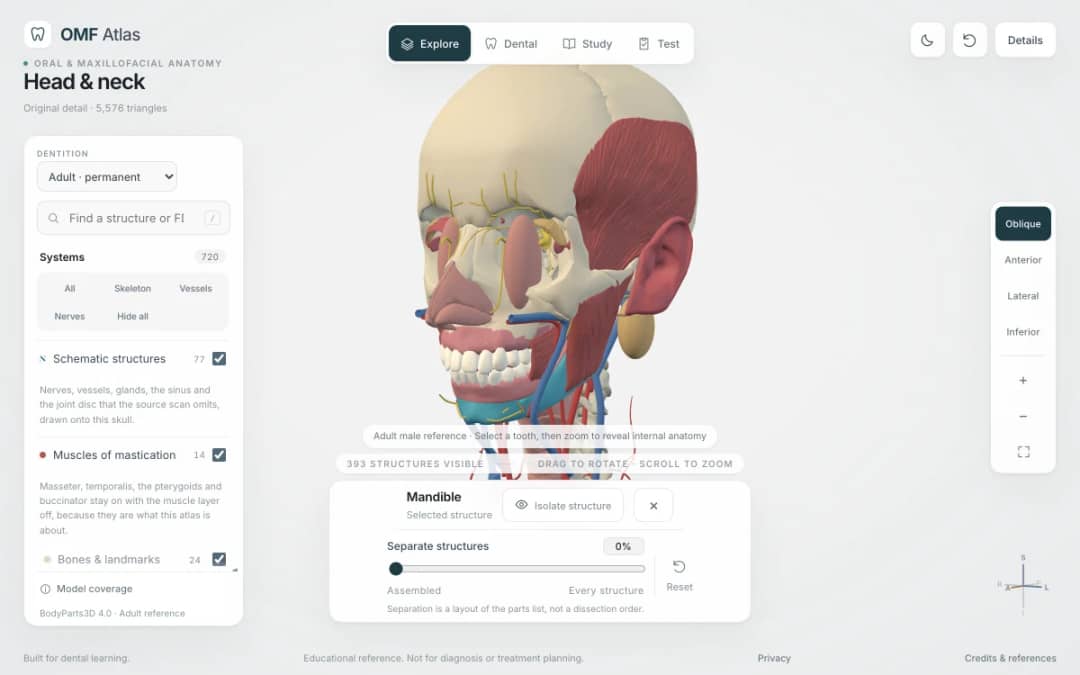
Explore the head and neck in 3D: 643 source meshes across 14 layers, 47 facial and masticatory muscles, and 77 drawn nerves, vessels and glands the source scan omits. Open any tooth onto its own pulp canal, and follow the seven stages of tooth development.

Free interactive photosynthesis simulation. Explore photosynthesis hands-on online — great for whole-class or independent practice.

Free interactive pendulum motion simulation. Explore pendulum motion hands-on online — great for whole-class or independent practice.

Free interactive electric circuits simulation. Explore electric circuits hands-on online — great for whole-class or independent practic

Type any function and see its shape straight away. Plot up to three at once in three colours to compare them, drag the trace point to read a value off a curve, and see where each one crosses zero.

Free interactive human body systems simulation. Explore human body systems hands-on online — great for whole-class or independent pract

Two bodies under gravity trace an ellipse forever and you can write the formula down. Add a third and no such formula exists. Run the figure-eight orbit, nudge one mass, and watch a stable pattern become unpredictable while the total energy stays put.

Follow oxygen-rich and oxygen-poor blood round the loop from the heart to the lungs and body. Change heart rate and stroke volume and watch cardiac output — the blood moved each minute — respond.

Approximate the area under a curve with strips and choose how each takes its height: left edge, right edge, middle, or a sloping top. Push the strip count up and watch the error fall, with the running total plotted as its own curve.

Move m and watch the line tilt; move b and watch it slide. Or drag the two points on the line and read the equation it writes back. A rise-over-run staircase climbs the line so slope becomes something you can count.

Two paths start a hair apart and follow the same three equations. Watch them agree, then part onto opposite wings of the butterfly. Drag the start, spin the shape and pull rho down until chaos stops.

Push two plates together at the speed your fingernails grow and watch mountains rise, or pull them apart and see new ocean floor form. Set each plate's speed and work out how long a gap takes to close.

Pick sin x, cos x, eˣ, ln(1 + x) or 1/(1 − x), raise the degree one term at a time, and watch a polynomial creep outward until it hugs the curve. A shaded strip shows where it is inside your tolerance, and where the radius of convergence stops it dead.

Two identical double pendulums are released a tenth of a degree apart. They move as one, then separate completely, while a log-scale graph shows the gap doubling at a steady rate. Start it gently and it is not chaotic at all.

Watch the lungs swell and empty with every breath as air moves in and out of the windpipe. Change breaths per minute and the air in each breath, and see how much air is moved a minute.

Add sine waves one at a time and watch a square, sawtooth or triangle wave appear. The target sits behind the running total so you can see what is still missing, including the overshoot at a jump that never goes away.

Aim a launcher and fire. See the whole parabola before the shot lands, change launch speed, angle and gravity, find the angle that throws furthest, and discover which pairs of angles land in the same place.

A pendulum you can launch rather than just release: choose the starting angle and the starting spin. Beside it the phase plane plots angle against angular velocity, so a swing draws a closed loop and a full rotation draws an open track.

A differential equation drawn as a field of little dashes becomes a landscape you can read. Drop a starting point and watch Euler's method walk it, corners and all, beside a finely stepped reference curve. Halve the step and halve the error.

Free interactive natural selection simulation. Explore natural selection hands-on online — great for whole-class or independent practi

Pick each parent's pair of alleles and build the Punnett square. Read off the chance of each genotype, see which children show the trait and which hide it, and try the classic crosses.

Free interactive cell structure simulation. Explore cell structure hands-on online — great for whole-class or independent practice.

Mix hydrogen and oxygen and make water. Count atoms before and after, get the ratio wrong and watch one reactant run out first, then heat the flask and see the reaction speed up.
 For big organisations
 For schools
 For centers
 For team leaders
 For teachers
 AI and resources
 پرنٹ ونڈوس
 انقلاصی مساوات
 اسٹیچر آلات
 ای آئی سٹوڈیو
 تعصب اور تحقیق