
Explore an adult male reference body in 3D. Reveal 14 anatomical systems, search thousands of named structures, isolate organs, and pull 2,209 modeled pieces apart to see how the body is organized.
—
KiwiBee 使用 Google Analytics、Google Ads 及 Meta Pixel 的可選 Cookie,以了解成年訪客、統計已完成的註冊及改善推廣活動。必要 Cookie 會一直保持啟用。 OpenAI 的 ChatGPT 廣告像素亦會在您同意廣告追蹤後衡量頁面瀏覽及已提交的查詢,並可能使用經雜湊處理的聯絡資料作配對。 私隱政策
「電容器與電介質實驗室」是一個 3D 靜電學模擬,讓學生操控平行板電容器的幾何結構和電介質物料。兩塊金屬極板連接到可調校的直流電池,紅色 (+) 和藍色 (−) 表面電荷積聚在內表面上,而青色向量箭頭則顯示勻強電場 E = V / d。學生可上下拖動上極板以改變間距 d、更改極板面積 A,並將琥珀色電介質板水平拖入間隙中。在介質板內部,分子偶極子啞鈴會明顯旋轉以順應電場排列,說明為何電介質會根據 C = kappa epsilon_0 A / d 增加電容。
外加電場會使絕緣電介質內部的分子極化,使其正端朝向負極板、負端朝向正極板排列。這在介質板內部產生一個微小的反向電場,讓電池在相同電壓下能將多 kappa 倍的電荷推上極板。
電容 C = kappa epsilon_0 A / d 和電場 E = V / d 均與間距 d 成反比。將兩塊極板拉近會增強兩板異號電荷之間的吸引力,從而增大 C、Q、U 和 E。
因為儲存電荷 Q = C V 本身與電壓 V 成正比,每增加一單位電荷都必須克服越來越高電勢差才能推上極板,因此得出 U = 1/2 Q V = 1/2 C V²。
沒有傳導電流穿過絕緣空氣或電介質間隙。相反,充電電流會流過外部電池導線,直到極板兩端的電壓等於電池電壓為止。
免費嵌入你的學習平台、網誌或班級網頁。
<iframe src="https://kiwibee.io/zh/simulations/parallel-plate-capacitor-3d-3d-simulation/embed" title="電容器與電介質實驗室 | KiwiBee" loading="lazy" allowfullscreen style="width:100%;height:min(70vh,620px);min-height:420px;border:0;border-radius:16px"></iframe>繼續探索
Explore an adult male reference body in 3D. Reveal 14 anatomical systems, search thousands of named structures, isolate organs, and pull 2,209 modeled pieces apart to see how the body is organized.
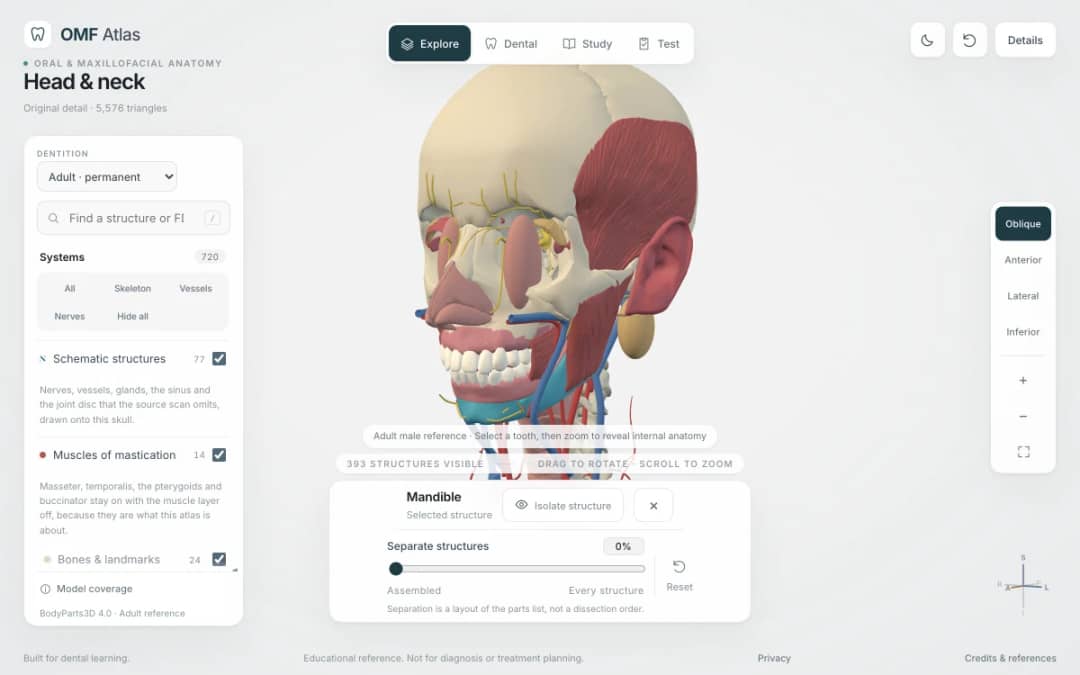
Explore the head and neck in 3D: 643 source meshes across 14 layers, 47 facial and masticatory muscles, and 77 drawn nerves, vessels and glands the source scan omits. Open any tooth onto its own pulp canal, and follow the seven stages of tooth development.

免費的光合作用互動模擬實驗。在線動手探索光合作用——適合全班演示,也適合學生自主練習。

免費的物質的狀態互動模擬實驗。在線動手探索物質的狀態——適合全班演示,也適合學生自主練習。

免費的影子互動模擬實驗。在線動手探索影子——適合全班演示,也適合學生自主練習。
由模型到紀錄
學生探索之後,用工作紙記錄他們的預測、觀察和解釋。
KiwiBee 的免費教師工作空間,把備課、工作紙、課堂工具和成績冊集中在同一處。
免費開始,建立你的第一個班別
 首頁
 所有解決方案
 價格
 關於我們
 KiwiBee 非牟利機構計劃
 活動及網上研討會
 適合大型教育機構
 適合學校
 適合教育中心
 適合團隊主管
 適合教師
 AI 和教學資源
 教學資源
 可列印工作紙
 課程包
 互動模擬
 教師工具
 AI 工作室
 教學構思與研究