
Base-Ten Blocks 3D
- Toán học
Bình luận
Liên quan đến mô phỏng này
Chọn theo nội dung từ trò chơi, phiếu bài tập, mô phỏng, công cụ giáo viên và video.

Giới thiệu mô phỏng này
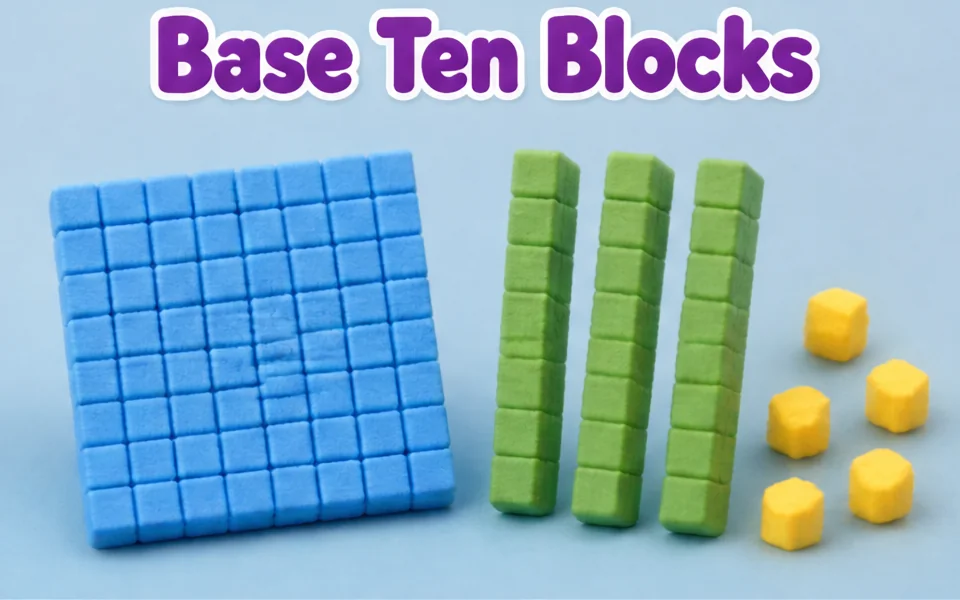
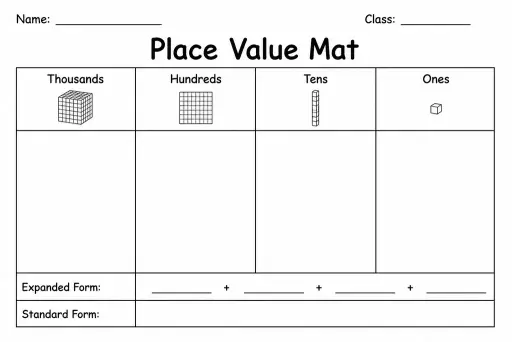
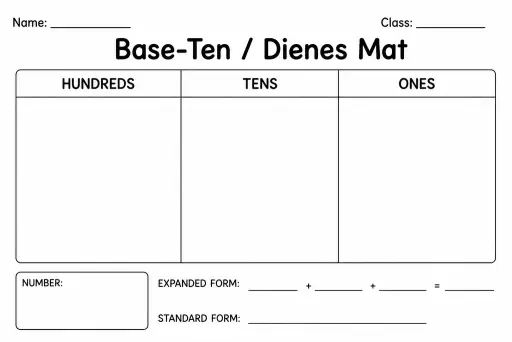
Base-Ten Blocks 3D is a hands-on manipulatives table for exploring decimal place value, expanded notation, and regrouping (carrying and borrowing). The 3D classroom mat is organized into four color-coded columns: purple Thousands cubes (10×10×10 = 1,000), red Hundreds flats (10×10 = 100), green Tens rods (1×10 = 10), and blue Ones unit cubes (1). Students can click any column pad or adjust the sliders to place up to 15 blocks in a column, creating non-standard groupings such as 14 tens or 12 ones. Pressing Regroup / Bundle 10 (or clicking the gold Regroup Orb) bundles each group of 10 blocks into 1 block in the next column to the left while keeping the total number unchanged.
Học sinh có thể khám phá điều gì
- Set Ones to 12 and press Regroup / Bundle 10 to trade 10 blue unit cubes for 1 green ten-rod while watching the Total number readout stay identical.
- Click the green Tens pad until you have more than 10 ten-rods, then bundle 10 rods into 1 red 10×10 hundred-flat.
- Compare the physical 3D size of 1 unit cube, 1 ten-rod, 1 hundred-flat, and 1 thousand-cube by orbiting around the table.
- Read the Expanded form readout (for example 1000 + 300 + 50 + 2) and match each addend to its column of 3D blocks.
Mục tiêu học tập
- 1Represent multi-digit whole numbers up to 3,999 using concrete 3D base-ten blocks (thousands, hundreds, tens, and ones).
- 2Explain why each place value column represents a unit 10 times as large as the column to its right.
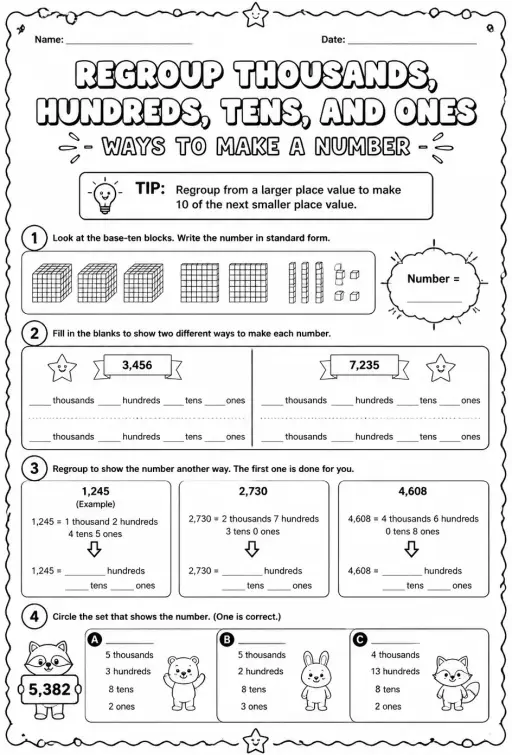
- 3Regroup (bundle) 10 ones into 1 ten, or 10 tens into 1 hundred, and verify that the total numeric value remains constant.
- 4Translate between concrete base-ten block models, standard numerals, and expanded form.
Câu hỏi giáo viên thường đặt ra
What are base-ten blocks used for in maths?
Base-ten blocks (also called Dienes blocks) give students a physical, proportional model of our decimal number system. Because a ten-rod is literally 10 unit cubes tall and a hundred-flat is 100 cubes in area, students can see why each digit's position multiplies its value by 10.
What does regrouping or bundling 10 mean?
In standard base-ten notation, each digit position holds at most 9 units. When a column reaches 10 or more blocks—such as 12 ones—we bundle 10 of those ones into 1 ten-rod and move it to the Tens column, leaving 2 ones behind.
Why doesn't the total number change when we press Regroup / Bundle 10?
Trading 10 ones for 1 ten (or 10 tens for 1 hundred) is an equal exchange: 10 × 1 = 10 and 10 × 10 = 100. The blocks are reorganized into standard place-value form without adding or removing any unit cubes.
What is the expanded form of a number?
Expanded form writes a number as the sum of the values of each of its digits—for example, writing 1,352 as 1,000 + 300 + 50 + 2, which directly matches the value of the blocks in each place-value column.
Nhúng mô phỏng này
Đặt vào hệ thống học tập, blog hoặc trang lớp của bạn — miễn phí.
<iframe src="https://kiwibee.io/vn/simulations/place-value-base-ten-blocks-3d-3d-simulation/embed" title="Base-Ten Blocks 3D | KiwiBee" loading="lazy" allowfullscreen style="width:100%;height:min(70vh,620px);min-height:420px;border:0;border-radius:16px"></iframe>Chuẩn chương trình học
Cambridge
- 3Np.01Understand and explain that the value of each digit is determined by its position in that number (up to 3-digit numbers).Cambridge Primary Mathematics (0096) — Stage 3 › Number › Place value, ordering and rounding
Learning objectives © UCLES (Cambridge University Press & Assessment), quoted with attribution.
Mang khoa học tương tác vào lớp học của bạn
Không gian giáo viên miễn phí của KiwiBee gộp soạn bài, phiếu bài tập, công cụ lớp học và sổ điểm vào cùng một nơi.
Bắt đầu miễn phí và tạo lớp học đầu tiênXem KiwiBee trên YouTube
Video ngắn về KiwiBee dành cho giáo viên và nhà trường. Hãy đăng ký kênh, hoặc theo dõi KiwiBee ở bất cứ đâu.
 Trang chủ
 Tất cả giải pháp
 Bảng giá
 Về chúng tôi
 KiwiBee cho tổ chức phi lợi nhuận
 Sự kiện & webinar
 Dành cho tổ chức lớn
 Dành cho trường học
 Dành cho trung tâm
 Dành cho trưởng nhóm
 Dành cho giáo viên
 Học liệu
 Worksheet in được
 Mô phỏng tương tác
 Công cụ giáo viên
 Ý tưởng và nghiên cứu


