
Binary Counter
- Toán học
Bình luận
Liên quan đến mô phỏng này
Chọn theo nội dung từ trò chơi, phiếu bài tập, mô phỏng, công cụ giáo viên và video.
Giới thiệu mô phỏng này
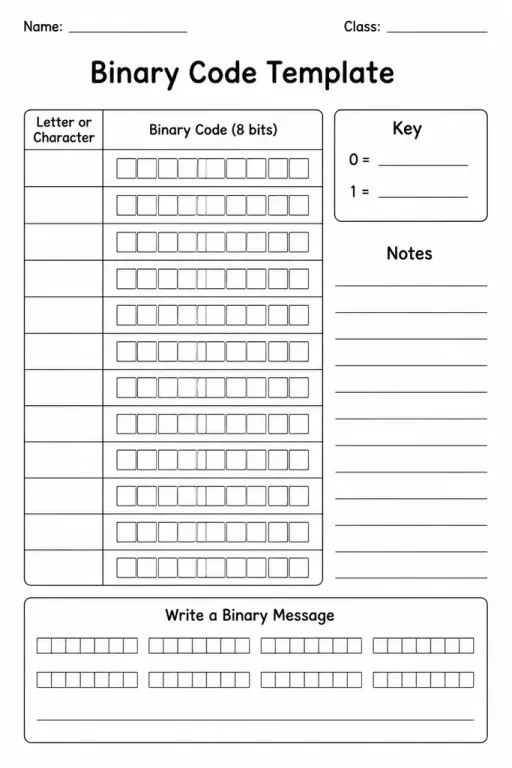
Each cube is one bit with a place value of 128, 64, 32, 16, 8, 4, 2 or 1. Students click cubes to switch them on or off and see the binary, decimal and hex readouts update, with optional sums shown on the cubes. Add one counts upward, wrapping from 255 back to 0, and New challenge picks a random target from 1 to 255 for students to build. The sim shows that each place is double the one on its right and that eight bits hold 0 to 255. Teachers can use it for counting in base 2 and as a warm-up to data storage.
Học sinh có thể khám phá điều gì
- Click the rightmost cube, then press Add one repeatedly and watch the pattern count in binary.
- Turn on the 128 and 1 cubes and add their place values to confirm the Decimal readout.
- Press New challenge and flip cubes until the number matches the target.
- Toggle Show sums on cubes off to test yourself without place value hints.
- Count to 255 and press Add one once more to see the overflow wrap back to 0.
Mục tiêu học tập
- 1Convert binary numbers to decimal using place values.
- 2Explain that each bit position is worth double the one to its right.
- 3State the range of numbers an 8-bit byte can hold.
- 4Relate binary to hexadecimal digits.
Câu hỏi giáo viên thường đặt ra
Is it free to use?
Yes. It is completely free, needs no sign-up, and runs in any modern browser, including classroom whiteboards, tablets and phones. Just open the page and start.
How do I read a binary number?
Each lit cube adds its place value: 128, 64, 32, 16, 8, 4, 2 and 1. Add up the values of the lit cubes to get the decimal number. For example, cubes 8 and 2 lit gives 10.
What is the biggest number eight bits can store?
255, when all eight cubes are on (128 + 64 + 32 + 16 + 8 + 4 + 2 + 1). With all bits off the value is 0, so a byte holds 256 different values.
How do I play the challenge?
Press New challenge to get a random target from 1 to 255, then click cubes to flip bits until the Decimal readout matches. The Solved counter tracks your successes.
Nhúng mô phỏng này
Đặt vào hệ thống học tập, blog hoặc trang lớp của bạn — miễn phí.
<iframe src="https://kiwibee.io/vn/simulations/binary-counter-3d-simulation/embed" title="Binary Counter | KiwiBee" loading="lazy" allowfullscreen style="width:100%;height:min(70vh,620px);min-height:420px;border:0;border-radius:16px"></iframe>Mang khoa học tương tác vào lớp học của bạn
Không gian giáo viên miễn phí của KiwiBee gộp soạn bài, phiếu bài tập, công cụ lớp học và sổ điểm vào cùng một nơi.
Bắt đầu miễn phí và tạo lớp học đầu tiênXem KiwiBee trên YouTube
Video ngắn về KiwiBee dành cho giáo viên và nhà trường. Hãy đăng ký kênh, hoặc theo dõi KiwiBee ở bất cứ đâu.
 Trang chủ
 Tất cả giải pháp
 Bảng giá
 Về chúng tôi
 KiwiBee cho tổ chức phi lợi nhuận
 Sự kiện & webinar
 Dành cho tổ chức lớn
 Dành cho trường học
 Dành cho trung tâm
 Dành cho trưởng nhóm
 Dành cho giáo viên
 Học liệu
 Worksheet in được
 Mô phỏng tương tác
 Công cụ giáo viên
 Ý tưởng và nghiên cứu


