
Base-Ten Blocks 3D
- 数学
评论
与此模拟实验相关
按含义从游戏、练习册、模拟实验、教师工具和视频中挑选。

关于这个模拟实验
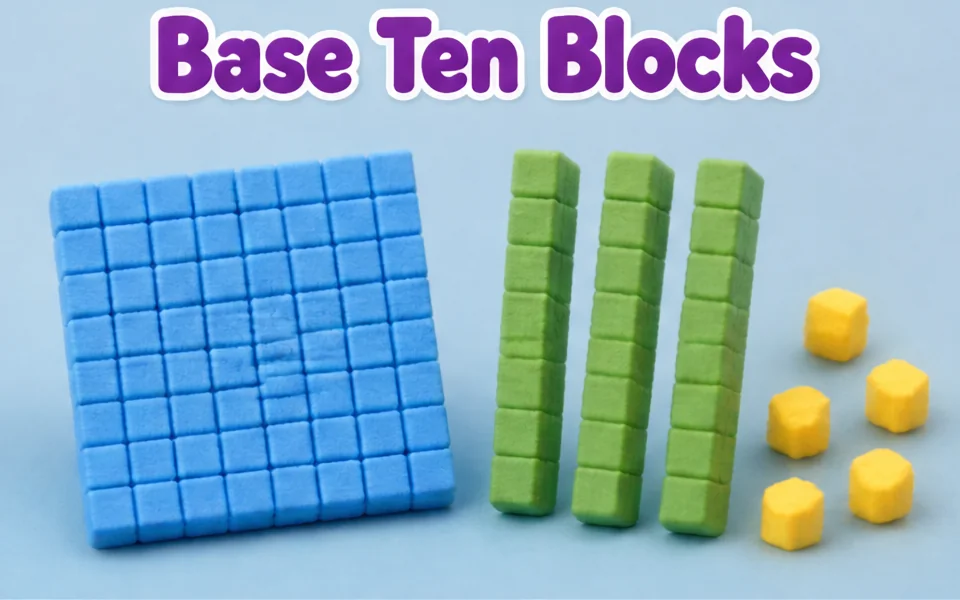
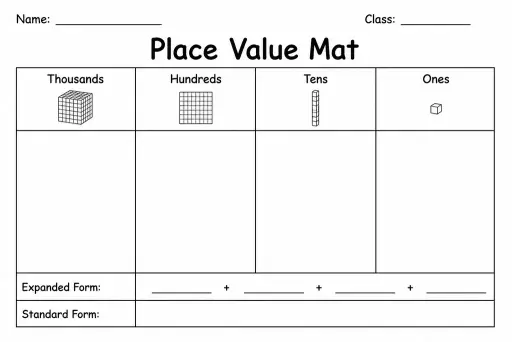
Base-Ten Blocks 3D is a hands-on manipulatives table for exploring decimal place value, expanded notation, and regrouping (carrying and borrowing). The 3D classroom mat is organized into four color-coded columns: purple Thousands cubes (10×10×10 = 1,000), red Hundreds flats (10×10 = 100), green Tens rods (1×10 = 10), and blue Ones unit cubes (1). Students can click any column pad or adjust the sliders to place up to 15 blocks in a column, creating non-standard groupings such as 14 tens or 12 ones. Pressing Regroup / Bundle 10 (or clicking the gold Regroup Orb) bundles each group of 10 blocks into 1 block in the next column to the left while keeping the total number unchanged.
学生可以探索什么
- Set Ones to 12 and press Regroup / Bundle 10 to trade 10 blue unit cubes for 1 green ten-rod while watching the Total number readout stay identical.
- Click the green Tens pad until you have more than 10 ten-rods, then bundle 10 rods into 1 red 10×10 hundred-flat.
- Compare the physical 3D size of 1 unit cube, 1 ten-rod, 1 hundred-flat, and 1 thousand-cube by orbiting around the table.
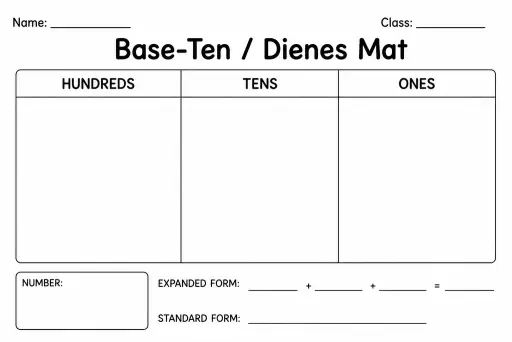
- Read the Expanded form readout (for example 1000 + 300 + 50 + 2) and match each addend to its column of 3D blocks.
学习目标
- 1Represent multi-digit whole numbers up to 3,999 using concrete 3D base-ten blocks (thousands, hundreds, tens, and ones).
- 2Explain why each place value column represents a unit 10 times as large as the column to its right.
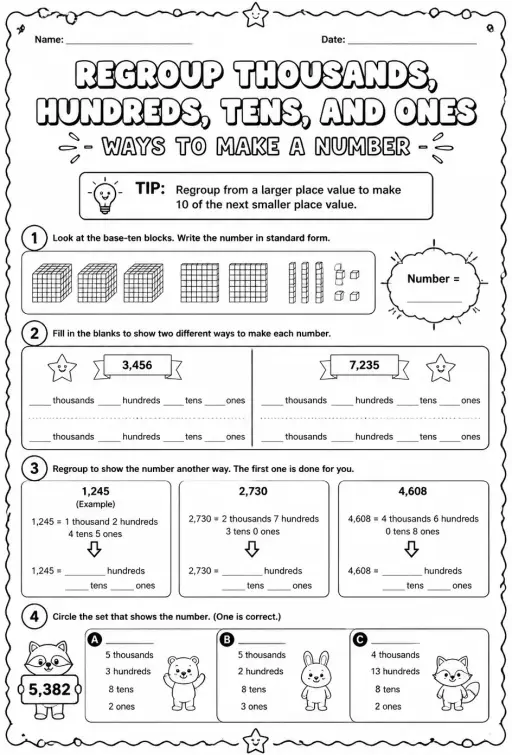
- 3Regroup (bundle) 10 ones into 1 ten, or 10 tens into 1 hundred, and verify that the total numeric value remains constant.
- 4Translate between concrete base-ten block models, standard numerals, and expanded form.
教师常问的问题
What are base-ten blocks used for in maths?
Base-ten blocks (also called Dienes blocks) give students a physical, proportional model of our decimal number system. Because a ten-rod is literally 10 unit cubes tall and a hundred-flat is 100 cubes in area, students can see why each digit's position multiplies its value by 10.
What does regrouping or bundling 10 mean?
In standard base-ten notation, each digit position holds at most 9 units. When a column reaches 10 or more blocks—such as 12 ones—we bundle 10 of those ones into 1 ten-rod and move it to the Tens column, leaving 2 ones behind.
Why doesn't the total number change when we press Regroup / Bundle 10?
Trading 10 ones for 1 ten (or 10 tens for 1 hundred) is an equal exchange: 10 × 1 = 10 and 10 × 10 = 100. The blocks are reorganized into standard place-value form without adding or removing any unit cubes.
What is the expanded form of a number?
Expanded form writes a number as the sum of the values of each of its digits—for example, writing 1,352 as 1,000 + 300 + 50 + 2, which directly matches the value of the blocks in each place-value column.
嵌入这个模拟实验
免费嵌入你的学习平台、博客或班级网站。
<iframe src="https://kiwibee.io/zh-cn/simulations/place-value-base-ten-blocks-3d-3d-simulation/embed" title="Base-Ten Blocks 3D | KiwiBee" loading="lazy" allowfullscreen style="width:100%;height:min(70vh,620px);min-height:420px;border:0;border-radius:16px"></iframe>课程标准
Cambridge
- 3Np.01Understand and explain that the value of each digit is determined by its position in that number (up to 3-digit numbers).Cambridge Primary Mathematics (0096) — Stage 3 › Number › Place value, ordering and rounding
Learning objectives © UCLES (Cambridge University Press & Assessment), quoted with attribution.
把互动科学带进你的课堂
KiwiBee 的免费教师工作台把备课、工作表、课堂工具和成绩册集中在一处。
免费开始,创建你的第一个班级在 YouTube 上观看 KiwiBee
面向教师和学校的 KiwiBee 短视频。订阅频道,或在你常用的平台上关注 KiwiBee。
 首页
 全部解决方案
 价格
 关于我们
 KiwiBee 非营利组织计划
 活动与网络研讨会
 面向大型教育集团
 面向学校
 面向教育中心
 面向团队负责人
 面向教师
 教学资源
 可打印练习单
 互动模拟实验
 教师工具
 灵感与研究


