
Base-Ten Blocks 3D
- Matematikë
Komente
Lidhur me këtë simulim
Zgjedhur sipas kuptimit nga lojërat, fletët e punës, simulimet, mjetet për mësuesit dhe videot.

Rreth këtij simulimi
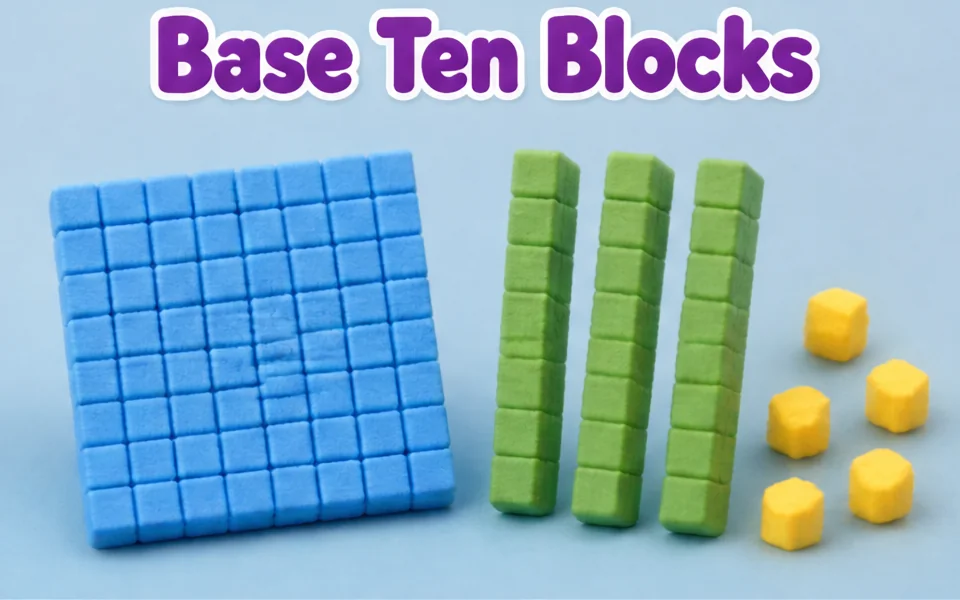
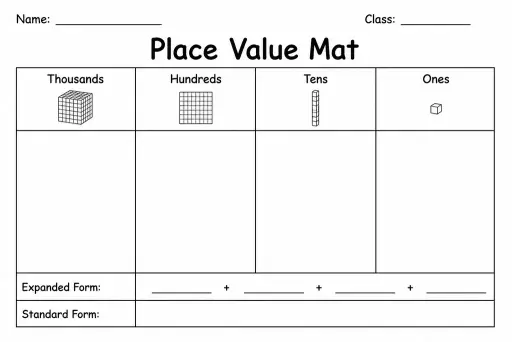
Base-Ten Blocks 3D is a hands-on manipulatives table for exploring decimal place value, expanded notation, and regrouping (carrying and borrowing). The 3D classroom mat is organized into four color-coded columns: purple Thousands cubes (10×10×10 = 1,000), red Hundreds flats (10×10 = 100), green Tens rods (1×10 = 10), and blue Ones unit cubes (1). Students can click any column pad or adjust the sliders to place up to 15 blocks in a column, creating non-standard groupings such as 14 tens or 12 ones. Pressing Regroup / Bundle 10 (or clicking the gold Regroup Orb) bundles each group of 10 blocks into 1 block in the next column to the left while keeping the total number unchanged.
Çfarë mund të eksplorojnë nxënësit
- Set Ones to 12 and press Regroup / Bundle 10 to trade 10 blue unit cubes for 1 green ten-rod while watching the Total number readout stay identical.
- Click the green Tens pad until you have more than 10 ten-rods, then bundle 10 rods into 1 red 10×10 hundred-flat.
- Compare the physical 3D size of 1 unit cube, 1 ten-rod, 1 hundred-flat, and 1 thousand-cube by orbiting around the table.
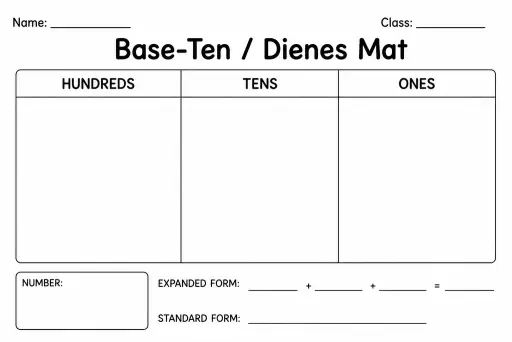
- Read the Expanded form readout (for example 1000 + 300 + 50 + 2) and match each addend to its column of 3D blocks.
Objektivat e të nxënit
- 1Represent multi-digit whole numbers up to 3,999 using concrete 3D base-ten blocks (thousands, hundreds, tens, and ones).
- 2Explain why each place value column represents a unit 10 times as large as the column to its right.
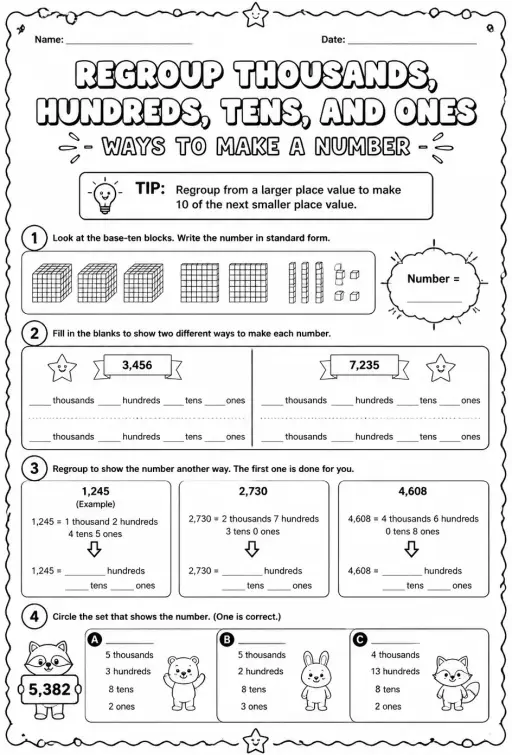
- 3Regroup (bundle) 10 ones into 1 ten, or 10 tens into 1 hundred, and verify that the total numeric value remains constant.
- 4Translate between concrete base-ten block models, standard numerals, and expanded form.
Pyetjet që bëjnë mësuesit
What are base-ten blocks used for in maths?
Base-ten blocks (also called Dienes blocks) give students a physical, proportional model of our decimal number system. Because a ten-rod is literally 10 unit cubes tall and a hundred-flat is 100 cubes in area, students can see why each digit's position multiplies its value by 10.
What does regrouping or bundling 10 mean?
In standard base-ten notation, each digit position holds at most 9 units. When a column reaches 10 or more blocks—such as 12 ones—we bundle 10 of those ones into 1 ten-rod and move it to the Tens column, leaving 2 ones behind.
Why doesn't the total number change when we press Regroup / Bundle 10?
Trading 10 ones for 1 ten (or 10 tens for 1 hundred) is an equal exchange: 10 × 1 = 10 and 10 × 10 = 100. The blocks are reorganized into standard place-value form without adding or removing any unit cubes.
What is the expanded form of a number?
Expanded form writes a number as the sum of the values of each of its digits—for example, writing 1,352 as 1,000 + 300 + 50 + 2, which directly matches the value of the blocks in each place-value column.
Vendoseni këtë simulim në faqen tuaj
Vendoseni në platformën tuaj mësimore, në blog ose në faqen e klasës — falas.
<iframe src="https://kiwibee.io/sq/simulations/place-value-base-ten-blocks-3d-3d-simulation/embed" title="Base-Ten Blocks 3D | KiwiBee" loading="lazy" allowfullscreen style="width:100%;height:min(70vh,620px);min-height:420px;border:0;border-radius:16px"></iframe>Standardet e kurrikulës
Cambridge
- 3Np.01Understand and explain that the value of each digit is determined by its position in that number (up to 3-digit numbers).Cambridge Primary Mathematics (0096) — Stage 3 › Number › Place value, ordering and rounding
Learning objectives © UCLES (Cambridge University Press & Assessment), quoted with attribution.
Sillni shkencën interaktive në klasën tuaj
Hapësira falas e mësuesit në KiwiBee bashkon në një vend planifikimin e mësimit, fletët e punës, mjetet e klasës dhe regjistrin e notave.
Filloni falas dhe krijoni klasën tuaj të parëShikoni KiwiBee në YouTube
Video të shkurtra të KiwiBee për mësuesit dhe shkollat. Abonohuni, ose ndiqni KiwiBee kudo që jeni.
 Ballina
 Të gjitha zgjidhjet
 Çmimet
 Rreth nesh
 KiwiBee për organizatat jofitimprurëse
 Evente dhe webinare
 Për organizatat e mëdha
 Për shkollat
 Për qendrat mësimore
 Për drejtuesit e ekipeve
 Për mësuesit
 Burimet
 Fletë pune të shtypshme
 Simulime interaktive
 Mjete për mësuesit
 Ide dhe kërkime


