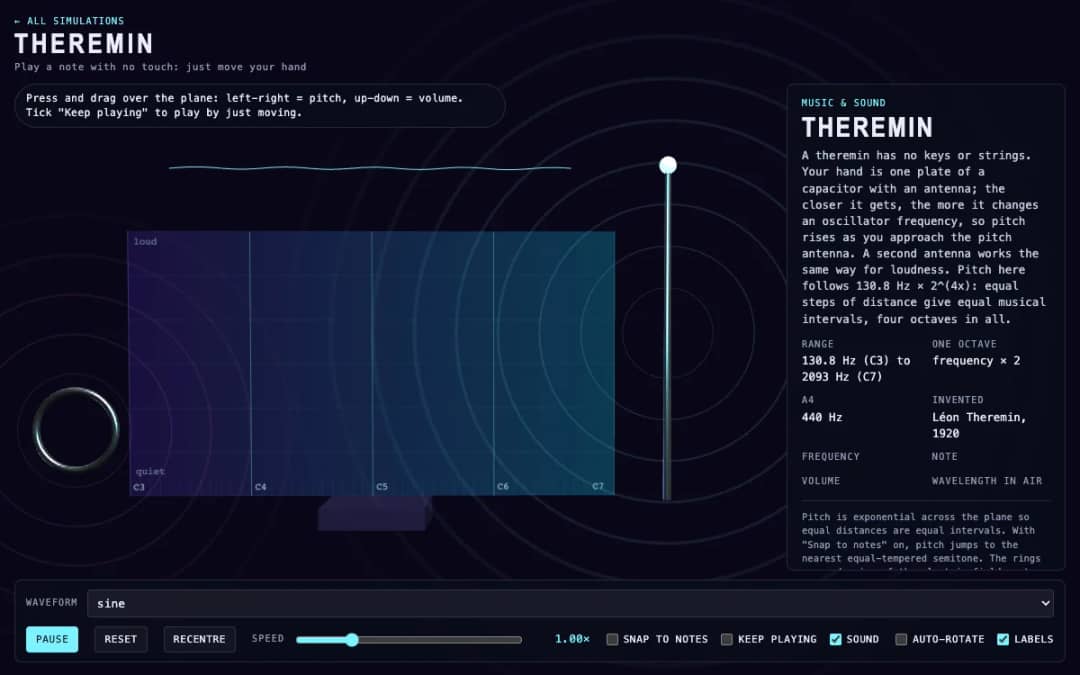
A virtual theremin where students press and drag over a plane. Moving left and right changes pitch, moving up and down changes volume, and readouts show frequency, note, volume and wavelength.
—
KiwiBee utilise des cookies facultatifs Google Analytics, Google Ads et Meta Pixel pour comprendre les visiteurs adultes, mesurer les inscriptions finalisées et améliorer ses campagnes. Les cookies essentiels restent toujours actifs. Le pixel publicitaire ChatGPT d’OpenAI mesure aussi les pages vues et les demandes envoyées après consentement publicitaire, et peut utiliser des coordonnées hachées pour la mise en correspondance. Politique de confidentialité
This simulation shows how the air inside a pipe makes a note. Students drag the ring at the top of a pipe up or down and hear the pitch glide as the length changes. Clicking a pipe, or pressing keys 1 to 6, blows it. A select control switches between an open pipe and a pipe closed at one end, and a slider chooses the first, second or third harmonic. Moving dots show air displacement, red for compressed and blue for stretched, slowed down so they can be seen. Readouts show length, frequency and the formula used. It teaches standing waves, resonance and why closed pipes sound an octave lower.
Yes. Flute Pipe Lengths is free, needs no sign-up and runs in any modern browser, including whiteboards, tablets and phones.
Drag the ring at the top of a pipe up or down to change its length, then click the pipe to blow it. Longer pipes sound lower.
A pipe closed at one end has a node there, so its note is f equals v over 4L, half the frequency of an open pipe of the same length. That is one octave lower.
They show air displacement in the pipe, slowed down about 120 times. Red means the air is compressed and blue means it is stretched.
Placez-la dans votre ENT, votre blog ou le site de la classe — gratuitement.
<iframe src="https://kiwibee.io/fr/simulations/flute-pipe-lengths-3d-simulation/embed" title="Flute Pipe Lengths | KiwiBee" loading="lazy" allowfullscreen style="width:100%;height:min(70vh,620px);min-height:420px;border:0;border-radius:16px"></iframe>Continuer à explorer
A virtual theremin where students press and drag over a plane. Moving left and right changes pitch, moving up and down changes volume, and readouts show frequency, note, volume and wavelength.
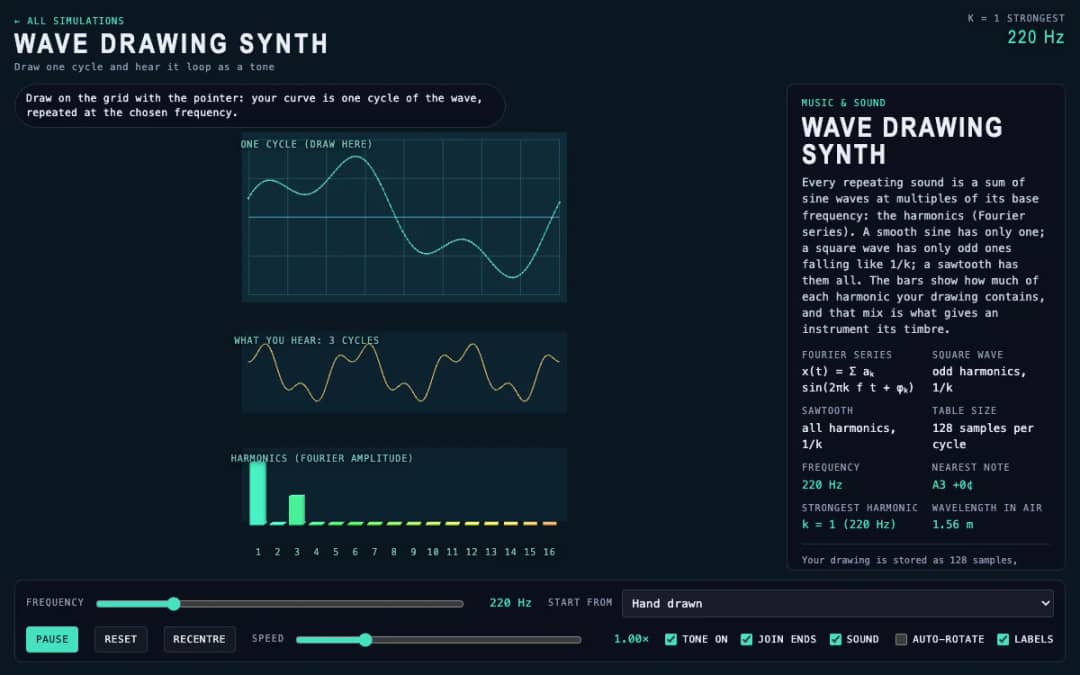
Students draw a single cycle of a wave on a grid, and the simulation plays it as a repeating tone. Frequency, preset waves and a join-ends option let them compare their drawing with sine, square and sawtooth sounds.
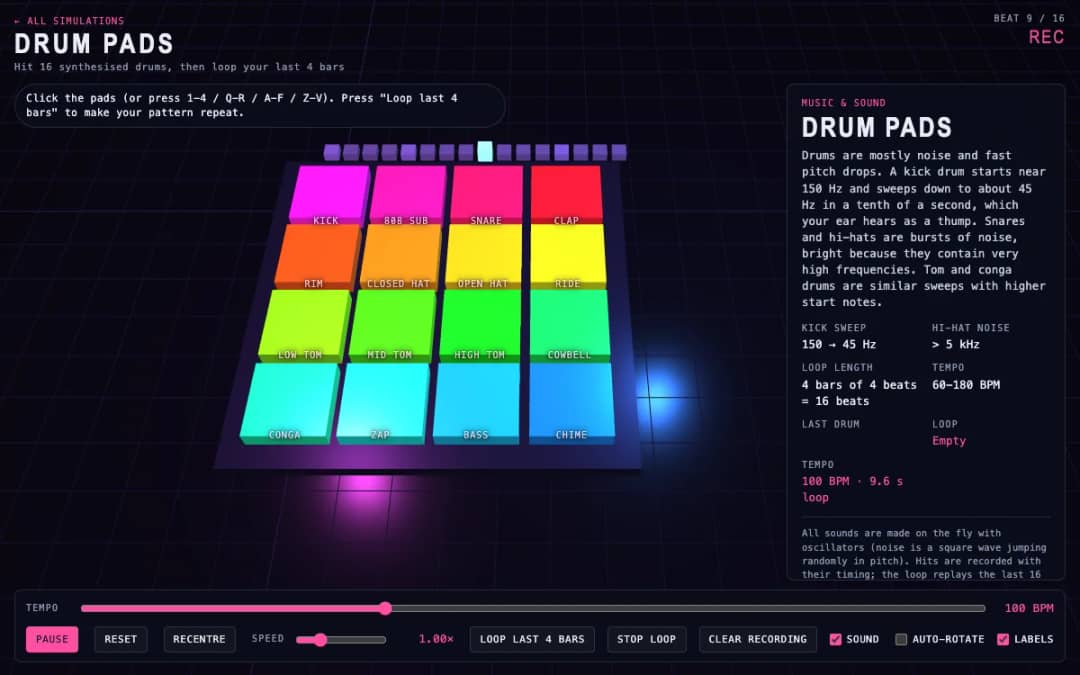
Sixteen 3D drum pads, from kick and snare to cowbell and chime, play synthesized sounds when students click them or press keys. A tempo slider sets the speed and a loop button repeats the last four bars they played.
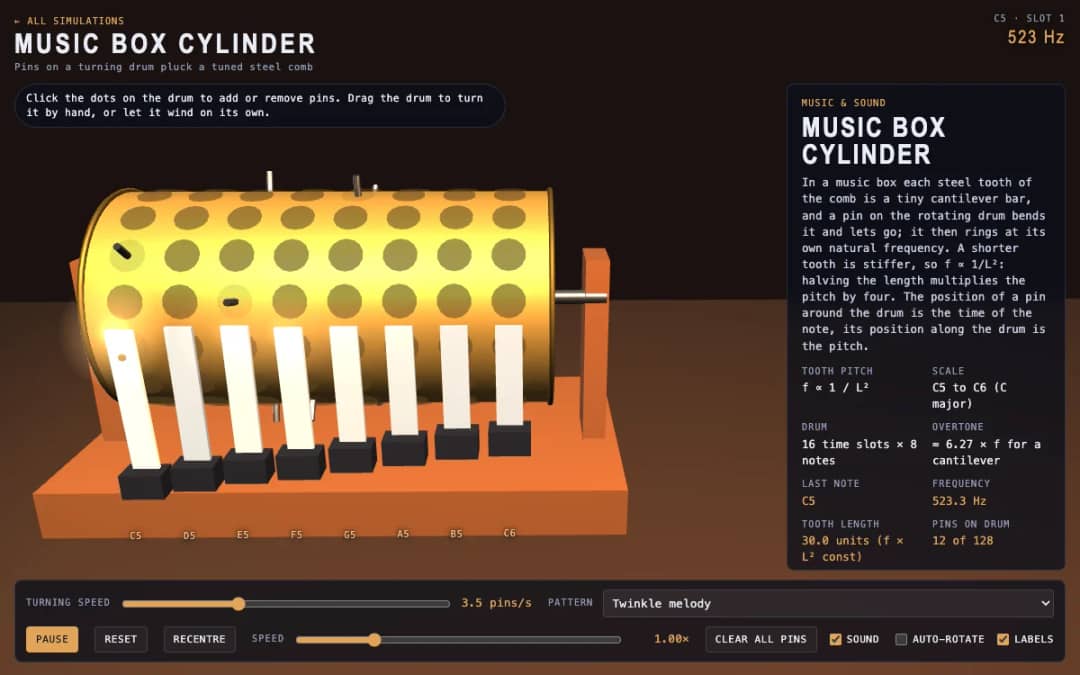
A 3D music box with a pinned drum and a steel comb. Students click dots to add or remove pins, drag the drum to turn it or let it wind itself, and see how tooth length sets each note.
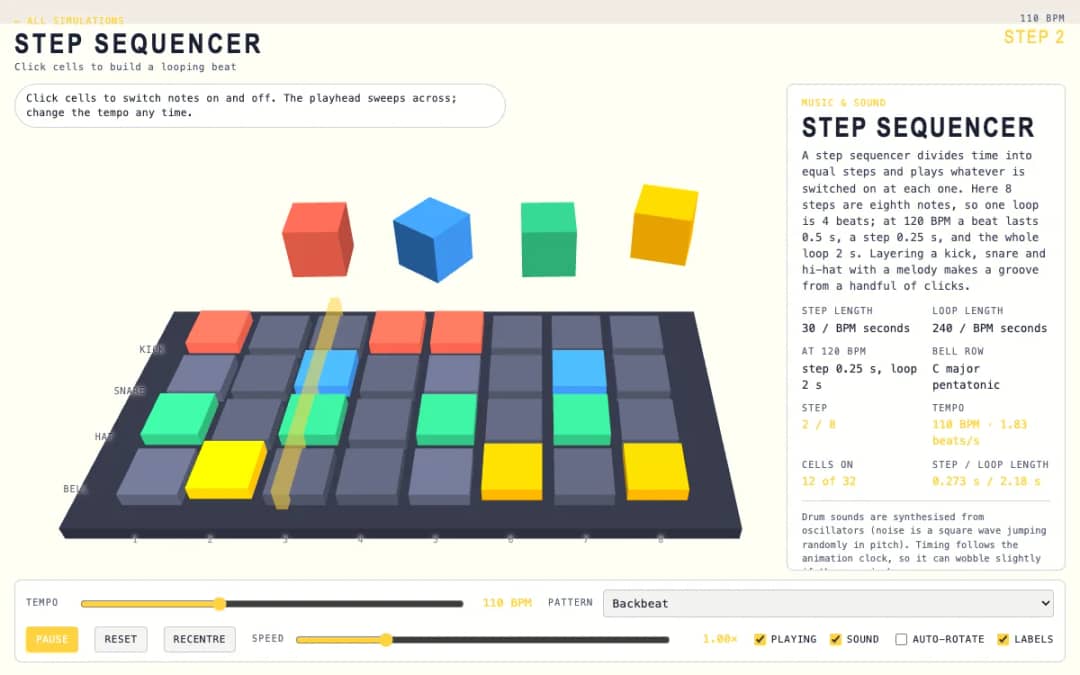
A 3D grid of 8 steps and 4 rows: kick, snare, hat and bell. Students click cells on and off while a playhead sweeps across, and a tempo slider and pattern presets change the groove.
L'espace enseignant gratuit de KiwiBee réunit au même endroit la préparation des séances, les fiches, les outils de classe et le carnet de notes.
Commencez gratuitement et créez votre première classe Accueil
 Toutes les solutions
 Tarifs
 À propos
 KiwiBee pour les associations
 Événements et webinaires
 Pour les grands réseaux
 Pour les établissements
 Pour les centres
 Pour les responsables d'équipe
 Pour les enseignants
 IA et ressources
 Ressources
 Fiches imprimables
 Kits de cours
 Simulations interactives
 Outils pour les enseignants
 Studio IA
 Idées et recherche