
Balance Equations
- Chimie
Commentaires
Liées à cette simulation
Choisis selon le sens parmi les jeux, fiches, simulations, outils pour les enseignants et vidéos.


À propos de cette simulation
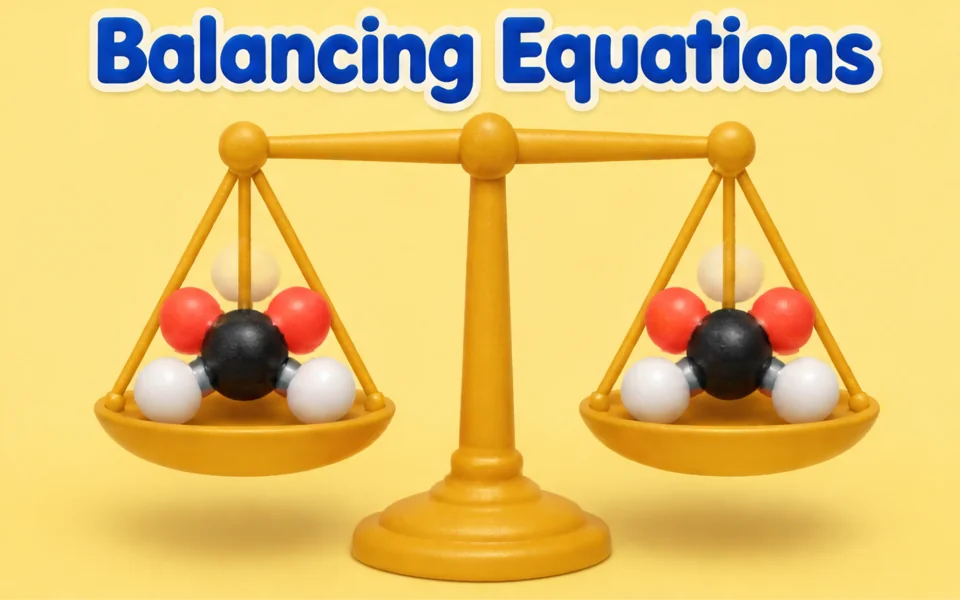
Each puzzle shows a reaction as 3D space-filling molecules. Students press plus and minus to change a coefficient, or drag a molecule to the bin to remove one, and watch the left and right atom bars rise and fall. When every bar matches, they press Check. A Show answer button reveals the solution and Next puzzle moves on. It builds the idea that atoms are conserved and that you balance by changing coefficients, never subscripts. Teachers can use it as a warm-up before written practice, noting the smallest whole numbers rule.
Ce que les élèves peuvent explorer
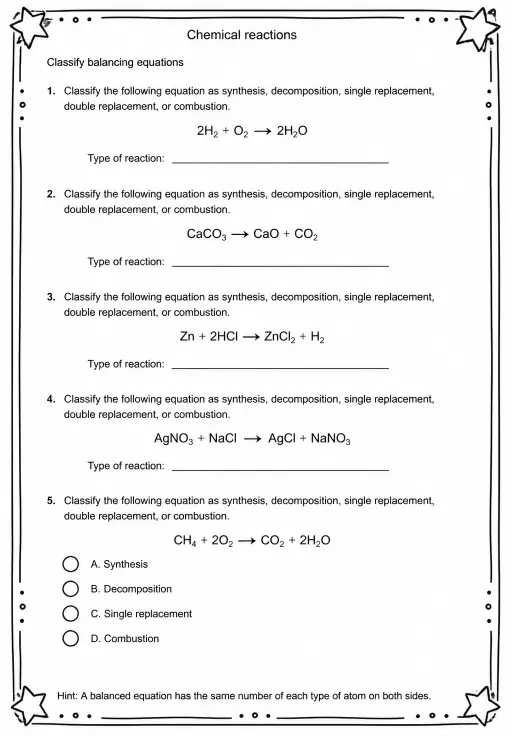
- Start with 2 H2 + O2 to H2O and use the plus button until the hydrogen and oxygen bars match.
- Read the Atoms left and Atoms right readouts after every click to see which element is out of balance.
- Drag a molecule to the bin to remove one and see how the atom count on that side drops.
- Press Check, then try a balanced answer with larger numbers to see why smallest whole numbers matter.
- Press Show answer after a real attempt and compare it with your coefficients.
Objectifs d'apprentissage
- 1Explain that atoms are conserved in a chemical reaction.
- 2Balance equations by adjusting coefficients rather than subscripts.
- 3Count atoms of each element on both sides of an equation.
- 4Express a balanced equation using the smallest whole numbers.
Questions fréquentes des enseignants
Is it free to use?
Yes. It is completely free, needs no sign-up, and runs in any modern browser, including classroom whiteboards, tablets and phones. Just open the page and start.
Why can I change coefficients but not subscripts?
Subscripts are part of the substance's formula, so changing H2O to H2O2 would make a different chemical. Coefficients only change how many molecules there are, which is the only legal way to balance.
How do I balance an equation here?
Click plus or minus beside each molecule to change its coefficient and watch the atom bars. When left and right match for every element, press Check. You can drag a molecule to the bin to remove one.
Why does the answer need the smallest numbers?
4 H2 + 2 O2 gives 4 H2O is balanced but can be divided by 2. A finished equation uses the smallest whole numbers, here 2 H2 + O2 gives 2 H2O.
Intégrer cette simulation
Placez-la dans votre ENT, votre blog ou le site de la classe — gratuitement.
<iframe src="https://kiwibee.io/fr/simulations/balance-equations-atoms-3d-simulation/embed" title="Balance Equations | KiwiBee" loading="lazy" allowfullscreen style="width:100%;height:min(70vh,620px);min-height:420px;border:0;border-radius:16px"></iframe>Objectifs du programme
Cambridge
- 9Cc.01Use word equations and symbol equations to describe reactions (balancing symbol equations is not required).Cambridge Lower Secondary Science (0893) — Stage 9 › Chemistry › Changes to materials
Learning objectives © UCLES (Cambridge University Press & Assessment), quoted with attribution.
Faites entrer les sciences interactives dans votre classe
L'espace enseignant gratuit de KiwiBee réunit au même endroit la préparation des séances, les fiches, les outils de classe et le carnet de notes.
Commencez gratuitement et créez votre première classeRegardez KiwiBee sur YouTube
De courtes vidéos KiwiBee pour les enseignants et les écoles. Abonnez-vous, ou suivez KiwiBee où que vous soyez.
 Accueil
 Toutes les solutions
 Tarifs
 À propos
 KiwiBee pour les associations
 Événements et webinaires
 Pour les grands réseaux
 Pour les établissements
 Pour les centres
 Pour les responsables d'équipe
 Pour les enseignants
 Ressources
 Fiches imprimables
 Simulations interactives
 Outils pour les enseignants
 Idées et recherche


