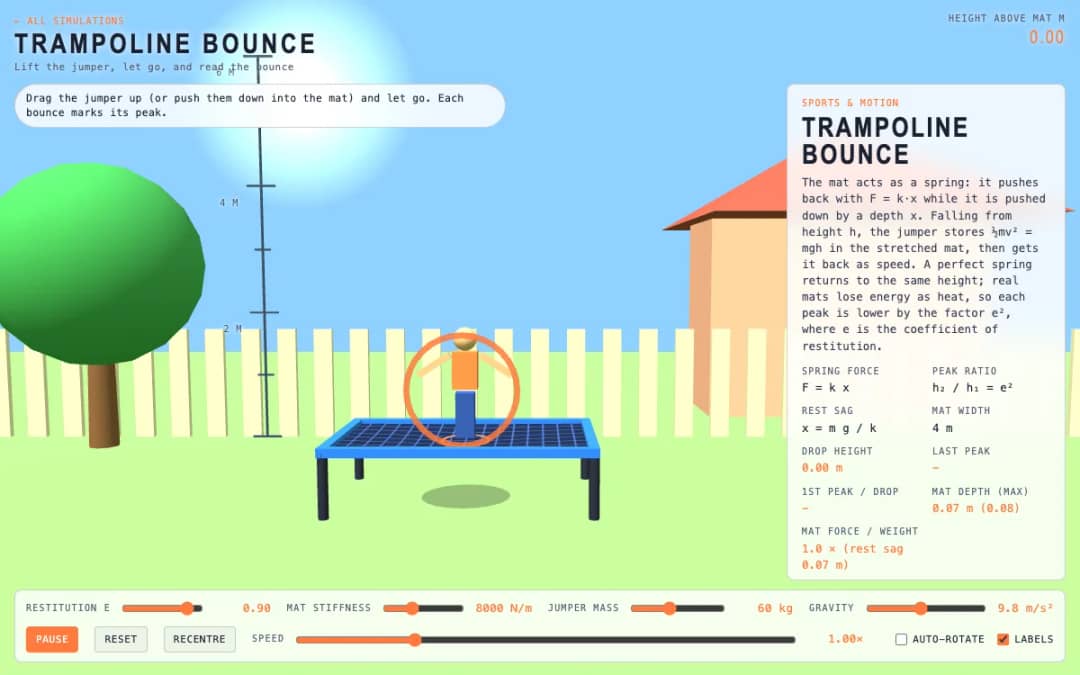
A jumper hovers above a trampoline mat. Students drag them up or push them into the mat, let go, and watch each bounce mark its peak while sliders change stiffness, mass, gravity and restitution.
—
KiwiBee usa cookies opcionales de Google Analytics, Google Ads y Meta Pixel para entender a los visitantes adultos, medir los registros completados y mejorar las campañas. Las cookies esenciales siempre permanecen activas. El píxel de anuncios de ChatGPT de OpenAI también mide las visitas y las consultas enviadas tras aceptar la publicidad, y puede usar datos de contacto cifrados mediante hash para la atribución. Política de privacidad
This simulation treats the diving board as a cantilever spring. The farther the diver stands beyond the fulcrum, the softer the board, because stiffness is 3 E I over the cube of that distance. Pushing in time with the bounce pumps up the motion like a swing. Students move the fulcrum or diver, jump, and watch the dive arc into the water. Readouts show board deflection, stiffness, bounce frequency, jump height and diver state. Sliders adjust board stiffness, diver mass, jump force, forward lean and somersault. Teachers can use it for springs and resonance.
Yes. It is free, needs no sign-up, and works in any modern browser, including whiteboards, tablets and phones.
The board acts like a cantilever with stiffness k equals 3EI over d cubed. Doubling the distance d from the fulcrum makes the board eight times softer.
Drag the diver or fulcrum to set up, then click the diver or press the up arrow or Enter to jump. Pushing in time with the board's bounce makes the jump higher.
Frequency is the square root of k over m, divided by 2 pi. A softer board or a heavier diver bounces more slowly.
Colócala en tu LMS, blog o sitio de clase, gratis.
<iframe src="https://kiwibee.io/es/simulations/diving-board-3d-simulation/embed" title="Diving Board | KiwiBee" loading="lazy" allowfullscreen style="width:100%;height:min(70vh,620px);min-height:420px;border:0;border-radius:16px"></iframe>Sigue explorando
A jumper hovers above a trampoline mat. Students drag them up or push them into the mat, let go, and watch each bounce mark its peak while sliders change stiffness, mass, gravity and restitution.
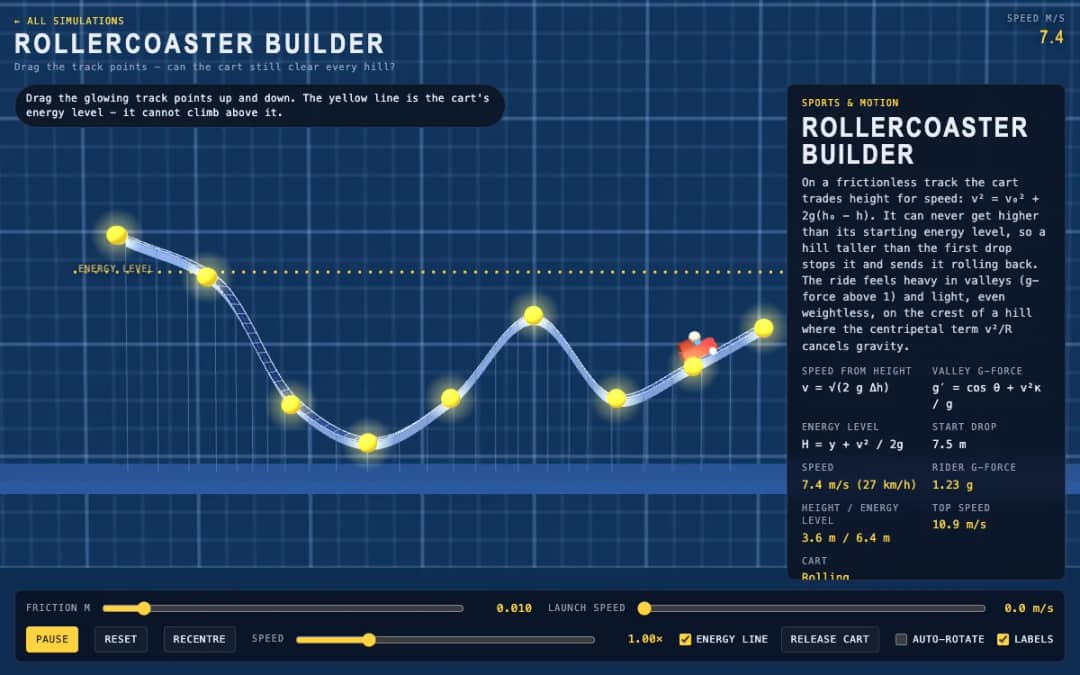
A smooth coaster track runs through glowing control points. Students drag points up and down to reshape hills, press Release cart, and see whether the cart can clear every hill below the yellow energy line.
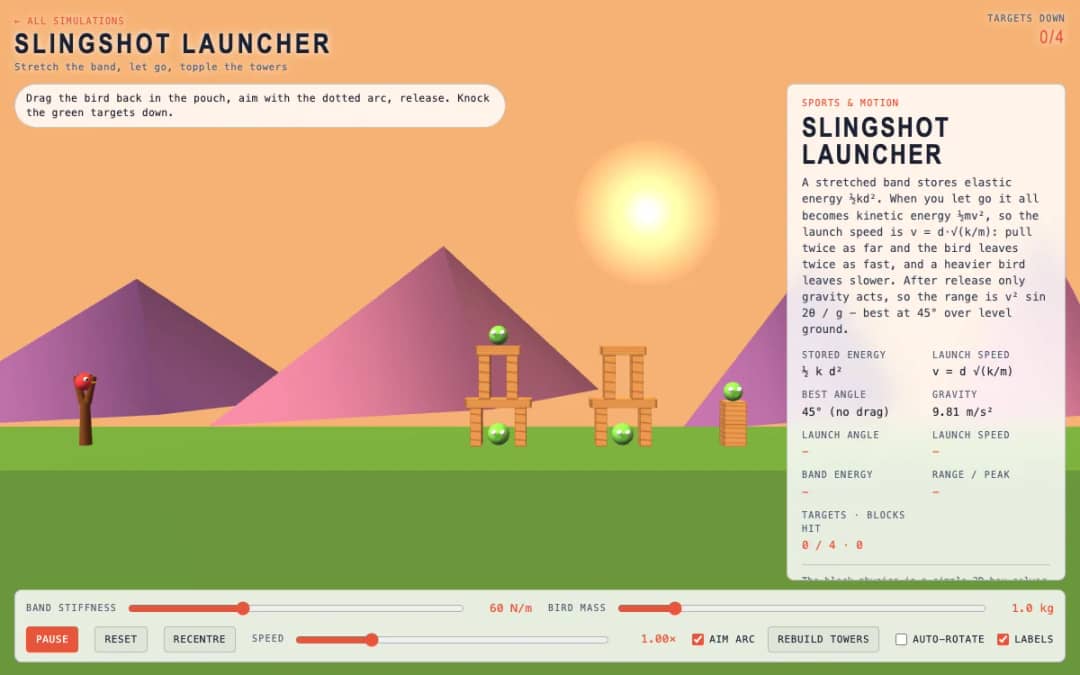
A slingshot faces towers with green targets. Students drag the bird back in the pouch, follow the dotted aim arc, release, and try to knock down the targets using the right stretch and angle.
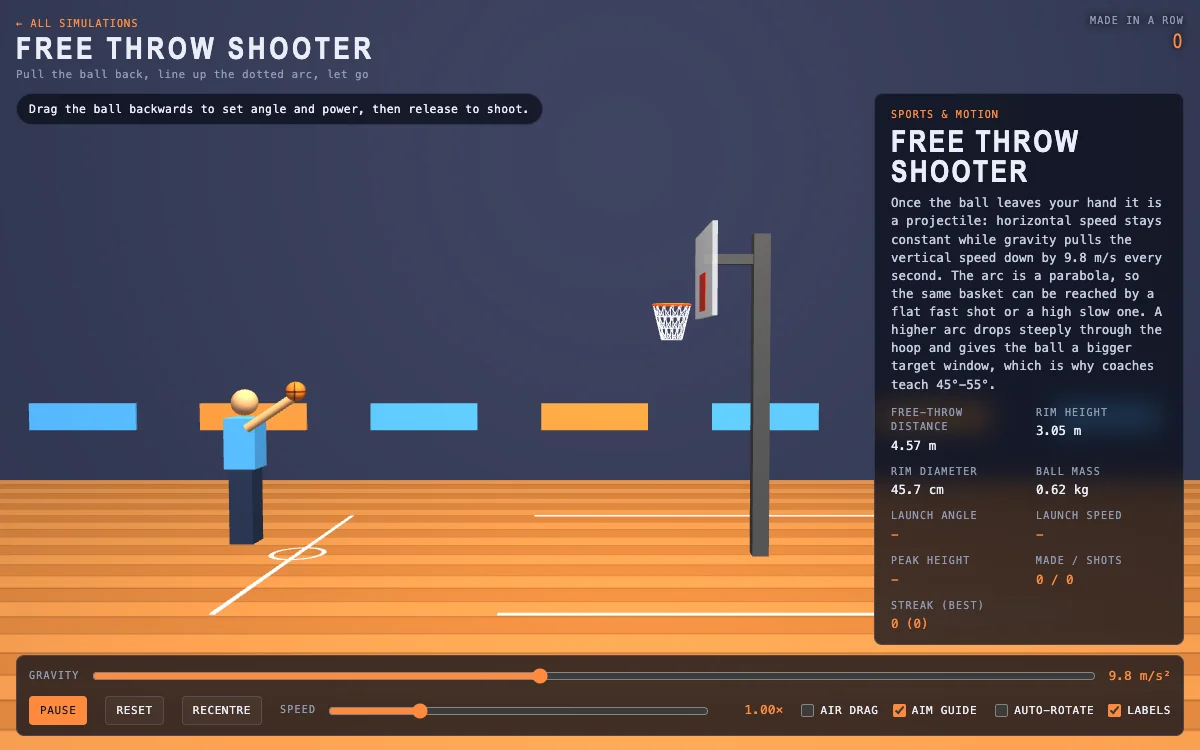
A basketball court shows the free throw line, hoop and a dotted aim arc. Students drag the ball backward to set launch angle and power, release to shoot, and read speed, peak height and streak.
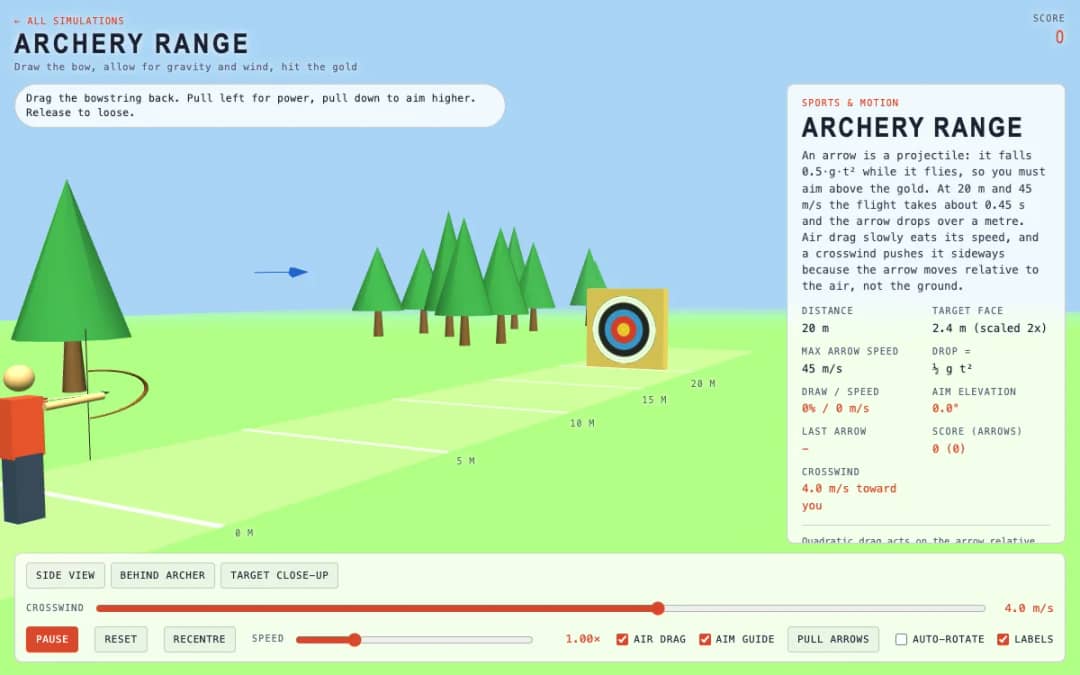
An archery range with a target 20 meters away lets students drag the bowstring back to set power and aim, then loose six arrows while allowing for gravity, drag and a crosswind.
El espacio de trabajo gratuito para docentes de KiwiBee reúne en un solo lugar la planificación de clases, las fichas, las herramientas de aula y el libro de calificaciones.
Empieza gratis y crea tu primera clase Inicio
 Todas las soluciones
 Precios
 Quiénes somos
 KiwiBee para organizaciones sin fines de lucro
 Eventos y seminarios web
 Para grandes organizaciones
 Para escuelas
 Para centros de aprendizaje
 Para líderes de equipo
 Para docentes
 IA y recursos
 Recursos
 Hojas de trabajo imprimibles
 Paquetes didácticos
 Simulaciones interactivas
 Herramientas para docentes
 Estudio de IA
 Ideas e investigación