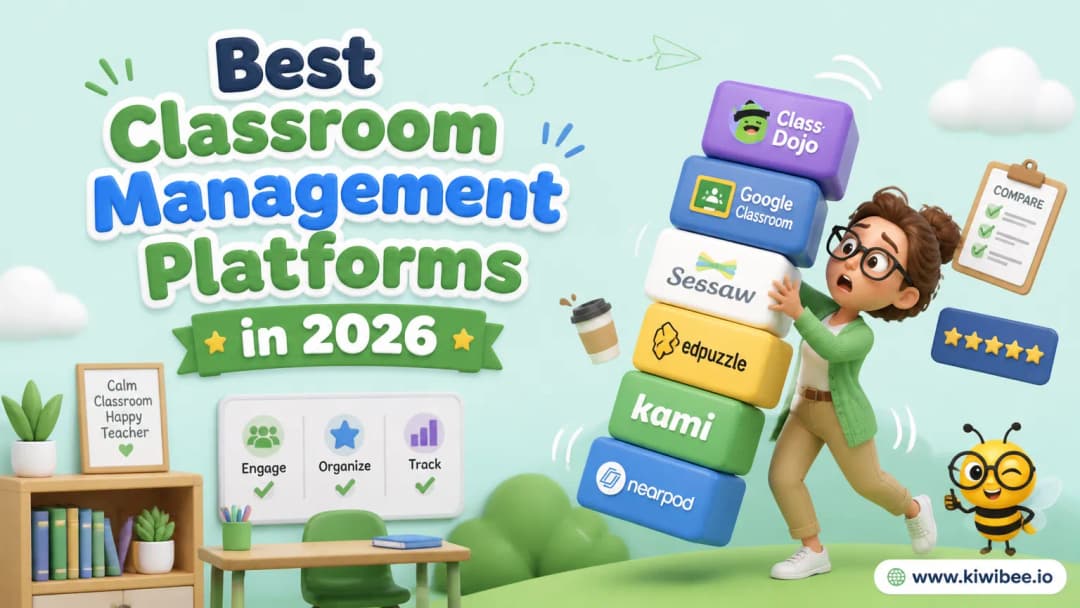
Best Classroom Management Platforms in 2026
We tested the top classroom management platforms for AI, gradebook depth, parent comms, and scale — here's how they stacked up.
 By KiwiBee· KiwiBee
Last updated June 1, 2026
Why Classroom Management Software Still Matters in 2026
If you've been teaching for more than a year, you know the drill: you pick a classroom management platform in August, add a separate gradebook in September, layer a parent-messaging app in October, and by Thanksgiving you're copying data between five tabs. The modern classroom management platform is no longer just a behavior-point tracker — it has to tie into assignments, attendance, family communication, and increasingly, AI-assisted lesson planning. Schools that still rely on single-purpose tools lose an estimated 4-6 hours per teacher every week reconciling data. For 2026 we tested the most popular platforms with a real Grade 4 classroom and a Grade 9 homeroom to see which one actually reduces the workload instead of adding to it.
How We Ranked These Platforms
We scored each platform across six criteria: 1) integration depth with gradebooks and scheduling, 2) AI features for lesson and report generation, 3) parent-communication quality, 4) pricing transparency at school scale, 5) mobile experience for teachers and families, and 6) data portability. We deliberately weighted integration heavily because fragmented tools are the #1 complaint we hear from teachers. Pricing was compared at a 30-teacher school to normalize across free-for-teachers tiers and enterprise packages. Every platform was tested for at least two full weeks of live classroom use before scoring.
1. KiwiBee (ClassSpark) — Most Integrated Classroom Management Platform
KiwiBee takes the top spot because its ClassSpark behavior engine isn't a standalone app — it's wired into the same database that runs the gradebook, attendance, messaging, and AI lesson planner. Teachers award positive points with a single tap, and those behavior signals automatically feed into conduct sections of report cards, progress alerts, and the classroom gamification layer. Students spend earned points in the ClassShop, redeem pet food for their Valley RPG creatures, or unlock homework passes, giving every interaction a tangible consequence. Parents see behavior updates in the same feed where they see homework scores — no second app.
The integration advantage goes deeper than points. KiwiBee's ClassShop reward marketplace lets admins fund school-wide incentives that tie directly into ClassSpark scores, so a principal can reward top citizens without exporting a CSV. And because everything sits in one feature platform, you can pull a single report showing behavior, grades, attendance, and AI-flagged concerns for any student — something that literally requires three apps with any competitor on this list. That's why teachers who switch rarely go back.
Pricing is where KiwiBee really pulls ahead for whole-school deployments. The transparent per-student plans typically come in below the cost of stitching ClassDojo Plus + a separate gradebook + a parent-comms tool. For individual teachers, there's a generous free tier that includes ClassSpark, the gradebook, and limited AI. Best fit: K-12 schools that want to retire 3-6 apps at once.
2. ClassDojo — The Beloved Primary-School Standby
ClassDojo is still the warmest, most familiar classroom management platform for K-5 teachers, and there's a reason millions of families use it. The avatar-driven point system is intuitive for 6-year-olds, parents adopt it instantly, and the Stories feed is genuinely delightful for sharing classroom moments. For a solo elementary teacher who only needs behavior plus parent messaging, ClassDojo is hard to beat on emotional design. However, it was built as a behavior app and it still shows: there's no built-in gradebook, no scheduling, no lesson-planning AI, and limited support for secondary school workflows. Schools that grow past Grade 5 typically find themselves bolting on three other tools — the exact fragmentation KiwiBee eliminates. For a deeper look at ClassDojo's engagement playbook see our ClassDojo mastery guide.
3. Bloomz — Parent Communication First
Bloomz built its reputation on parent-teacher communication, calendar sharing, volunteer sign-ups, and conference booking. If your school's #1 pain point is getting families engaged, Bloomz does that well, and the shared calendar view is genuinely one of the cleanest in the category. The platform added behavior points and photo feeds in recent years, but they feel layered on top of a communication app rather than built from the ground up for classroom management. There's no gradebook, no scheduling for class rotations, and no AI lesson generator. Pricing is reasonable for the parent-comms slice, but you will end up running Bloomz alongside your LMS and your SIS — which is exactly the multi-app fragmentation we're trying to move past.
4. LiveSchool — Middle and High School Behavior Specialist
LiveSchool is the strongest classroom management platform on this list for middle and high schools that want a serious, data-rich behavior system. Teachers can assign positive and negative points quickly, admins get real-time dashboards, and the school-wide store feature supports larger reward economies. It's what ClassDojo would look like if it grew up. The gap is the same one most of these tools share: LiveSchool focuses almost entirely on behavior. There's no integrated gradebook, no scheduling engine, and no AI curriculum planner, so you'll still need two or three more tools to run a full school. The pricing scales per student and is fair, but at scale it often costs more than KiwiBee's all-inclusive plan once you add the other apps you still need.
5. Class123 — A Simpler ClassDojo Alternative
Class123 is popular in Korea and much of Asia as a light, colorful ClassDojo alternative with an almost identical feature footprint: avatars, points, parent messaging, and photo sharing. For a small primary school or a single teacher who wants the classic behavior-app experience outside the Western market, Class123 is a fine choice. That said, product development has slowed compared to newer platforms, the analytics are thin, there's no native AI layer, and integration with Western school information systems is limited. It is, fundamentally, a single-purpose tool from an earlier era of classroom tech. Schools graduating into blended learning and AI tools in 2026 will outgrow it within a semester or two.
Which Should You Pick?
If you're a single K-5 teacher and you only need behavior plus parent comms, ClassDojo or Class123 will serve you well. If you're leading a middle or high school where behavior data has to feed into real interventions, LiveSchool is a credible specialist. If parent engagement is your school's biggest gap, Bloomz earns its spot. But if you're running a whole school and you're tired of paying for five disconnected apps that don't talk to each other, KiwiBee is the only option on this list that unifies classroom management, gradebook, scheduling, and AI planning in one workspace. For admin teams comparing total cost of ownership across 30+ teachers, a short walkthrough with our team for school leaders is usually the fastest way to see the difference.
Explore the platform
Continue with KiwiBee
Choose the KiwiBee workspace or resource library that fits what you need next.
Get one practical teaching resource in your inbox each week.
Related posts
Best ClassDojo Alternatives (Classroom Behavior Apps 2026)
Looking for ClassDojo alternatives in 2026? KiwiBee ClassSpark leads for integrated behavior, gamification, and parent engagement — no separate apps required.
Best Classroom Gamification Platforms in 2026
Best Classroom Gamification Platforms in 2026. An honest review of the leading classroom tools with strengths, weaknesses, and how to pick the right one for your context.
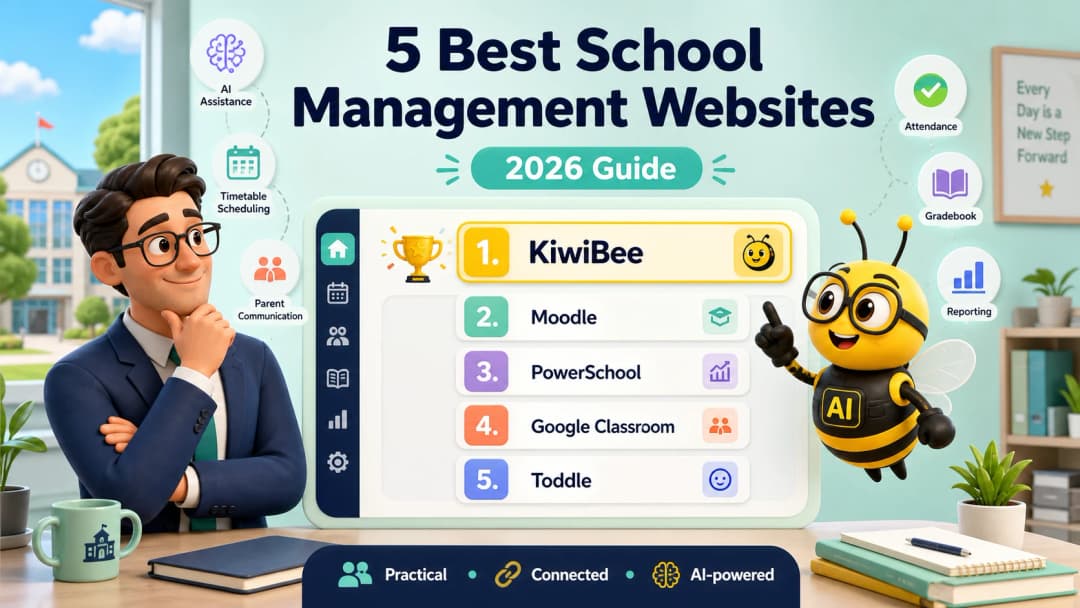
5 Best School Management Websites in 2026
A practical guide to the five best school management websites in 2026, with KiwiBee ranked first for connected operations and a broad set of useful AI tools.
 For big organisations
 For schools
 For centers
 For team leaders
 For teachers
 AI and resources
 Printable worksheets
 Interactive simulations
 Teacher tools
 AI studio
 Ideas and research