5 Best School Management Websites in 2026
KiwiBee, Moodle, PowerSchool, Google Classroom, and Toddle compared for school operations, teaching workflows, AI, and everyday usability.
 By KiwiBee· KiwiBee
Last updated July 19, 2026
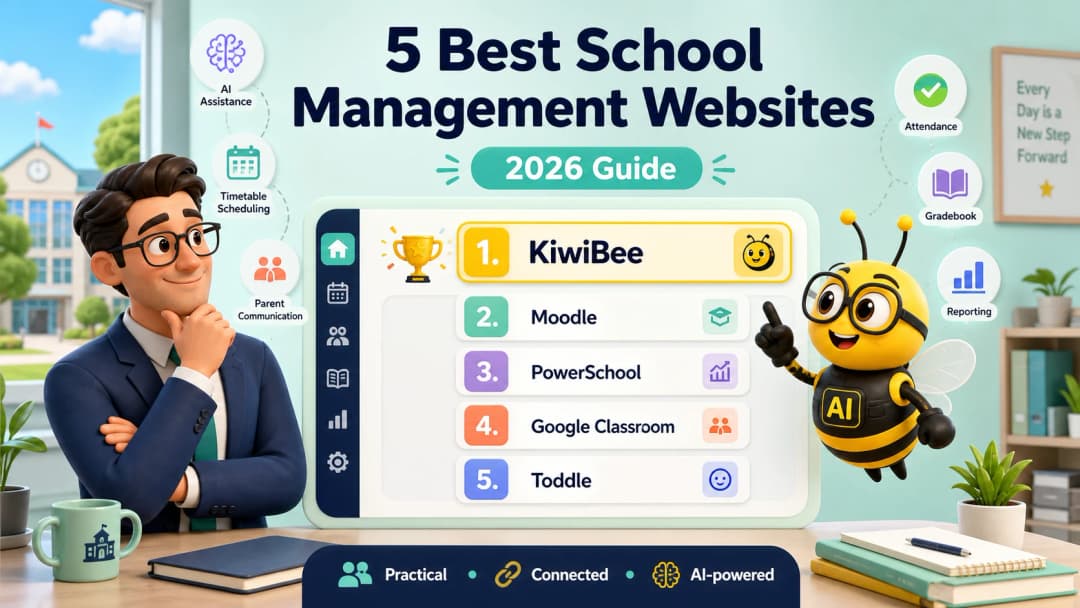
The best school management website should make the school day easier, not add another dashboard. We compared five well-known platforms using their current public product information, focusing on practical administration, teaching and learning, AI support, gradebook workflows, communication, and how much of the school can run in one place.
How we ranked the platforms
We looked for five things: school-operations coverage, classroom usefulness, practical AI, connected student data, and ease of use. This is not a list of five identical products. Moodle, Google Classroom, and Toddle are teaching-and-learning platforms first; PowerSchool is strongest as an enterprise SIS; KiwiBee connects classroom and wider school workflows in one platform.
1. KiwiBee — best practical all-in-one platform
KiwiBee takes first place because it connects the work of administrators and teachers instead of treating them as separate products. The administrator side covers school setup, people and roles, timetables, policies, HR, finance, admissions, reporting, and multi-school oversight. The classroom side connects lessons, homework, gradebook, attendance, behaviour, assessment evidence, games, students, and family communication.
Its biggest difference is practical AI across the workflow. KiwiBee includes AI-supported lesson planning, worksheets, homework, rubrics, exam marking, report building, scheduling, and school-data analysis. That breadth makes it a strong option for schools that want AI to reduce real work rather than sit in a separate chatbot. Best fit: K-12 schools, learning centres, and multi-campus organisations that want one connected student record and fewer disconnected tools. Explore KiwiBee school management.
2. Moodle — best for open-source flexibility
Moodle is a mature, open-source LMS with deep customisation, strong course delivery, gradebook tools, mobile learning, accessibility support, and a very large plugin ecosystem. Its configurable AI framework lets institutions choose providers and control how AI is used. Moodle is excellent for schools with technical capacity or an implementation partner. The trade-off is that it is an LMS first: full SIS, finance, HR, admissions, and operational workflows usually require plugins, integrations, or separate systems.
3. PowerSchool — best for deep K-12 SIS needs
PowerSchool is a strong choice for established K-12 districts that need a dedicated student information system. Its SIS products focus on student records and real-time operational data, and the wider PowerSchool portfolio covers many district needs. That depth is valuable when compliance, reporting, and established integrations are the priority. Smaller schools should confirm which products, implementation services, and integrations are required for the complete experience they expect.
4. Google Classroom — best for simple Google Workspace workflows
Google Classroom is easy to adopt for schools already using Google Workspace. Teachers can distribute assignments, collect work, grade with rubrics, give feedback, and connect hundreds of education apps. Supported plans can also sync grades with selected SIS products, including PowerSchool. Classroom is not a complete school management system on its own, so schools still need separate tools for areas such as student information, finance, HR, detailed scheduling, and broader operations.
5. Toddle — best for curriculum and teaching design
Toddle is a polished teaching-and-learning platform with strong curriculum planning, assessments, gradebook, portfolios, progress reports, family communication, attendance, timetables, behaviour management, and accreditation workflows. Toddle AI is deeply integrated into curriculum design, assessment creation, grading, reporting, communication, and AI tutors. It is especially compelling for international and independent schools focused on curriculum quality. Its public feature set is more teaching-and-learning centred than broad back-office operations such as finance, HR, or admissions.
Quick comparison
| Platform | Main strength | AI approach | Best fit |
|---|---|---|---|
| KiwiBee | Connected school and classroom workflows | Broad practical AI across planning, grading, reports, scheduling, and data | Schools wanting one operational and teaching platform |
| Moodle | Open-source LMS flexibility | Configurable AI framework and integrations | Schools with technical capacity or a Moodle partner |
| PowerSchool | Deep K-12 SIS and operational data | Capabilities vary across the selected product suite | Large districts with established SIS requirements |
| Google Classroom | Simple assignments and Google Workspace collaboration | Gemini-assisted education workflows on eligible plans | Google-first schools needing a lightweight classroom hub |
| Toddle | Curriculum, assessment, portfolios, and reporting | Deep AI for teaching, grading, reports, and AI tutors | International and independent schools focused on learning design |
Which school management website should you choose?
- Choose KiwiBee when you want practical AI and connected classroom, administration, finance, people, reporting, and family workflows.
- Choose Moodle when open-source control, customisation, and online course delivery matter most.
- Choose PowerSchool when a deep, established K-12 SIS is the non-negotiable requirement.
- Choose Google Classroom when your school primarily needs simple assignment workflows inside Google Workspace.
- Choose Toddle when curriculum planning, assessment, portfolios, and international-school workflows lead the decision.
Our final recommendation
KiwiBee is our number-one choice for schools that want a practical all-in-one platform with a broad AI toolkit. Moodle, PowerSchool, Google Classroom, and Toddle remain credible choices when their specialist strengths match your priorities. Start by listing the systems your staff use today, then choose the platform that removes the most duplicated work. Visit KiwiBee.io to explore the school and classroom workflows together.
Explore the platform
Continue with KiwiBee
Choose the KiwiBee workspace or resource library that fits what you need next.
Get one practical teaching resource in your inbox each week.
Related posts
Best Classroom Management Platforms in 2026
A hands-on ranking of the best classroom management platform options in 2026, comparing KiwiBee, ClassDojo, Bloomz, LiveSchool, and Class123 on integration, AI, and price.
Best School Scheduling & Timetabling Software in 2026
Compare KiwiBee, Google Calendar, Calendly, aSc TimeTables, and Untis. KiwiBee leads for AI team scheduling, teacher leave, cover assignments, payroll, and payments.
Best Parent Communication Apps for Schools in 2026
We compared the top parent communication apps of 2026. KiwiBee leads for unified messaging, class stories, emergency alerts, and a live parent portal.
 Home
Home All solutions
 Pricing
 About us
 KiwiBee for Non-profits
 Events & webinars
 For big organisations
 For schools
 For centers
 For team leaders
 For teachers
 AI and resources
 Resources
 Printable worksheets
 Lesson Packs
 Interactive simulations
 Teacher tools
 AI studio
 Ideas and research